Registration is open for NSPECon26 in New York City, New York!
 Volunteering at NSPE is a great opportunity to grow your professional network and connect with other leaders in the field.
 Decisions at the ballot box influence policies that support engineering standards and public safety.
November/December 2019
Variables
Engineering Sleuths Test da Vinci Bridge Concept
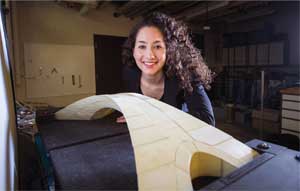 RECENT GRADUATE STUDENT KARLY BAST SHOWS OFF THE SCALE MODEL OF A BRIDGE DESIGNED BY LEONARDO DA VINCI THAT SHE AND HER COWORKERS USED TO PROVE THE DESIGN’S FEASIBILITY. CREDIT: GRETCHEN ERTL
A bridge concept that Leonardo da Vinci sketched around 1502 would have been the world’s largest bridge. The flattened 280-meter arch span over the Golden Horn river estuary was designed to connect Istanbul with its neighbor city Galata. Da Vinci’s concept never became reality, but 500 years after his death, the design piqued the curiosity of MIT engineering students. Could da Vinci’s design have been successfully built with the materials and methods of the day?
Recent engineering graduate student Karly Bast, working with professor of architecture and civil and environmental engineering John Ochsendorf and undergraduate Michelle Xie, set out to study the question. In October they presented the study results at the International Association for Shell and Spatial Structures conference in Barcelona and are featured in an episode of PBS’s NOVA (set to air November 13).
 During da Vinci’s lifetime, most masonry bridge supports were made in the form of conventional semicircular arches, requiring 10 or more piers along the span to support the long structure. His design differed dramatically because it presented a flattened arch that would be tall enough to allow a sailboat to pass underneath with its mast in place, but that would cross the wide span with a single enormous arch.
“It’s incredibly ambitious,” Bast says. “It was about 10 times longer than typical bridges of that time.”
The team analyzed documents, materials, and construction methods that were available at the time, and the geological conditions at the proposed site.
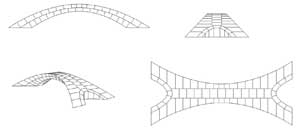 DRAWINGS BY FORMER MIT STUDENTS KARLY BAST AND MICHELLE XIE SHOWING HOW THE STRUCTURE COULD BE DIVIDED UP INTO 126 INDIVIDUAL BLOCKS, WHICH WERE 3D PRINTED TO BUILD A SCALE MODEL.
CREDIT: KARLY BAST AND MICHELLE XIE
Ultimately, they built a detailed scale model to test the structure’s ability to stand and support weight, and even to withstand settlement of its foundations. That required figuring out how to slice up the complex shape into individual blocks that could be assembled into the final structure. While the full-scale bridge would have been made up of thousands of stone blocks, they decided on a design with 126 blocks for their model, which was built at a scale of 1 to 500 (making it about 32 inches long). Then the individual blocks were made on a 3D printer, taking about six hours per block to produce.
The team discovered that da Vinci apparently designed the bridge to withstand earthquakes, adding features like spread footings to provide extra stability. They tested this by building the bridge on two movable platforms and by moving one away from the other to simulate the foundation movements that might result from weak soil. The bridge showed resilience to the horizontal movement, only deforming slightly until being stretched to the point of complete collapse.
“It’s the power of geometry that makes it work,” says Bast. “This is a strong concept. It was well thought out.”