

 Registration is open for NSPECon26 in New York City, New York!
 Volunteering at NSPE is a great opportunity to grow your professional network and connect with other leaders in the field.
 Decisions at the ballot box influence policies that support engineering standards and public safety.
October 2014
A Watershed Moment?
Could Toledo’s water crisis be the necessary wake-up call for a better approach to algae blooms and nutrient pollution?
 BY EVA KAPLAN-LEISERSON
D
rinking water quality in the US is an issue that’s often “out of sight, out of mind.” Engineers do their jobs so well that citizens rarely have to consider what’s in the water they’re ingesting—until an incident occurs such as the one this summer in Toledo, Ohio.
The City of Toledo instituted a drinking water ban for almost 500,000 people in northwest Ohio and southeast Michigan for two days in August, after unsafe levels of the toxin microcystin appeared in the water. There is no current consensus for what exactly went wrong with water testing and treatment. But what seems clear is that algae blooms on Lake Erie led to a surge in the toxin.
Algae blooms are an issue not just for Toledo but for many areas of the country, where factors such as climate change and nutrient pollution are making the problem worse. According to the Environmental Protection Agency, climate change resulting from human activity “has recently been identified as a contributing factor” to blooms. In addition, harmful algae blooms have been “strongly correlated with excessive levels of nutrients in water bodies with low turbidity.”
Defining the Problem
Nutrients such as nitrogen and phosphorous in water can be attributed to both point (for example, sewage treatment plant discharges) and nonpoint (run off from agriculture, roads, and stormwater) sources. In addition to some algae proving toxic to humans—such as the microcystin in Toledo—nontoxic algae blooms can decrease the oxygen in the water necessary for aquatic life as the algae dies and decomposes, creating “dead zones.”
According to the EPA, more than 166 dead zones have been documented in the US, such as in the Chesapeake Bay and the Gulf of Mexico. The latter is the largest in the country, measuring 5,052 square miles in August. As the EPA website explains, the zone occurs each summer due to nutrient pollution from the Mississippi River Basin, an area that drains 31 upstream states.
The blooms and dead zones come with a cost. Not only do they hurt the fishing and tourism industries, but also blooms in drinking water sources can increase treatment costs.
Toledo Mayor D. Michael Collins said the incident was a wake-up call for community action. However, this is not a new issue; on the contrary, engineers and others have been working on it for years.
Some believe concerns haven’t been taken seriously enough. “When we bring this subject up for conversation with regulators, everyone sort of walks out of the room,” the Toledo commissioner of public utilities, Donald Moline, P.E., told the New York Times in August. “The whole drinking-water community has been raising these issues, and so far we haven’t seen a viable response.”
A Complicated Issue
Many factors contribute to difficulty in addressing algae blooms. For instance, testing and monitoring for toxins is currently voluntary US-wide.
Addressing causes of blooms is also tricky. Ben Grumbles is president of the US Water Alliance, a nonprofit that brings together stakeholders to work toward a holistic water policy. He believes nutrient pollution is one of the greatest water quality challenges facing the country and nutrient management one of the most important and urgent opportunities.
Grumbles stresses that the country has made a lot of progress in the last 40 years in controlling identifiable sources of nutrient pollution. Wastewater and stormwater utilities have been “on the hook,” he says, under the Clean Water Act. But there isn’t the same regulation for diffuse sources of nutrient pollution.
 ALGAE SMOOTHIE, ANYONE? HIGHER TEMPERATURES AND NUTRIENT POLLUTION CONTRIBUTED TO ALGAE GROWTH IN THIS WATER FROM LAKE ERIE.
Michael Falk, P.E., is a wastewater process engineer at HDR Engineering specializing in nutrient removal. As he explains, it would be a struggle to regulate farmers on nutrients from fertilizer. Any increased costs would be passed to the consumer, and “I don’t think anyone wants to see food prices go up.”
Another complicating factor is the lack of consistency across the country. Many areas don’t have nutrient limits—but Falk thinks a shift is occurring. The issue is beginning to infiltrate inland, he says, and regulators are taking action. “In the next few permitting cycles,” he says, “I would say a majority of [wastewater] plants are going to shift towards [limits].”
One of the obstacles that Falk points out is the lack of good science. Because of factors such as nonpoint sources, “pointing the finger at one source such as a utility [and saying], ‘If you turn the knob this way and remove the nutrients, it will positively impact the watershed,’ is really hard to prove.”
In addition, some limits are so small that they are difficult for a utility to reliably meet—or even measure.
According to Amit Pramanik, acting director of research for the Water Environment Research Foundation, there is a lot of variability in trying to measure to extremely low levels. In addition, significant amounts of energy and chemicals are needed to get to those levels, he says. “The good news is that some of the regulators are beginning to realize that.”
Falk worked on a study for the Water Environment Federation examining the balance between nutrient removal and sustainability. It noted that attention on stringent nutrient discharge permits has ignored sustainability impacts, and it examined whether there was a point of diminishing returns in which effects, such as greenhouse gas emissions and energy demand, outweighed water quality benefits.
 MICHAEL FALK, P.E.
The research did find such a point, noting that a more sustainable strategy than requiring higher levels of treatment from point sources would be combining a lower level of treatment with best management practices from nonpoint sources. In a 2011 article published on the study, the authors stated that this approach could achieve comparable water quality.
It’s important that regulators consider this tipping point for each watershed, says Falk, considering where it makes sense to stop utilities from going any lower and looking at other ways to reduce load limits.
Holistic Solutions
Holistic is a term commonly used to describe the necessary approach for these issues. For instance, Falk notes that wastewater utilities are often the first ones to receive blame because they have a pipe that can be regulated. However, a more creative, holistic approach to managing the watershed is needed, he says.
“I don’t think folks can argue that removing at least a portion of the nutrients is not going to be of value to society and the watershed, but regulating down to extremely low limits at treatment plants doesn’t seem like an appropriate plan of attack,” he explains. “It’s a combination of regulating the treatment plant, understanding the loads to the watershed, [and] determining whether there are best management practices for agriculture that can be implemented.”
Pramanik agrees, noting that instead of focusing on just one part of the problem, we may need to devote attention and funding to other areas, such as the agricultural or stormwater sectors.
In the future, more well-rounded approaches are needed, he says. “Don’t get siloed.” While engineers often specialize in either wastewater, drinking water, or stormwater, it’s “all one water,” he points out. “We have to be responsible and work together” to make progress.
This is exactly the mission of the US Water Alliance. Its president, Grumbles, emphasizes that the country needs a national water vision and framework for integrated approaches.
He says this can be a scary concept to some, because people think they could lose sovereignty to solve their unique challenges. “That’s not the case,” he says. “Instead, it’s about having the left and the right hand know what each is doing.”
 BEN GRUMBLES
In August, the alliance issued a report based on a series of meetings that brought together agriculture, wastewater, and drinking water leaders along with representatives of environmental; business; academic and scientific; and local, state, and federal interests.
The aim: to examine ways to protect Mississippi River watersheds, based on the realization that current point-source nutrient regulation and nonpoint source voluntary efforts are not leading to a healthy Mississippi River Basin and Gulf of Mexico.
The work aimed to find ways for farmers and utilities to collaborate for more efficient, effective, and equitable ways to reduce nutrient pollution.
As the report indicates, relying only on end-of-pipe technology to achieve permit limits results in high expenses for water treatment plants and in many cases will not result in a meaningful reduction in overall nutrient loadings. In addition, because permits are site-specific rather than watershed-specific, they don’t result in outcomes at a scale needed for the watershed, it says. Weather and rainfall also affect nutrient loading, even with the very best practices in place.
The participants gathered four times over almost a year. Although the stakeholders disagreed in some areas (sources of excess nutrients and extent of impacts), they agreed that both the agriculture and water sectors would benefit from efforts to reduce the amount of nutrients leaving agricultural areas.
Report recommendations included:
-
Expand effective watershed-based cooperative leadership and decision-making;
-
Further develop and implement market mechanisms, such as water quality trading, to reduce nutrients;
-
Improve data, monitoring, and modeling to support decisions and markets; and
-
Develop “watershed protection utilities,” organizations focused on cost-effective results.
Expanding Innovation
One approach receiving increased interest is water quality trading. Discussed for decades, the strategy has faced resistance in the past, but a more rigorous approach reliant on good data is helping to drive growth.
Water quality trading, similar to emissions cap and trade, sets nutrient pollution limits but then enables flexibility via market-based payments. For example, utilities can incentivize farmers to use best management activities such as establishing buffer strips to soak up nutrient runoff.
“Farmers can not only be good stewards but get a new revenue stream for carrying out an activity not required by law,” says Grumbles. And utilities can often reduce costs by avoiding building or upgrading treatment plants.
These activities are showing promise in watersheds across the country, Grumbles continues. According to the US Water Alliance report, many states have policies supporting water quality trading and 14 have operating trading programs. According to the alliance president, the EPA and Department of Agriculture have indicated that these methods are encouraging ways to reduce nutrient pollution.
Nutrient recovery is another promising strategy. Earlier this year, the Water Environment Research Foundation was awarded an EPA grant to establish a National Research Center for Resource Recovery and Nutrient Management. It will provide data, demonstrations, and tools to help shift the view of nutrients so they are seen as resources that are part of a sustainable managed system.
For example, economically recoverable phosphorous sources are expected to last only 50–100 more years. A shortage would affect food production. As Pramanik explains, the utility of the future will be able to recover and commoditize the nutrient, closing the loop for a more holistic system.
Wendell Khunjar, EIT, is director of applied wastewater research at environmental firm Hazen and Sawyer, and co- principal investigator on the research. He says its components include increasing utilities’ awareness of the recovery technologies available, developing user-friendly tools to compare nutrient recovery versus removal economics, and researching emerging technologies.
More
• “Special Treatment,” August/September 2008 PE
• “Coming Together to Protect Mississippi River Watersheds,” www.uswateralliance.org/2014/08/22/mississippi-river-nutrient-dialogues
• www.werf.org/i/a/ka/Nutrients.aspx and www.werf.org/i/ka/Resource_Recovery/a/ka/Resource_Recovery.aspx
One goal is to create a platform of logistical and technological options for utilities to choose from based on their particular situations.
Currently, about 15–20 utilities in the US are implementing or close to implementing nutrient recovery, Khunjar says. While there are up-front costs for set-up, and selling the products won’t provide a huge pay-off, ultimately the method can help reduce energy consumption and operation costs. Payback, depending on facility size, can range from five years to greater than 20 years, he explains. The facilities that are doing it now find a payback on average of 5–15 years.
Nutrient recovery alone won’t eliminate algae blooms and dead zones, Khunjar notes, but it is an important element of a larger integrated nutrient management strategy that needs to be explored. He cautions, however, that any new methods must protect the public equally well as traditional ones.
Beyond Toledo
The EPA has pledged almost $12 million to federal and state agencies to target harmful algae blooms in Lake Erie as part of the Great Lakes Restoration Initiative. The money will expand monitoring and increase incentives for farmers to reduce run-off.
According to a September Washington Post article, a “growing chorus” is calling for the EPA to create a national standard for allowable amounts of microcystin. A few states have set their own drinking water standards for the toxin, relying on World Health Organization information, but there is no consistent US guideline.
More study is needed, though, to determine the effects of algae-related toxins. An EPA spokeswoman quoted in the Post said the agency is working toward developing drinking water advisories and testing methods to be released next year that could guide treatment plants and states.
Will we ever completely eliminate harmful algae blooms? Pramanik doesn’t think so. “We just can’t fight nature all the time,” he says. “But we can work to minimize [the effects].”
The PE and the Plan
Warren Henry, P.E., is the new program manager for water system improvements in Toledo. He stepped forward to offer his help after the incident, even taking a pay cut. His license means he has a duty to help protect the public, he says.
Prior to other roles in Toledo public service, the civil engineer had spent 34 years in consulting engineering specializing in water and wastewater.
Calling the water crisis “life changing” for himself and others, he explains that it shook the public’s trust in a basic utility they had taken for granted. “It’s going to take a long time to restore that,” he says.
Henry will concentrate on guiding the water program and improvements to the regional water system, fostering dialogue among regional stakeholders.
That includes a focus on treatment plant upgrades (four years remain on a five-year capital improvement program) and steps to address issues immediately and in the short-term. But he will also work on creating a long-term vision for the region from a multijurisdictional, “holistic” perspective.
Henry declines to speculate on causes for the Toledo crisis, but he notes that—like other infrastructure nationwide—the treatment facility is not in the condition it needs to be. One of his goals is to fix that.
The PE also stresses the need for better science leading to consistent guidelines on algae toxicity. He hopes the Toledo experience has raised awareness and will encourage federal standards.
Henry explains that he has traveled all over the world, including some places where you “don’t dare” drink the water. The Toledo crisis cast the US in a third-world light, he says. “We set ourselves forward as being one of the leading countries in the world, and then suddenly we can’t drink the water that comes out of the tap.”
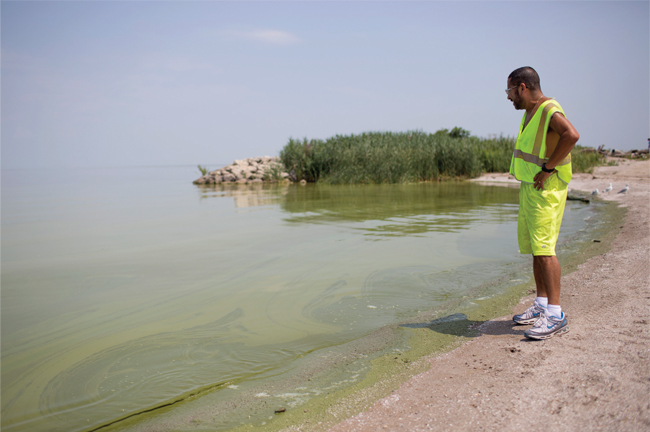
HORACIO ROMERO OF TOLEDO, OHIO, LOOKS AT ALGAE IN LAKE ERIE AT MAUMEE BAY STATE PARK ON AUGUST 4, 2014, IN OREGON, OHIO. TOLEDO, OHIO, AREA RESIDENTS FACED A TWO-DAY BAN ON DRINKING TAP WATER DUE TO THE PRESENCE OF ALGAE-RELATED TOXINS.
PHOTO BY AARON P. BERNSTEIN/GETTY IMAGES
More Featured Articles

NSPE continues to advocate for legislation that will revitalize and modernize the nation’s infrastructure. The Society’s efforts contributed to significant gains this year, such as the passage of the Water Resources Reform and Development Act, which identifies more than $12 billion worth of new water infrastructure projects and authorizes funding for them. >>
It is expected, and frequently required by law, that those who practice engineering be of the utmost integrity. Ethical practice is important for the protection of the health, safety, and welfare of the public as well as the protection of the profession and the individual careers of professional engineers. In the face of new trends in engineering and familiar ethics challenges, the NSPE Code of Ethics remains a reliable resource. >>
PE recently asked a handful of experts to rate engineers’ overall business skills. The average answer: C. The ability to bring in work and understand the financials are important for engineers at all levels, not just for company principals. In return, these skills help make workers more marketable and can expand their employment opportunities. >>
Margaret Ingels was the first woman in the country to receive a graduate degree in mechanical engineering, and she launched her career in the early 1900s. Ingels is among the female engineers highlighted in a new book, Women of Steel and Stone: 22 Inspirational Architects, Engineers, and Landscape Designers. While there is still much room for improvement in bringing diversity to the profession, these examples may motivate a new generation. >>
If an engineering professional wants to be the quintessential project manager, he or she will need more than just top-notch technical expertise and the ability to manage budgets and schedules. Increasingly, successful project management requires that professionals ramp up their communications, relationship building, and leadership skills. Professional engineering leaders shared with PE their experiences and advice on effective project management. >>
As extreme weather events become more common, awareness is growing about the importance of resilience—the ability to prepare for and recover from disasters. NSPE has joined more than 20 other design and construction industry groups to endorse a statement on resilience to show lawmakers and the public the seriousness with which the design, construction, and planning sectors are taking the issue. >>
Six years ago, PE noted that green or sustainable building was “in” for 2008, but warned that design professionals who ignored normal risk management procedures amid the hype at the time could experience increased liability risks. Since then, green building has greatly changed, and the liability concerns of 2008 are not all concerns of today. >>
Three-dimensional printing, also called additive manufacturing, has existed for decades but was primarily used for forming prototypes. Recently the technology has advanced to a point in which it is affecting a bigger proportion of modern life. Some are calling it another Industrial Revolution. Engineers are likely to benefit greatly from the use of 3D printers to help speed up the design cycle. >>
Some engineers have discovered that blogging is a powerful communication tool that helps them connect with previously unreachable audiences. Professional engineers and industry insiders share with PE how they use blogging to tell about the profession in addition to the rewards, risks, and recommendations for success. >>
Career plans can help engineers stay focused on their own development and reach the places they want to go in their careers. Drawing up a plan is easy, but following a plan of real value takes time and effort. Career coaching consultants offer their advice on how professional engineers can establish goals and map out a successful and fulfilling career path. >>
Continuing education, industrial exemptions, licensing mobility, and licensing law uniformity are just some of the issues that engineering licensing board members are continually addressing in the interest of professional engineers nationwide. PE spoke with current licensing board members to learn how they dedicate their time and talents to maintaining the profession’s standards and protecting the public.. >>
What’s on the horizon for the AEC industry for 2014? The outlook is positive, yet securing the next project while navigating the ins and outs of contracts and risk management will present challenges for almost any design firm leader. Three professional liability and risk management experts shared with PE magazine their take on the current trends and the do’s and don’ts that should be a priority for engineering professionals. >>