

 Registration is open for NSPECon26 in New York City, New York!
 Volunteering at NSPE is a great opportunity to grow your professional network and connect with other leaders in the field.
 Decisions at the ballot box influence policies that support engineering standards and public safety.
The convergence of artificial intelligence (AI), cybersecurity, and interconnected infrastructure is reshaping the global economy—demanding a reimagined approach to public safety. Professional engineering licensure, rooted in education, experience, and examination, provides a proven framework to mitigate risks in this digital age. By integrating engineering and technology licensure and certification into emerging fields like AI-driven infrastructure and cyber-informed systems, engineers can safeguard against open-source vulnerabilities, nation-state attacks, and systemic failures while fostering innovation through interdisciplinary collaboration. The vulnerability of emerging technology is growing and proactive risk management and secure design are critical.
Licensure’s Evolution: From Software Engineering to Systems Integration
The National Council of Examiners for Engineering and Surveying (NCEES) has long been a steward of public safety, but its Software Engineering PE exam, launched in 2013, faced challenges, including low adoption and eventual discontinuation in 2019. This highlighted a critical gap—the lack of regulatory mandates for digital systems. However, lessons from this era informed and are driving adoption of modern initiatives like NICET’s Systems Software Integrator (SSI) Certification, which targets professionals integrating software into physical systems.
The SSI Certification addresses decentralized accountability in cyberphysical systems by certifying a single responsible-in-charge professional with stop-work authority. Candidates must demonstrate expertise in:
- Cybersecurity Postures: Implementing zero-trust architectures and validating software bills of materials.
- Functional Safety: Ensuring systems like smart grids withstand adversarial attacks.
- Risk Mitigation: Managing dependencies in open-source software, where vulnerabilities like Heartbleed and GHOST have exposed critical infrastructure to exploitation.
With requirements mirroring traditional licensure (three to six years of experience, a 125-question exam, and recertification every three years), the SSI Certification bridges historical rigor with modern digital demands.
Cyber-Informed Engineering: A National Security Imperative
Idaho National Laboratory’s Cyber-Informed Engineering (CIE) initiative, supported by the Department of Energy, embeds cybersecurity into infrastructure designThe CIE initiative prioritizes consequence-driven design to identify systems whose failure would cause catastrophic harm (e.g., power grids) and real-time threat modeling to proactively address vulnerabilities in AI-driven systems, such as adversarial machine learning attacks.
Nation-state actors increasingly target critical infrastructure through ransomware and supply chain compromises Licensed engineers trained in CIE principles are uniquely positioned to counter these threats, aligning with licensure’s mandate to protect the public safety, security, and the environment.
The BOAT Framework and Process Optimization
The Business, Organization, Algorithm, and Technology (BOAT) framework can be implemented to harmonize innovation with safety The Process Activity Flow Framework® integrates requirements, simulation, and deployment, ensuring systems like AI-driven predictive maintenance adhere to ethical and technical standards. Key principles of the framework include:
- Business Alignment: Ensuring solutions meet regulatory and public needs.
- Organizational Leadership: Creating a common vision and plan.
- Algorithmic Transparency: Avoiding "black box" AI models that obscure decision-making.
- Technology Resilience: Implementing fail-safes against cyber intrusions.
This framework complements licensure by ensuring engineers possess the interdisciplinary expertise to navigate complex, integrated systems.
Public-Private Partnerships Accelerate Secure Innovation
Collaboration between government, academia, and industry is critical to advancing cybersecurity solutions that protect our national infrastructure The Florida Institute for National Security (FINS) at the University of Florida exemplifies this approach through groundbreaking partnerships with federal agencies. FINS, led by Director Damon Woodard, Ph.D., and Associate Director Domenic Forte, Ph.D., has established a first-of-its-kind collaboration with the Central Intelligence Agency (CIA) to research AI and machine learning applications in cybersecurity This pioneering work focuses on reinforcement learning techniques to detect and prevent network infiltration before damage occurs.
FINS has also formed an Education Partnership Agreement with the National Security Agency (NSA), enhancing STEM education through technical exchanges and resource sharing "This partnership will cultivate a wellspring of talent and innovation, bridging the gap between academic research and practical applications in intelligence and cybersecurity," Woodard notes in a statement announcing the collaboration.
The Florida Engineering Society and American Council of Engineering Companies (ACEC) further strengthens industry collaboration through its technology resources hub and best practices for digital asset protection. ACEC’s guidance helps engineering firms navigate emerging technologies while maintaining data security, emphasizing that "industry collaboration on best practices and threat intelligence sharing is vital for safeguarding digital assets."
Other notable collaborations include:
- The National Institute of Science and Technology’s Cybersecurity Framework: Leveraging industry input to shape standards for AI and IoT security.
- DOE’s CIE Program: Partnering with the Idaho National Laboratory and private firms to harden energy systems
- CISA’s AI Cybersecurity Collaboration Playbook: Providing guidance to organizations across the AI community for voluntarily sharing cybersecurity information.
Regional initiatives like Florida Atlantic University’s Center for Connected Autonomy and AI, which recently secured nearly $800,000 from the Department of Defense, demonstrate how universities are becoming crucial innovation hubs for next-generation autonomous systems research.
Professional engineering licensure strengthens these partnerships by establishing universal competency benchmarks, enabling compliance, and fostering trust For instance, the 5 Whys root-cause analysis (Lean) and Heijunka workflow balancing (Six Sigma) help engineers preempt failures in critical infrastructure while providing a common framework for cross-sector collaboration.
AI-POWERED CYBERATTACKS
- Automated, scalable phishing and malware.
- Deepfakes for impersonation and social engineering surged by 550% from 2019 to 2023, with projections of 8 million deepfakes online by 2025.
Vulnerabilities in AI Systems
- Projected to grow to 32.1 billion devices by 2030. IoT devices often lack robust security, making them prime targets for botnet-driven attacks.
- Data poisoning and adversarial attacks. Model theft and insecure AI pipelines.
Infrastructure Risks
- Increased by 2,600% since 2018, impacting 54 million individuals in 2023.
- IoT devices have weak security and are DDoS targets.
- Cloud misconfigurations & supply chain attacks.
Human and Organizational Challenges
- There is a skills gap and a cybersecurity workforce shortage of nearly 4.8 million professionals globally.
- State-sponsored attacks often target critical sectors like energy and healthcare, causing average losses of $82 million per incident.
Why It Matters
- AI amplifies both attack and defense capabilities.
- Infrastructure complexity increases attack surface.
- Proactive risk management and secure design are critical.
Bridging Licensure and Digital Transformation
Modern engineering demands fluency in AI integration, data-driven decision-making, and process automation. Continuous improvement methodologies enhance this transition:
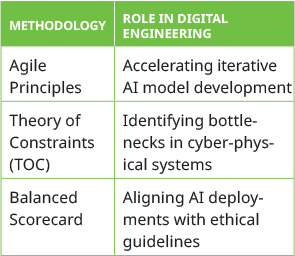
Licensed engineers leveraging these tools aligns with protecting the public welfare, mitigating risks of negligence or incompetence.
Certification and Licensure as the Guardian of Digital Progress
As AI and cyber threats redefine engineering’s scope, professional certification and licensure remains indispensable Initiatives like the SSI certification and CIE demonstrate how licensure can evolve to address digital economy challenges. By certifying expertise in systems integration, threat mitigation, and ethical AI, certification and licensure ensures engineers remain stewards of public safety Through collaboration and continuous improvement, the profession will continue to innovate responsibly upholding its duty to protect health, safety, and welfare in an increasingly interconnected world.

Ben Amaba is an active NSPE member, an industrial and systems engineering fellow, and a global leader in industrial manufacturing, infrastructure, and supply chain solutions, with a current focus on applying AI, digital twins, and cybersecurity to critical systems.
More PE Community: Industry Articles
Our society is abuzz with talk about artificial intelligence (AI) and how it is changing our live

In a world increasingly driven by technological advancements and complex innovations, the ability to communicate technical information to nonengineer audiences is a crucial skill for engineers.
July/August 2020
September/October 2019