

 Registration is open for NSPECon26 in New York City, New York!
 Volunteering at NSPE is a great opportunity to grow your professional network and connect with other leaders in the field.
 Decisions at the ballot box influence policies that support engineering standards and public safety.
November/December 2019
Communities: Industry
New Graduate Program Bolsters Massachusetts as Hub for Wind Energy
With offshore wind energy set to receive large-scale investment in the coming years from private and government entities, Tufts University in Medford, Massachusetts, will offer a first-of-its-kind graduate program that will give students hands-on experience in the offshore wind industry with guidance from private-sector leaders.
Tufts’ three-semester MS in offshore wind energy engineering will contribute to advancing partnerships and research on offshore wind power and increasing the amount of electricity supplied by wind energy in the coming years.
The program, which will reside within Tufts’ department of civil and environmental engineering, will incorporate courses created in partnership with industry members of Tufts’ newly formed Offshore Power Research and Education Collaborative.
New core courses will cover clean energy engineering and the design and analysis of offshore support structures. Electives will focus on the technical aspects of wind power such as geographic information systems and applied data science, and broader issues such as climate change policy and energy finance.
The program comes after the federal government leased development rights to establish wind farms off the coast of Massachusetts for more than $400 million last December. The Interior Department predicts that wind could generate up to 4.1 gigawatts in renewable energy, enough to power more than 1 million homes.
In 2015, a Department of Energy report said it aimed for the nation to generate at least 20% of its energy by wind by 2030. Tufts’ program director Eric Hines, a longtime advocate for the advancement of offshore wind energy research and education, believes the program’s creation is vital to achieving that 20% wind energy output goal.
“If wind power is to continue its growth as an energy source, we need not only research and development, but also programs that educate a generation of engineers who are devoted to sustainable development and energy independence,” Hines says. “This is a first step toward making climate and energy sustainability a priority.”
Hines, along with other Tufts faculty, are involved in the Massachusetts Research Partnership in Offshore Wind. Tufts is one of the six academic and research institutions that received $300,000 in 2016 for funding to explore offshore wind.
In 2018, members of the partnership authored a white paper, “Reaching Convergence in United States Offshore Wind Energy Research,” which examined the various methods and locations to implement large scale offshore wind energy research and facilities. Hines is a significant contributor to both the partnership and the white paper.
The implementation of the Tufts’ program will serve only to bolster Massachusetts’ status as a wind energy hub. In January, Danish turbine manufacturer MHI Vestas Offshore Wind announced plans to locate its US headquarters in Boston.
According to Hines, firms from Spain, the UK, and the Netherlands already have expressed interest in hiring Tufts’ graduates.
“The US offshore wind industry will need tens of thousands of new professionals in the coming decades,” Hines says, “and we are excited to join our POWER-US partner institutions to help make sure we are ready.”
While other states along the east coast have committed to building more than 10,000 megawatts of offshore wind power capacity in the next decade, Massachusetts is the trendsetter. But other states, including South Carolina, North Carolina, Virginia, Maryland, Delaware, New Jersey, New York, Rhode Island, and Maine, have been steadily increasing their wind energy acreage in the last decade.
“Offshore wind energy worldwide has benefited tremendously from advances in turbine technology over the decades,” Hines says. “The technology has now matured to a level where large-scale deployment will be about the impact on the environment, port facilities, US manufacturing, resilient design, and transmission. A Tufts graduate education can provide that level of broad, integrative thinking needed for workable solutions.”
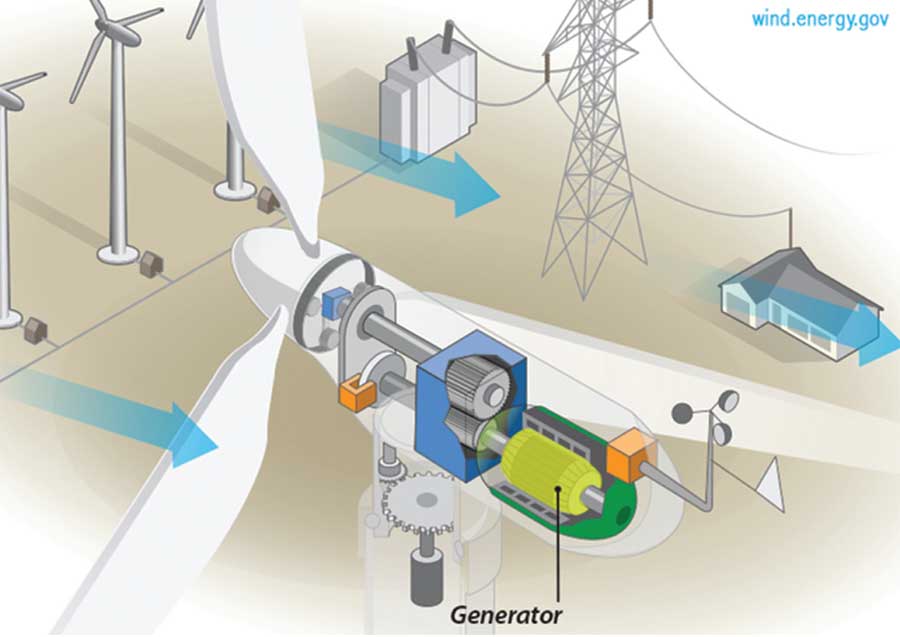 TUFTS’ PROGRAM WILL ALLOW STUDENTS TO BETTER UNDERSTAND HOW TURBINES HARNESS THE POWER OF THE WIND.
CREDIT: DOE WIND ENERGY TECHNOLOGIES OFFICE
More PE Community: Industry Articles
September/October 2019
May/June 2019