Registration is open for NSPECon26 in New York City, New York!
 Volunteering at NSPE is a great opportunity to grow your professional network and connect with other leaders in the field.
 Decisions at the ballot box influence policies that support engineering standards and public safety.
March/April 2020
Communities: Government
Engineering on the Last Frontier
 In rural Alaska, infrastructure challenges are myriad. More than a fifth of rural Alaskan households lack in-home water and sewer service. Dozens of rural communities face a catastrophic threat from the combination of erosion, flooding, and thawing permafrost; and approximately 200 must provide and maintain their own independent microgrid power systems.
Enter the Denali Commission, a 14-person federal agency enhancing the state’s infrastructure through partnerships with Alaskans and tribal, federal, state, and local governments. NSPE member Tom Wolf, P.E., serves as program manager at the agency, overseeing energy, bulk fuel, and sanitation.
As Wolf explains, the grant-making commission launched in 1999 to help direct federal funds. The main driver: helping communities with bulk fuel storage facilities and rural power systems.
Reliable and affordable energy has long been a challenge in the state. According to a 2016 report, about 200 rural villages have “unsustainably high” utility and energy costs due to issues with road access and the high costs of transporting fuel via air or barge.
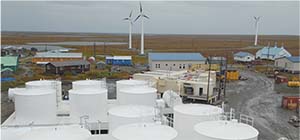 THE KASIGLUK MICRO-GRID--BULK FUEL TANK FARM SHOWN IN THE FOREGROUND WITH POWERPLANT AND WIND TURBINES THAT ALSO CONTRIBUTE POWER TO KASIGLUK’S MICROGRID BEHIND.
Sustainable Energy Solutions for Rural Alaska noted that rural utilities can pay up to four times more for fuel than utilities in other parts of the state. At the same time, when temperatures may drop to 70 degrees below zero, keeping the heat and lights running is a necessity.
Most local power systems are “islanded microgrids,” Wolf explains, with power generated by diesel-powered plants. It’s critical for communities to have sufficient fuel storage when they may get deliveries only a couple of times a year.
Prior to the start of the commission, many of the bulk fuel facilities were more than 30 years old and falling into disrepair. They were no longer meeting regulations and in danger of being closed. Former Alaska Senator Ted Stevens (R) wanted to invest in upgrading and building facilities and generated the idea for the commission.
It was modeled after the Appalachian Regional Commission, another federal agency with similar aims. Other commissions are focused on the Gulf states and parts of Maine, New Hampshire, Vermont, and New York. The Denali Commission is the only one serving a single state, but it covers the largest territory.
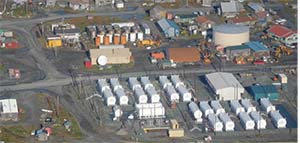 THE DENALI COMMISSION AND OTHER PARTNERS FUNDED THIS NEW 755,000-GALLON CONSOLIDATED BULK FUEL FARM AND 2.7 MEGAWATT POWER PLANT IN TOGIAK, ALASKA.
Since its genesis, the Denali Commission’s focus has expanded to not only rural power systems and bulk fuel but also transportation, sanitation, broadband infrastructure, health facilities, and housing, as well as workforce and economic development.
The agency even helped with the relocation of an entire town, Newtok, due to erosion and flooding tied to climate change.
The commission does not perform work itself but rather serves as a funding agency. According to its website, it has invested more than $1.2 billion in more than 300 communities. Most are predominantly Alaska Native-populated.
Wolf grew up in Alaska and has worked in the state since graduating from college. His civil and arctic engineering background ensures a project is carried out according to the grant requirements. Wolf attends meetings on scope, budget, and schedule; participates in design reviews; and visits sites to verify that projects are built as planned.
Recent projects he’s participated in include construction of new bulk fuel facilities; upgrades to drainage and local roads; and completion of an ATV trail between two villages.
The commission is also funding a study for a new intertie from south central Alaska to communities and military facilities in the state’s interior that currently use individual microgrids. The project would greatly reduce energy costs, Wolf says.
The small federal agency has broad authorities, he explains, for involvement in any project that helps rural Alaska. And because of that size, “we can be pretty nimble.”
Recent appropriations for the Denali Commission have been about $20 million annually, so the agency often can’t fund an entire project. Wolf says its aim is often to be a gap funder. “Maybe a grantee…just needs a little more money to put them over the top and get a project going. It’s a great way for us to jump in and help out.” That allows the commission to leverage its funds, he says, and “do a lot with less.”