

 Registration is open for NSPECon26 in New York City, New York!
 Volunteering at NSPE is a great opportunity to grow your professional network and connect with other leaders in the field.
 Decisions at the ballot box influence policies that support engineering standards and public safety.
May/June 2019
Communities: Government
Holding Back the Waters
Midwest flooding this spring caused an estimated $12 billion in damages to homes, business, farms, and infrastructure. The US Army Corps of Engineers counted at least 50 levees that were breached or overtopped. And a March New York Times headline gave voice to residents’ concerns: “Will Our Levees Be the Next to Fail?”
In the Mississippi Levee District, home of the 176-mile Mainline Mississippi River Levee, an NSPE member is taking an approach of continuous improvement for the safety of residents in his area. Recalling memories of the area’s 1927 “Great Flood” and the 2011 “Epic Flood,” Peter Nimrod, P.E., chief engineer of the Mississippi Levee Board, says, “We want people to feel very safe and comfortable living behind the levee, with their homes, businesses, children, schools, and farmland.” He continues, “We don’t just sit around thinking our levee is great—we want the levee to get better and better.”
The Mainline Mississippi River Levee is built to the “project design flood,” the worst-case scenario, with a 360-foot-wide base and rising 30 feet tall on average. And while 1927 was the last levee failure on the system, Nimrod points to the need for constant attention to ensure that never happens again anywhere on the lower Mississippi River Valley.
The Levee District, governed by the levee board, maintains and operates 212 miles of levees along the river; maintains 360 miles of interior streams; and collaborates with the Corps of Engineers on levee and interior drainage projects.
The board’s responsibilities include leading flood fights. And major floods have been increasing, says Nimrod—from an historic average of once every 20 years to an average of once every two years since 2008. “So, it’s really different out there.”
He attributes this to increased rainfall, additional development through the Mississippi River Valley, and famers doing a better job improving their land to shed water.
Under the PE’s leadership, the levee board is constantly seeking out weak spots and developing permanent solutions to them. For instance, the all-night flood fights during the Epic Flood of 2011, a multihundred-year record-breaking flood, led to federal lobbying efforts for Corps of Engineers funds to fix 11 problem areas along the levee system. With solutions such as seepage berms and relief wells, those areas haven’t had issues in the four major floods since.
Another current priority is backwater flooding. During heavy spring rainfalls, drainage structures had to be closed to keep the Mississippi River from backing into the Mississippi Delta. But that led to more than 500,000 acres of land underwater. Road closures and animals seeking higher ground caused issues for motorists.
The levee board has been working for the last 10 years on approval for a pump project that would move the water over the levee and would be the “last piece of the puzzle” for flood control in the delta, Nimrod says.
“Misinformation” about wetland impact has held up the project, Nimrod explains, but he’s working hard to get the US Environmental Protection Agency to revisit the issue—especially in light of the historic backwater flooding this year. The impact would be balanced out by reforestation of existing agricultural land, he says, and result in a 20% net gain in wetland functionality. “It’s a win-win for the environment, and it’s a win-win for the people in their homes, the farmland, and their businesses.”
When high-water events do occur, rumors fly among local residents. “Everybody is thinking the levee is going to fail,” says Nimrod. The public needs to hear from someone they trust, so he serves as a frequent voice in local news media. Although it’s not in engineers’ DNA to seek the spotlight, he says, his job requires it.
“We focus a lot during a flood event on getting the word out. Whether that’s by email, Facebook, TV, newspaper,” he says. “Getting the right information out there so people know ‘Peter Nimrod said this, so I trust what he’s saying,’ as opposed to a rumor that they hear from [the guy] down the street.”
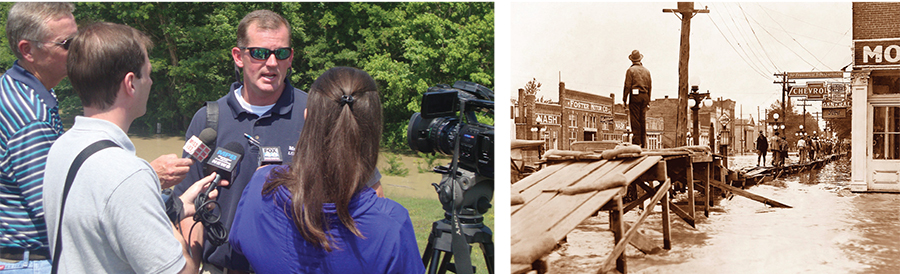
LEFT: PETER NIMROD, P.E., AT A PRESS CONFERENCE DURING THE 2011 “EPIC FLOOD” ALONG THE LOWER MISSISSIPPI RIVER. RIGHT: THE GREAT FLOOD OF 1927 IN THE LOWER MISSISSIPPI RIVER VALLEY DISPLACED HUNDREDS OF THOUSANDS OF PEOPLE, PUT MILLIONS OF ACRES UNDER WATER, AND LED TO THE DEATHS OF AROUND 250 PEOPLE. BOTH IMAGES: THE MISSISSIPPI LEVEE BOARD
More PE Community: Government Articles

March/April 2018