

 Registration is open for NSPECon26 in New York City, New York!
 Volunteering at NSPE is a great opportunity to grow your professional network and connect with other leaders in the field.
 Decisions at the ballot box influence policies that support engineering standards and public safety.
November/December 2019
Communities: Government
AVs and Gridlock: The Missing Piece
BY SAMUEL I. SCHWARTZ, P.E.
 According to a report from the Texas Transportation Institute, congestion levels in 85 of the largest metropolitan areas have all increased nearly every year since at least 1986. The American Highway Users Alliance found that drivers stuck on roads with bottlenecks experience delays of about 91 million hours every year, the equivalent of 45,500 person-work years. The lost value of time to the economy from congestion just in this handful of locations is upward of $2.4 billion annually.
With the stakes and costs this high, the enthusiasm around the belief that autonomous technology can end global gridlock is understandable. It would be great if the solution to congestion really was as simple as setting a single autonomous vehicle into a stream of commuters. But it’s not that easy.
I have little doubt that AVs in sufficient numbers on a freeway will sharply reduce the number of jams. I also believe that the carrying capacity of freeways will increase with very high percentages of AVs. But I am less optimistic that we will see such improvements on city streets, where an increase in the sheer number of vehicles, made worse by the attractiveness of AVs, may actually worsen traffic flow.
We must plan for an AV future in the right ways and include both public and private stakeholders in the search for transport solutions. If people can embrace ride-sharing, and if we can coordinate it with public transit, congestion could be dramatically reduced.
What Can Go Right If We’re Smart
 Congestion disaster will happen if we continue to emphasize the car as private transportation carrying one person on a disproportionate number of individual trips. The consequences of increased traffic congestion could be disastrous if we shortsightedly allow the AV industry to dictate the terms of travel.
If we’re smart and insist on a variety of stakeholders having a say in how traffic laws and policies pertaining to AVs are written, we can cut down on lost time and money and decrease congestion while enhancing transportation. The right way to introduce AVs so as to reduce gridlock is to integrate them into our transit systems. The role of transit will evolve as AVs and ride-sharing become more common.
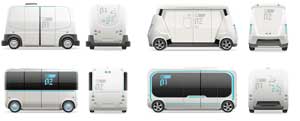
Transit agencies should focus on high-frequency, high-capacity services in dense urban corridors and provide first- and last-mile connections through lower-capacity on-demand driverless shuttles as well as expanded mobility hubs. City-operated robo-buses could deliver much more service for the same amount of money. Smaller buses, operating at a lower cost per mile with less labor, would provide more frequent service at lower fares.
In many suburbs, AVs could link to existing or new transit lines that will link trains to buses. Cities can also work with transit agencies and private companies alike to design and adopt smartcards, open data, and universal apps that will allow riders to find, compare, book, and pay for trips that combine buses, trains, bikes, and ride-sharing vehicles. Such services will match customers with the most efficient (and healthiest) travel choices.
AVs could also help ease congestion if we create policies around them that limit their negative aspects and reinforce the positive. Dynamic road-charging—whether on a real-time basis or in an arrangement that varies by time, day, season, origin, destination, number of passengers, and household income—can be done through a combination of congestion pricing, zone pricing, variable tolls, and vehicle-miles-traveled (VMT) and vehicle-hours-traveled (VHT) fees.
On-demand real-time mass transit is another benefit of smart traffic planning. Imagine a transit system that knows when a high school football game is ending, a concert will be over, or how many people are likely to be at a particular stop. Smart mass transit will also reduce the need for fleets of large buses; instead, a variety of passenger-capacity vehicles will be configured to respond to the needs of travelers. A 40-person bus would not need to be dispatched to pick up a handful of people. AVs can help meet the demand for living and working in proximity to amenities through mixed-use neighborhoods, whether in urban areas or small towns and suburbs.
If ride-sharing becomes mainstream—and more convenient, efficient, pleasant and cheaper than owning a personal vehicle—we may see a dramatic decrease in congestion everywhere. Commuters may be more willing to forgo using their own cars if ride-sharing has been able to customize destinations.
Several players in the field—and they will most certainly be joined by others—are even now working on providing a convenient, inexpensive, and pleasant ride-sharing experience. The Israeli-based company Via launched its US services in New York and has since expanded to Chicago and Washington. Using a mobile app, Via guides commuters to a “virtual bus stop” nearest to where they are located. There they hop into a Via-owned SUV with other riders who are going in the same direction. One by one, passengers are dropped off for a much more affordable fee than a taxi would charge. Once these vehicles are autonomous, the cost of ride-sharing will go down from the already affordable $6 it costs in New York, since the cost of drivers will be eliminated.
Uber has integrated with the Transit app in more than 50 US cities to show commuters how they can combine an Uber ride with public transit more efficiently to get to their destinations. This is part of Uber’s effort to position itself as a complement, rather than an alternative, to public transportation.
In October 2016, the Finnish company MaaS Global launched an app called Whim, which serves as a portal to a wide array of transportation services. For a flat fee, riders get unlimited access to transit and receive points that can be spent on taxi rides or car rentals. The app is part of an effort by the Finnish Ministry of Transport and Communications to get a head start on the mobility-as-a-service (MaaS) model. Its goal is not just to get people to the places they need to go more cheaply and faster—its core mission is to minimize car ownership.
Managed fleets of AVs could reduce wait times and shuttle more people in fewer vehicles, while also preventing empty vehicles from roaming the streets. These fleets could be incentivized depending on who they serve and how. For instance, if a fleet meets certain service targets (for example, running full 80% of the time) or exceeds its target (running full 90% of the time), it could earn a reduction in its operating fees.
A fleet that serves disabled persons or people living in so-called last-mile transit areas could earn a subsidy. At the same time, there would be no incentives rewarding a fleet that runs below capacity more than 50% of the time or has no capacity to serve disadvantaged populations, and costs might even be imposed on such underperforming fleets.
The only way to truly reduce congestion and encourage people to use more environmentally friendly alternatives, including mass transit, ride-sharing, biking, and walking, is to make these alternatives more appealing to more people. In a city, suburb, or exurb, transit has to be accessible, fast, convenient, and comfortable. Ride-sharing in AVs has to be quick and convenient, and access to rural areas and nature has to be available equitably.
We also need to show both the political and personal will to make the relative cost of individual ownership more expensive than riding transit and sharing multi-passenger AVs. Reducing congestion via financial disincentives can also help raise the money that is likely to be needed to create and maintain attractive alternatives.
There are so many positive side effects of reduced congestion: less pollution and fewer greenhouse gas emissions, increased safety, and more livable communities.
NSPE member Samuel I. Schwartz, P.E., is CEO of Sam Schwartz Transportation Consultants. During the 1980 New York City transit strike, he released the word gridlock to the lexicon. Previously, Schwartz was New York City’s traffic commissioner and the Department of Transportation’s chief engineer. He is the author of Street Smart: The Rise of Cities and the Fall of Cars (2015) and No One at the Wheel: Driverless Cars and the Road of the Future (2018).
This article has been adapted from No One at the Wheel: Driverless Cars and the Road of the Future by Samuel I. Schwartz. Copyright ©2018. Available from PublicAffairs, an imprint of Perseus Books, LLC, a subsidiary of Hachette Book Group, Inc.
More PE Community: Government Articles

March/April 2018