

 Registration is open for NSPECon26 in New York City, New York!
 Volunteering at NSPE is a great opportunity to grow your professional network and connect with other leaders in the field.
 Decisions at the ballot box influence policies that support engineering standards and public safety.
March/April 2020
Communities: Education
Education Adaptation a Must for Oil and Gas Industry
From 2016 to 2018, more than 2,000 graduates of US petroleum engineering programs entered the workforce annually, including a record high of 2,550 in 2017. In 2019, that number dropped significantly below 2,000, however, and is expected to drop further over the next few years. The numbers, and other trends, are signaling a change for the future of the industry.
To combat this downturn in graduates, US colleges that offer petroleum engineering degrees are working to adapt to how the industry operates, how petroleum engineering is perceived, and how its engineers are taught.
Over the last decade, while there has been a boom in US oil production, increasingly negative attitudes toward extractive enterprises have made the oil and gas industry less attractive to college students. These negative opinions have been sparked by factors both in and out of the industry’s control, including climate change, media coverage of environmental crises like oil spills, and decreasing oil demand in America and Europe. Together, these factors have resulted in layoffs, a cyclical problem for the industry.
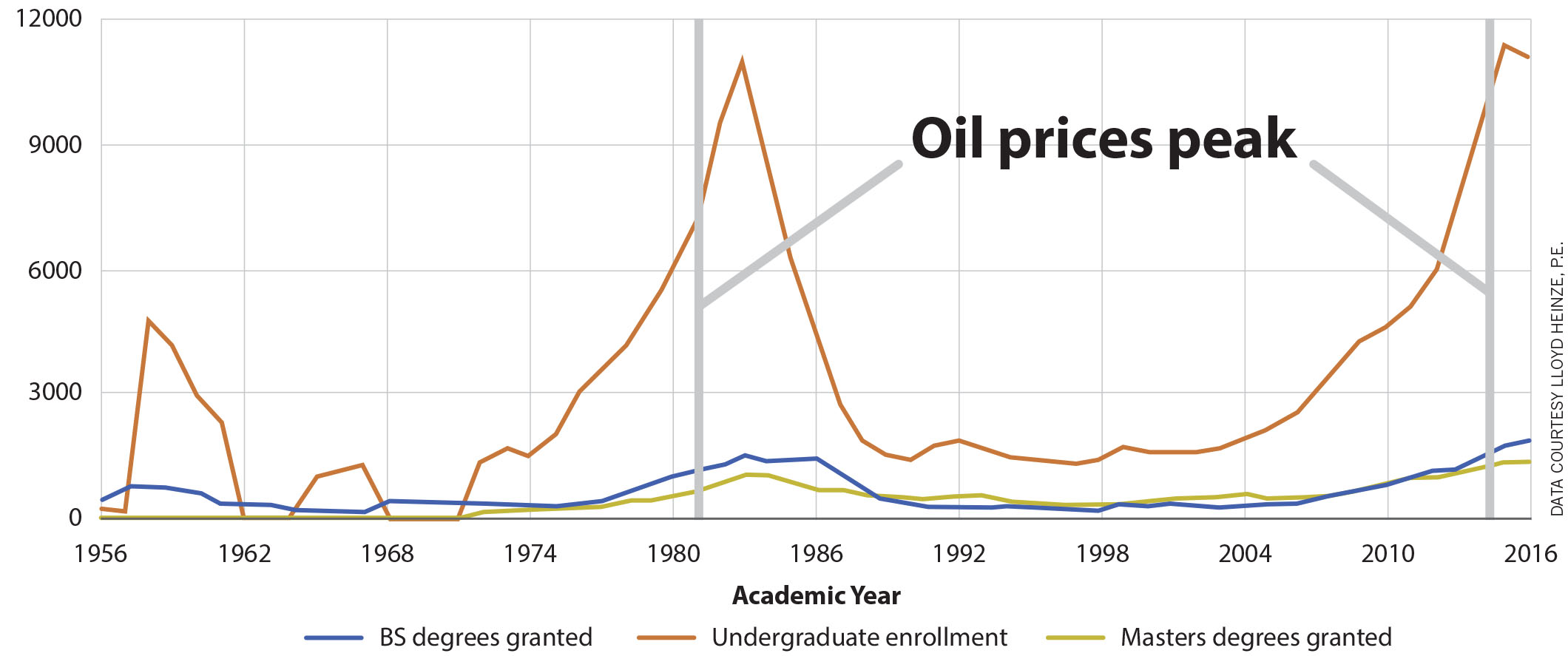
Texas Tech University professor Lloyd Heinze, P.E., has seen the results of the peaks and valleys in petroleum engineering education firsthand. According to Heinze, undergraduate enrollment in the Texas Tech program in 2019 dipped to nearly one-fifth the number of students enrolled in 2015—the program’s lowest since 2005.
“The students who haven’t made a long-term commitment yet are making a change based on what they are seeing,” says Heinze, who compiled the data himself.
To keep young engineers from changing their discipline of study, engineers like Nathan Meehan, P.E., are encouraging engineering educators to adapt to the more dynamic aspects of modern engineering, like automation and new technologies.
“The next generation of petroleum engineers will have to address demands for sustainability, lower carbon intensity, and needs for radical productivity improvements, which only AI and digital can drive,” stated the 2019 white paper “The End of Petroleum Engineering as We Know It.”
To change perceptions about the oil and gas industry, corporations like Chevron are partnering with local communities for social and educational efforts and to increase outreach to the people living in the places they operate. Organizations like the Society of Petroleum Engineers and its leaders are focused on promoting sustainable development by addressing climate change and working to improve energy efficiency, reduce emissions, and create and enable technologies that contribute to lower emissions.
But how can educators and students adapt during this time of change? The answer, according to Meehan, is by ensuring that petroleum engineering students are prepared with the knowledge needed to take part in the activities of other engineering disciplines outside of the oil and gas industry.
Meehan, who coauthored “The End of Petroleum Engineering as We Know It,” goes on to say that a four-year degree may not be long enough to adequately cover topics like advanced material sciences, supply chain, and big data analytics.
“During my time—at least during the ‘boom’ years—we were always able to attract the best and brightest students and students from other industries, like chemical and mechanical engineers. We are not seeing that as much,” Meehan says. “Unless we have a better model, we are not going to be able to retain and attract them.”
The good news, according to the white paper, is that the industry has always been able to adapt in the face of social, technological, and industry changes. Plus: “Today’s engineering students know the world is changing.” They are more digitally savvy than their predecessors, they have access to advanced computational tools, and they benefit from an increased emphasis on teamwork and collaboration.
The coauthors conclude that petroleum engineering faces long-term risks. “This suggests,” they add, “that we will need to revisit university education for petroleum engineers and all aspects of career development and training.”
Booms and Busts in Petroleum Engineering Education
More PE Community: Education Articles
January/February 2020
September/October 2019
September/October 2019