Registration is open for NSPECon26 in New York City, New York!
 Volunteering at NSPE is a great opportunity to grow your professional network and connect with other leaders in the field.
 Decisions at the ballot box influence policies that support engineering standards and public safety.
May/June 2018
PE Report
Vegas Autonomous Shuttle Creates a Buzz
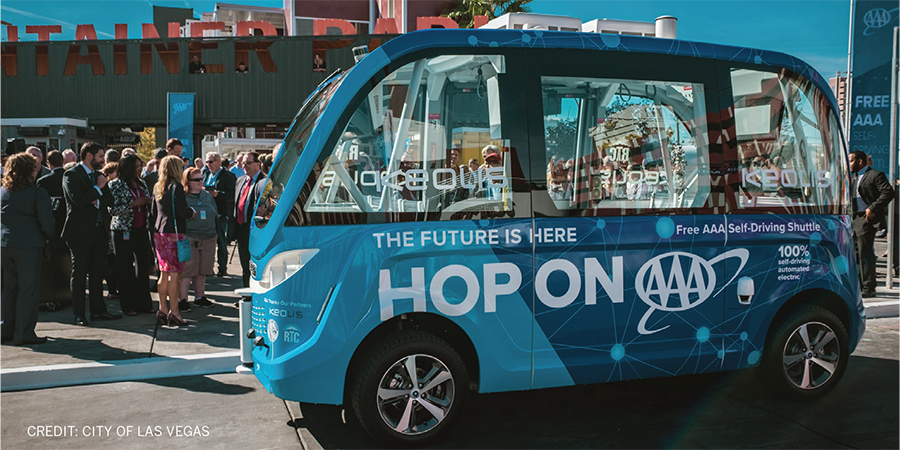 Visitors to Las Vegas usually get their thrills from betting it all on black or watching Penn and Teller remove an iPhone from a fish. But a new attraction, related to…transportation?....has lately been giving them a different kind of Vegas story to share.
An autonomous shuttle operating downtown has been causing a stir among visitors and residents alike since it was first tested in January 2017. National and international news media covered the initial pilot, says Director of Public Works Mike Janssen, P.E. “Holy moly, the world was on fire.”
Las Vegas has long taken pride in its foresight, calling itself an “epicenter for innovation” in its recent mobility master plan. (Janssen will be presenting on the plan at NSPE’s 2018 Professional Engineers Conference in July.) The city’s Innovation District downtown is designed to deploy and test new technologies, including those related to transportation. And Nevada was the first state to pass legislation, in 2011, to allow autonomous vehicle testing.
But, Janssen explains, Las Vegas’s futuristic transportation and mobility initiatives are all part of a longstanding mission: providing “safe, reliable, efficient transportation services” to residents and visitors.
The shuttle’s initial 10-day test was spearheaded by the transit vendor, Keolis North America. For that trial, one direction of Fremont Street, perhaps the city’s most famous street besides the Las Vegas Strip, was closed to traffic.
During the pilot, a local news reporter decided to jump into the street as the vehicle headed toward him, to verify its pedestrian-detecting capabilities. The shuttle performed as it was supposed to and slowed down. But the reporter’s action, Janssen notes, demonstrates the public’s uncertainty with autonomous vehicle technology and the need for such projects to illustrate how the technology works.
The eight-person shuttle is equipped with LIDAR technology, GPS, and cameras. An operator sits aboard to answer questions and take control if necessary. During the initial trial, 10,000 people took the ride.
A few months later, AAA reached out, wanting to conduct research into public perception of autonomous vehicles. The organization offered to fund the shuttle’s operation for one year and equip traffic signals with technology to communicate with it.
The self-driving vehicle now travels a six-tenths of a mile loop in the Fremont East Entertainment District. The shuttle talks to the signals with short range communication technology—for example, learning how long the light will remain green. It was the first self-driving vehicle in the country to be fully integrated with a city’s traffic infrastructure.
About 1,000 passengers a week ride the shuttle, and according to Janssen, it “has been a real fun ride for the public.” Based on AAA’s research, 98% of the riders recommended the experience. In addition, businesses in the entertainment district are seeing more customers, many of whom are drawn to the novelty of the ride.
However, the recent fatality in Arizona has increased attention on AV safety. Janssen explains that his department has been monitoring the reports and awaiting the findings of the National Transportation Safety Board. While the shuttle operates in less traffic and at lower speeds than the vehicle involved in that crash, the professional engineer says the tragic event is a reminder that “the technology still does have a long way to go before it’s commonplace.”
Janssen highlights the potential of autonomous vehicles to reduce the 90% of traffic fatalities that are caused by human error. At the same time, he says the same kind of debates that are happening nationwide are occurring within his staff. Autonomous vehicles could turn transportation into a utopia or a dystopia, he says, and “that answer is still [to be determined].”
What is clear to Janssen is that licensed engineers need to be involved in this emerging technology. It’s coming, he stresses. Stay involved and attuned, and “find a way to participate.”
Learn More
Attendees at NSPE’s Professional Engineers Conference in Las Vegas will have the opportunity to learn more about the city’s autonomous shuttle and other transportation projects in a presentation by Public Works Director Mike Janssen, P.E., on July 19 at noon.
NSPE has been working on various fronts to promote and protect the public health, safety, and welfare in the development and deployment of autonomous vehicle technologies—including with the recent release of policy guidelines for measuring the safety readiness of autonomous vehicles.