Registration is open for NSPECon26 in New York City, New York!
 Volunteering at NSPE is a great opportunity to grow your professional network and connect with other leaders in the field.
 Decisions at the ballot box influence policies that support engineering standards and public safety.
October 2014
COMMUNITIES: EDUCATION
Communication Countdown
Competition pushes engineers to quickly distill research for broad audience.
Engineering graduate students who try to explain their research to spouses, friends, or potential employers run into difficulties when they communicate in jargon to a nonspecialist audience.
But a competition begun in Australia is spreading to the US and helping students of all disciplines more effectively discuss their work. Three-Minute Thesis (3MT) requires participants to present a brief summary of their doctoral, or sometimes master’s, research in a clear and simple manner using just one PowerPoint slide.
The University of Queensland started the competition six years ago. It is now held in at least 17 countries worldwide and 170 universities, including more than 30 in the US.
This year, the University of Alabama will be holding its second 3MT competition. Last year, more than 200 doctoral students participated. Both the first-place winner and people’s choice award winner (voted on by the audience) were engineering students.
Will Guin, a PhD student in the Department of Civil, Construction, and Environmental Engineering, took home the first place prize, including a $1,000 scholarship. His presentation focused on using next-generation carbon nanotubes to reinforce composite materials.
The competition “sounded like a great opportunity to develop some of the soft skills that we as engineers don’t get to do as much,” says Guin, adding that it was the first time he had to boil down his research for a nontechnical audience.
In addition, 3MT provided a way for him to step back from his work and examine its broader effect. “It’s a healthier perspective when you see the global application,” he says.
Guin advanced to the next level, a competition at the Conference of Southern Graduate Schools annual meeting, where he won the people’s choice award. About a quarter of the presentations there were from engineers, he says, including the winner’s. He believes engineers have an edge in 3MT, because a lot of their research is cutting edge, and people realize it will affect their future.
This year, the University of Alabama is expanding its competition, expecting 500 participants, including master’s candidates, recruiting corporate sponsors, and broadcasting on its television network.
But 3MT is more than a one-day event. Overall, the entire U of A initiative lasts 10 weeks, incorporating preparation and several rounds of competition. Information sessions cover crafting an elevator speech and reaching an audience. The school also offers practice sessions and a mock competition. “It’s a series of teachable moments,” says David Francko, associate provost and graduate school dean.
According to Francko, the competition is helping the school produce better prepared, more confident, and more marketable graduate students. As a result, participants reported the experience helped them secure jobs, he says.
The competition also allows the school to highlight the great research happening there, says Francko. A spin-off effort starting in spring 2015 will give faculty research award winners five minutes to present their work.
The University of Virginia also launched its 3MT competition in 2013. Amy Clobes, associate director of professional development at the school, echoes the long-term benefits to students. Being able to communicate work in a clear and compelling way to people outside of their disciplines is a valuable skill to help students collaborate, secure funding, and apply for jobs, she says.
In addition, she explains that student competitors exchanged information with each other and with faculty judges for future networking and collaboration opportunities. “This is exactly one of the outcomes we hoped to foster,” she says.
By a small margin, engineers were the most highly represented group at the 2013 University of Virginia competition, says Clobes. Biomedical engineering student Lindsey Brinton took the top prize with her presentation on identifying early signs of pancreatic cancer and advanced to an international competition, where she won the people’s choice award.
Brinton explains that in preparing her presentation, she was “shocked” at how dependent she had become on discipline-specific jargon. “I realized how poorly I previously explained my research,” she says, noting that she now feels empowered to communicate her work to anyone.
Like Guin, Brinton says participating helped her refocus on the larger picture of her work. “I felt reinvigorated as I remembered why I started doing cancer research in the first place,” she says.
And as Philip Asare, a UVA finalist in the department of electrical and computer engineering, points out, the better engineers are able to explain their research to others, the better they can collaborate to solve the world’s problems.
Go to http://graduate.ua.edu/events/3mt_2013.html and http://gradstudies.virginia.edu/3MT-Video-Archive to watch videos of the 2013 winning presentations. Learn more at http://threeminutethesis.org.
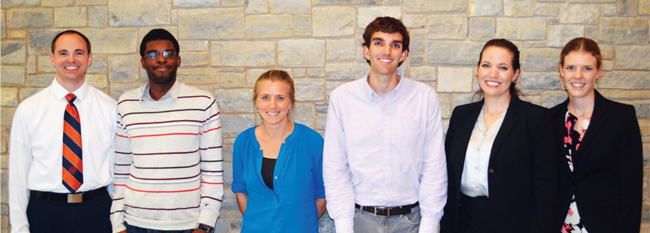
THE FINALISTS FROM THE 2013 UNIVERSITY OF VIRGINIA COMPETITION (LEFT TO RIGHT): NEIL PETERSON, NURSING; PHILIP ASARE, ELECTRICAL AND COMPUTER ENGINEERING; CHRISTINE MONAGHAN, EDUCATION; GEORGE CORTINA (RUNNER-UP), BIOMEDICAL ENGINEERING; LINDSEY BRINTON (FIRST PLACE), BIOMEDICAL ENGINEERING; LAURA ALEXANDER, RELIGIOUS STUDIES.