Registration is open for NSPECon26 in New York City, New York!
 Volunteering at NSPE is a great opportunity to grow your professional network and connect with other leaders in the field.
 Decisions at the ballot box influence policies that support engineering standards and public safety.
March 2014
COMMUNITIES: EDUCATION
Schools Show Not All Engineers Drive Trains
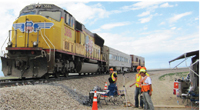 UNIVERSITY OF ILLINOIS RAILTEC STUDENTS AND RESEARCH ENGINEERS UNDERTAKE FULL-SCALE TESTING OF THEIR INSTRUMENTED CONCRETE CROSSTIES AT THE TRANSPORTATION TECHNOLOGY CENTER NEAR PUEBLO, COLORADO.
The railroad industry is putting out a help wanted sign for engineers. After decades of contraction, the industry is growing again but also dealing with an aging workforce, making the need for new talent even more critical. Colleges and universities are doing their part to help meet the growing demand.
NSPE member Michael Pochop, P.E., is a project manager for Hanson Professional Services and the former chair of the education and training committee of the American Railway Engineering and Maintenance-of-Way Association (AREMA). He explains that the railroad industry has been growing since it was “mostly deregulated” in 1980, with investment taking off in the late 1990s in both mainline freight and passenger corridors. But railways had previously reduced their workforce, and now retirements are further affecting supply.
In response, railway-specific engineering content is increasing at schools in the US and Canada, Pochop continues. He notes that AREMA has quadrupled the number of student chapters, to 17, in the last few years.
“It’s pretty hard not to believe the benefits of rail,” says Pasi Lautala, P.E., an assistant professor in Michigan Tech’s department of civil and environmental engineering and director of the school’s rail transportation program. He points to benefits such as efficiency and sustainability as reasons why passenger and freight rail transportation are growing.
Michigan Tech’s program focuses on three areas: education, projects and research, and events and extracurricular activities. The civil engineering department is working on a certificate program, but currently offers three rail electives. In addition, students from various disciplines can focus their senior design course on a railway project, which is typically funded by industry and includes industry advising. For instance, mechanical engineering students are redesigning and converting centerbeam cars used to transport lumber, of which there is a great oversupply, to cars that can transport frac sand.
Industry also funds Michigan Tech’s Railroad Engineering Activities Club, which provides monthly meetings with speakers, field trips, community events, and K–12 outreach.
One topic that’s been attracting attention in the railroad arena is high-speed rail. Michigan Tech built a proof of concept online learning system on high-speed rail for the Federal Railroad Administration, and is looking to expand it. Because railroad engineering is still a niche market, Lautala explains, online learning can help connect experienced faculty with interested students.
The University of Illinois at Urbana-Champaign (UIUC) has also added a high-speed curriculum to its railway engineering program. The civil engineering department started with one course in high-speed rail and now has four. The classes, which are especially popular with students from Europe and Asia, were initially funded with federal stimulus funds and took advantage of a visiting professor who had extensive experience with Taiwan’s high-speed rail project.
Overall, the school offers four core courses on railway engineering topics and eight technical courses. Undergraduate students focusing on transportation are required to take at least one of the core railroad courses. The school also offers an online certificate program, and each railroad course typically includes four or five online students.
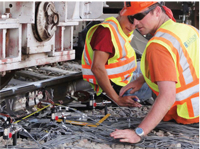 RESEARCH TO MEASURE STRESSES IN THE RAILWAY CROSSTIE FASTENING SYSTEM CONDUCTED BY UNIVERSITY OF ILLINOIS STUDENTS WILL HELP ADDRESS THE CRITICAL ENGINEERING CHALLENGES OF OPERATING HEAVY-AXLELOAD FREIGHT AND HIGHER-SPEED PASSENGER TRAINS ON THE SAME TRACK INFRASTRUCTURE.
The school’s program is consolidated within the Rail Transportation and Engineering Center. According to Tyler Dick, P.E., senior railway research engineer at the center, there has been a blurring of the traditional line between the civil engineers who design track infrastructure and the mechanical and electrical engineers who design vehicles. Now, solving challenges requires a more integrated approach, he says, and the school is looking to “end up with one field of railroad engineering that considers both equally.”
UIUC is also the lead institution of the National University Rail Center, a Department of Transportation center dedicated to rail research and education. One focus is developing guidelines and standards for railroad engineering course content.
In addition to technical skills, soft skills are a necessity for the industry’s engineers. Because of employee shortages, graduates move into positions of responsibility quickly, Dick says. So skills such as communication, teamwork, and management are necessary for success.
The field is a great one for young engineers, says Dick. “When the railroads come to you for the design of a project, typically it’s something they already wanted constructed a year ago.” When he worked in the industry, he would see projects go from proposal to service in six months. “The instant gratification of seeing the project under construction and then the trains running is exciting,” he says.