

 Registration is open for NSPECon26 in New York City, New York!
 Volunteering at NSPE is a great opportunity to grow your professional network and connect with other leaders in the field.
 Decisions at the ballot box influence policies that support engineering standards and public safety.
Spring 2022
The Truth About Professional Licensing
By Rebecca Bowman, Esq., P.E., D.F.E.
“Infrastructure money is coming! Infrastructure money is coming!” That clarion call to repair, replace, and update America’s aging and often-obsolete infrastructure is inspiring for professional engineers in every discipline and encouraging to all Americans with concerns about the safety of drinking water, bridges, roads, and property. Those same Americans deserve to have confidence in both what is being built and in the rigorous training and qualifications of the engineers behind it.
That well-deserved confidence is built upon the licensing process for all professional engineers and for the other professions involved in designing and constructing the built environment. Seventy-five percent of voters believe that it is important to ensure the qualifications of professionals in certain industries such as engineers and surveyors, according to research conducted by the Benenson Strategy Group to gauge attitudes on licensing standards. That protection is based upon a professional licensing system that regulates education, examination, and experience requirements.
Unfortunately, lawmakers in states across the country are facing pressure from special interest groups to weaken or even eliminate the rigor of licensure, the very mechanism that is so foundational to providing the very protections on which Americans rely. With this mounting pressure, NSPE and organizations representing architects, certified public accountants, landscape architects, and surveyors established the Alliance for Responsible Professional Licensing (ARPL) to counter and educate lawmakers on the importance of professional licensing. Legislative proposals since 2015 range from the elimination of all licensing to bills that would require states to accept licenses from any other state regardless of whether the out-of-state license was supported by qualifications of the same rigor. These destructive proposals are accompanied by assertions that the proposals would provide an economic benefit for women and people of color.
However, the facts show those assertions to be false. In addition to the protections provided by the rigor of licensure, an Oxford Economics study commissioned by the Alliance for Responsible Professional Licensing showed that licensure also results in 6.5% higher wages on average. Furthermore, possession of a license narrows the gender wage gap by about one-third and the wage gap for professionals of diverse backgrounds by about half. President Biden’s Executive Order 14036 of July 9, 2021, Executive Order on Promoting Competition in the American Economy, acknowledged that “many occupational licenses are critical to increasing wages for workers and especially workers of color.”
Perhaps the most insidious aspect of this special interest agenda is that many of the proposals do not acknowledge or concede that qualifications for licensure as a hair stylist should be different from the qualifications for licensure as a professional engineer. They implicitly argue that a haircut has the same risks as the design of a bridge or a water treatment facility. They make no distinction between an occupation and a profession whose paramount commitment is to the protection of the public’s health, safety, and welfare.
American Consumers Want Public Protections
The American consumer understands this distinction well. A public poll commissioned by ARPL tested the theory of consumer want and need for consumer protection. More than 70% of voters believe that there are professions with high impact on the public’s health, safety, and welfare that should be carefully and rigorously regulated. These professions included all of the professions that make-up and lead the ARPL coalition: architects, landscape architects, certified public accountants, surveyors, and professional engineers.
While legislators may seem confused about the significance of the distinction, their constituents are not. Three times in three years, West Virginia has considered a universal licensing bill. Through the leadership of a state-led ARPL coalition, both the bill and idea were rejected, and constituent outcry about safety has led to legislators considering the difference between occupational and professional licensing. In recent years, states across the nation have been encouraged by special interest groups to consider weakening or eliminating professional licensing but have returned to safer ground upon coming to understand the tremendous risk to the public.
To oppose rigorous licensing of professional engineers is to be anti-safety and to be anti-consumer. Opponents of rigorous licensing argue that the consumer is adequately protected by the legal system or by insurance or by internet reviews. What they fail to address is that both the legal system and insurance merely provide monetary “compensation” for physical damage. That means that someone must be injured or killed or suffer damage to property in order to receive that “compensation.” Ask a family who has lost a loved one to a structural collapse or a toxic exposure if money made them whole.
Licensure, on the other hand, is designed to prevent that physical damage, to prevent that structural collapse, to prevent that toxic exposure, by establishing minimum standards for education, examination, and experience before a license is granted. And, in the unlikely event that a holder of a license it granted cannot or will not perform appropriately even with the required education, examination, and experience, the applicable licensing board is empowered to strip the license.
Licensure is an Effective Tool
There are reasons why licensing is an effective tool for the protection of the public health, safety, and welfare. Licensing boards and subject matter experts set standards for continuing professional education. The nature of engineering practice has changed dramatically in the past 50 years, in the past 20 years, even in the past five years. In some cases, the fundamental science has advanced. In other cases, the fundamental science is relatively unchanged, but our understanding has changed. And, in still other cases, the fundamental science is relatively unchanged, but the tools we use for practice would have seemed like science fiction as little as a decade ago. If you doubt, ask an engineer who has been in practice for 50 years. At the same time, applicable codes have changed radically over time, mostly in the areas of safety and evolving technology. An engineer who was unaware of code changes would be designing incorrectly and inadequately. Continuing education required for the maintenance of a professional engineer’s license enhances both the real and the perceived competence of that licensee.
One arena of threats to licensure comes from a drive to ease perceived difficulties experienced by retired military and the spouses of active military. While this might, at first glance, appear to be a worthy and patriotic drive, the reality can be quite different. In states where such alterations to the licensing process have been enacted, those alterations often supplant efficient systems already in place. The net outcome of such alterations often actually increases the burdens upon and barriers to retired military and military spouses. One can understand that military spouses often have to deal with frequent and unanticipated transfers. However, that worthy and patriotic paintbrush is now being used on other first responders, who are already in place in the jurisdiction, as are their spouses. The underlying assumption is doubly flawed when applied to first responders.
While there are several additional significant issues associated with weakened licensure, there was a dramatic demonstration of the consequences in February 2021. More than two decades ago, Texas altered its licensing standards in favor of a concept called “consumer choice” and an open market. That concept suggests that consumers should be free to select the provider of their choice. Inherent in that concept is the assumption that consumers possess sufficient information to evaluate the qualifications of those offering engineering services. Selecting a provider of professional services should not be based on internet reviews or the sight of an engaging billboard. Last February, without an agency enforcing accountability, including updating energy resources, winter storms resulted in cascading energy failures—endangering people and property. Some have argued that the recent COVID-19 crisis and the emergency flexibility granted to medical providers demonstrate that universal licensing works. However, the actual question is “Why did licensing flexibility work in an emergency?” The answer is “Strong underlying licensing requirements.” Strong underlying licensing requirements meant that the emergency waivers did not endanger either the real or perceived qualifications of those heroic medical providers.
However, an even deeper examination is relevant to that argument. The human body in one state is functionally equivalent to the human body in another state. However, a structure in a state with hurricanes is not the same as a structure in a state with permafrost. A water treatment plant in a state with a shallow water table is different from a water treatment plan in a state with earthquakes. The built environment in one location is not necessarily functionally equivalent to the built environment in another location. Those differences can be significant, requiring completely different analysis, different materials, and differing solutions. Correspondingly, it is entirely appropriate for those jurisdictions to have differing qualification requirements.
This is not to say that licensure of professional engineers cannot be improved. Updates to licensure that align with the way that professional engineers actually work could benefit both the professional engineers and the public they serve, while increasing competition in the workplace. However, blanket monochromatic proposals to alter or delete licensure of professional engineers result in unintended consequences, with American consumers suffering the most. Licensing exists to protect the public. Legislators and regulators must take care that they never lose focus on that fundamental truth.
Fact Check: The Myths of Anti-Licensing
Time and again, calls for anti-licensing return to a handful of myths and purported problems that can only be solved by drastically weakening or outright eliminating licensing. The Alliance for Responsible Professional Licensing takes a closer look at those myths and sets the record straight.
Myth #1:
Fact: Some occupations are rightly calling for a careful review and recalibration of the education requirements to become licensed. This is what should be done. It is not, however, what anti-licensers are calling for. What anti-licensing seeks to do is broadly and arbitrarily lower education standards for all professions. Some proposals go so far as to disallow minimum education requirements for highly complex, technical professions that impact public safety and welfare.
Myth #2:
Fact: Well-designed professional licensing systems already include interstate practice and mobility and provisions for military spouses. The real threat comes from “universal licensing” proposals that would dilute existing mobility systems that have been working well for military personnel and the public for decades. What’s more, some of these proposals impose arbitrary residency requirements that create new barriers to practicing that would otherwise not exist. Most importantly, “universal licensing” will create a race to the bottom, hurt the public’s welfare, and create business insurance and liability implications.
Myth #3:
Fact: Licensing helps level the playing field for women and minorities. A 2021 study by Oxford Economics finds that licensing narrows the gender-driven wage gap by about a third and the race-driven wage gap by about half. In any industry, responsible licensing systems create well-defined career paths for workers–regardless of gender or ethnicity–and opportunities to achieve higher earnings.
Myth #4:
Fact: Licensing is pro-consumer and pro-competition because it enables consumers to choose from a pool of qualified licensed professionals. These qualifications are verified upfront by independent licensing boards composed of experts in a given professional field. Licensing also helps level the playing field for women and minorities, increasing fairness, competition, and merit-based career opportunities.
Access Alliance for Responsible Professional Licensing information and resources.
More Cover Story Articles

Members who dedicate their time and energy to volunteer positions in NSPE, their state societies, or local chapters are crucial to helping the Society meet its goals. They also find personal rewards that are integral to achieving fulfilling careers as professionals. Read more.

In August, drought conditions and low reservoir levels led the federal government to make the first-ever shortage declaration for the Colorado River. This declaration didn’t come as a surprise to professional engineers who are working on solutions for life with less water. Read more.

As calls to action for supporting sustainable communities ramp up, the engineering profession is being asked to take on a more prominent role in designing infrastructure, technologies, and systems that improve and reduce harm to society. Read more.

Artificial intelligence, autonomous vehicles, the internet of things, and robotics are just a few of the latest technological advancements that are transforming society as part of a fourth industrial revolution. Read more.

As the pandemic continues taking a heavy toll, the profession finds new ways of reaching students—from a distance. MATHCOUNTS, DiscoverE, and other STEM outreach programs, are using virtual technology to provide creative initiatives and programs. Read more.
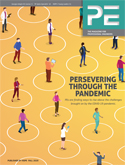
The COVID-19 pandemic has created both new and harsh realities with uncertainty around when conditions will get definitively better. NSPE members, just like everyone else, are trying their best to persevere through both personal and work-life challenges brought on by the pandemic... Read more.

Going about our daily lives just a few months ago, we had no idea of the profound changes in store for us. Then, almost overnight, life turned topsy-turvy—throwing every aspect into tumult like loose items in an earthquake. The pandemic, plus a countrywide shut down, an economy on hold. Read more.

As the effects of climate change proliferate, young engineers feel a responsibility to take action with their work. For this reason, they are increasingly choosing to work for companies that share this perspective. Read more.

Fatalities in crashes involving pedestrians have been on a steady rise for a decade. Professional engineers and traffic safety consultants are resolved to take on this public safety issue with practical solutions to reverse this deadly trend. Read more.


NSPE members took their Professional Engineers Day celebrations to the offices of federal legislators and staffers, advocating for and educating about the critical role of the licensed professional engineer and pushing for passage of a pipeline safety bill.
Read more.
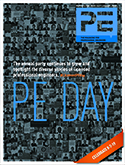
On the first Wednesday in August, PE Day celebrates the contributions of licensed professional engineers. Now in its fourth year, the event has gained a loyal and growing following that loves putting the attention on hard-working professionals who rarely aim to go viral. Read more.