

 Registration is open for NSPECon26 in New York City, New York!
 Volunteering at NSPE is a great opportunity to grow your professional network and connect with other leaders in the field.
 Decisions at the ballot box influence policies that support engineering standards and public safety.
Summer 2021
Meeting Today’s Needs With Tomorrow in Mind
BY DANIELLE BOYKIN
As calls to action for supporting sustainable communities ramp up, the engineering profession is being asked to take on a more prominent role in designing infrastructure, technologies, and systems that improve and reduce harm to society.
Earlier this year, NSPE affirmed that licensed professional engineers are uniquely positioned to create, maintain, and renew sustainable communities. These sustainable communities—communities that meet the needs of the present without compromising the ability of future generations to meet their own needs—are critical to the public health, safety, and welfare, says the Society position statement. The statement continues NSPE’s recognition of sustainability’s importance, including the addition of a professional obligation to the Engineering Code of Ethics in 2006 and a Professional Policy on the Environment in 2018.
Going forward, NSPE’s Committee on Policy and Advocacy will be tasked with establishing goals and recommendations that bolster the Society’s commitment to sustainability. This work will include examining the public policy perspectives and recommendations of other organizations, including the United Nations Sustainable Development Goals. “I hope it lets the profession know that NSPE has a position, and it sparks a discussion that not only are engineers integral to the built environment, but they are also key players in impacts to the environment and the sustainability of our communities and our planet,” says Patty Mamola, P.E., COPA cochair.
Over time, the profession’s perspectives on sustainability have changed. In NSPE’s 2020 Engineering Outlook & Salary Survey, 49% of participants indicated that they agreed and 41% strongly agreed that professional engineers should promote sustainable and green design solutions. Mamola believes that a younger generation of engineers is driving this growing viewpoint. A generational divide on the stewardship role of engineers with respect to climate and extreme weather challenges, she says, was apparent at an Engineering Change Lab Summit in 2020. “It was eye-opening to hear the younger engineers speak up and state they didn’t believe engineers were doing enough to protect the environment while the older engineers pointed out the nonreality of their beliefs and assumptions,” she recalls. “The younger engineers also began to realize there was more they could be doing even in their junior-level positions.”
Discussions, like the one at the ECL Summit, are essential, adds Mamola, and show that when engineers are silent, they give the impression that protecting precious natural resources and creating sustainable communities are not priorities.
The sustainability position statement, adopted in February, says engineers can and are providing solutions by:
- Optimizing living conditions (e.g., ecovillages, eco-municipalities, and sustainable cities);
- Considering economic drivers (green building, sustainable agriculture) and establishing best work practices (sustainable architecture);
- Using science to develop new technologies (green technologies, renewable energy, and sustainable fission and fusion power); and
- Designing systems in a holistic manner and adjusting individual lifestyles to conserve natural resources. Engineering sustainable solutions requires systems thinking rather than solving isolated problems that could lead to unintended consequences.
Sustainable Engineering is Good Engineering
Sustainability is also establishing itself on college campuses. In a 2020 report, the National Academies called on institutes of higher education to embrace sustainability education as a vital field of study and improve students’ ability to design, implement, and lead proactive change. These programs, the report says, should enhance the capacities of graduates to translate knowledge into the action needed to meet emerging local, regional, national, and global needs.
Another recommendation advises professional societies to support sustainability education and pursue collaborative opportunities to: provide a forum for convening sustainability students, researchers, and professionals; build partnerships with the public and the private sectors; offer formalized training and mentorship; promote information sharing; develop shared principles and values; establish a model for assessing sustainability education programs; and establish and lead a cross-sector effort to track and analyze employment in sustainability-focused jobs.
Brad Allenby and his colleagues within Arizona State University’s School of Sustainable Engineering and the Built Environment are equipping their students with the knowledge and skills to make connections between engineering design and considerations around the long-term wellbeing of society.
In today’s world, sustainable engineering is good engineering, says Allenby, the President’s Professor and Lincoln Professor of Engineering and Ethics. “Sustainability is a broad system concept. The environmental part of sustainability is fairly obvious and something that engineers of all stripes are getting better at working on and often integrating during the first stages of their projects.”
Promoting and implementing sustainability doesn’t come without challenges, though. The challenges often arise when it comes time for an engineer to process the views of stakeholders and try to understand what it all means for a specific design or project. “Engineers have to balance sustainability with existing social, legal, economic, and legacy technical systems,” he explains.
The ASU program teaches students about the types of discussion that they may have with nongovernmental organizations, the public policies and politics involved, and the differences among countries. “They are not experts,” Allenby says of the students, “but at least they are aware of enough so that they can connect with the experts in those domains to help create more comprehensive and stable solutions.”
Allenby makes sure his engineering students are aware of these issues and understand that, in many cases, their value to society comes from their skill as real-world problem solvers. “There are plenty of activists, there are plenty of people with very strong opinions on all sides, but you need somebody who can bring them together, understand what they are saying, and build a design that works.”
Allenby adds, “What we really want to do is build a building that treats its occupants as well as possible, provides as healthy environment as possible and, at the same time, reduces environmental impacts because it reduces costs. Now who’s going to argue with that? That’s sustainability.”
Sustainability in Action
For NSPE member K. James Taylor Jr., P.E., sustainability is more than just a buzzword; it’s about incorporating the best possible design solutions into projects to benefit the public. “We haven’t [adequately] invested into our infrastructure for many, many years and it’s starting to fail,” says the president of the Delaware Engineering Society and 2020 NSPE Emerging Leaders Program graduate. “We need to break away from this and come up with the best solutions, not just for the need right now, but looking down the line.”
When working on land development projects for Duffield Associates, Taylor makes it a priority to educate clients about sustainability. “I think a lot of owners want to do what’s right in the world, but they need that education piece to be able to say, ‘Yes…this is the direction we need to go.’”
Over the years, Taylor has observed that not just owner clients are focusing on protecting the environment. “Suppliers for proprietary products, such as pipes and other things we put into the ground, are trying to find more ways to become more sustainable or using recyclable materials,” he says. “This is great because they are seeing that the market is being driven this way.”
The push is also coming from government agencies like the Environmental Protection Agency, says Taylor. “They are pushing for more green practices for stormwater [management] that will help with water quality, which means that you are doing different things with plantings, biosoils, and rain gardens because it really helps the environment as a whole.”
Since 2015, Duffield Associates has worked with biopharmaceutical client Incyte Corporation on its headquarters expansion project in Wilmington, Delaware. The 154,000-square-foot building and a 355-car parking garage incorporate sustainable and green design elements. The firm provided civil and geotechnical engineering services, including site layout and grading, utility design, stormwater management, and land development approvals. When geotechnical conditions at the site presented challenges to stormwater management, implementing a variety of green practices provided a remedy. Bio-retention areas, porous pavement, underground stormwater facilities, and a green roof on the parking garage (with outdoor seating for employees) were put into place. “It’s an urban environment with green space,” says Taylor. “This also provides an example and discussion piece for other commercial projects.”
Another sustainability project for Duffield Associates is helping to create a more sustainable Philadelphia through a contract with the Philadelphia Water Department (PWD) that supports the city’s Green City, Clean Waters program. The program seeks to restore local waterways through the implementation of green stormwater infrastructure and investments in traditional infrastructure. Duffield’s work with PWD has included the design of more than 150 blocks of green streets in residential, commercial, and institutional areas to provide stormwater management, increase tree canopy, and provide neighborhood greening through the implementation of stormwater planters, bumpouts, and tree trenches. The firm has also designed rain garden and subsurface storage projects in city parks to provide better site and street runoff management.
In January, Duffield Associates entered onto a private equity-based platform with three other companies to create the National Engineering & Environmental Consulting Platform. The platform is focused on providing environmental, engineering and water services that contribute to sustainable design elements, from natural resources and environmental planning to renewable energy, sea-level rise and resiliency, environmental assessment and remediation, and water resource planning. “Sustainable design is the filter through which we view solutions for all of our technical practice areas,” Taylor adds. “All engineers have to be conscious about what our impact is on the world around us when we are doing this design work and make sure that we are benefiting our communities.”
How are you supporting sustainable communities? Share details about a project or program at your company, government agency, or university for a future article in PE ([email protected]).

SINCE 2015, DUFFIELD ASSOCIATES HAS WORKED WITH BIOPHARMACEUTICAL CLIENT INCYTE CORPORATION ON ITS HEADQUARTERS EXPANSION PROJECT IN WILMINGTON, DELAWARE (LEFT PHOTO). THE 154,000-SQUARE-FOOT BUILDING AND A 355-CAR PARKING GARAGE INCORPORATE SUSTAINABLE AND GREEN DESIGN ELEMENTS.
More Cover Story Articles

Artificial intelligence, autonomous vehicles, the internet of things, and robotics are just a few of the latest technological advancements that are transforming society as part of a fourth industrial revolution. Read more.

As the pandemic continues taking a heavy toll, the profession finds new ways of reaching students—from a distance. MATHCOUNTS, DiscoverE, and other STEM outreach programs, are using virtual technology to provide creative initiatives and programs. Read more.

The COVID-19 pandemic has created both new and harsh realities with uncertainty around when conditions will get definitively better. NSPE members, just like everyone else, are trying their best to persevere through both personal and work-life challenges brought on by the pandemic... Read more.

Going about our daily lives just a few months ago, we had no idea of the profound changes in store for us. Then, almost overnight, life turned topsy-turvy—throwing every aspect into tumult like loose items in an earthquake. The pandemic, plus a countrywide shut down, an economy on hold. Read more.

As the effects of climate change proliferate, young engineers feel a responsibility to take action with their work. For this reason, they are increasingly choosing to work for companies that share this perspective. Read more.
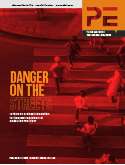
Fatalities in crashes involving pedestrians have been on a steady rise for a decade. Professional engineers and traffic safety consultants are resolved to take on this public safety issue with practical solutions to reverse this deadly trend. Read more.

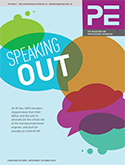
NSPE members took their Professional Engineers Day celebrations to the offices of federal legislators and staffers, advocating for and educating about the critical role of the licensed professional engineer and pushing for passage of a pipeline safety bill.
Read more.
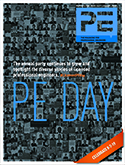
On the first Wednesday in August, PE Day celebrates the contributions of licensed professional engineers. Now in its fourth year, the event has gained a loyal and growing following that loves putting the attention on hard-working professionals who rarely aim to go viral. Read more.

Extreme weather events tied to climate change are occurring more frequently, and costing more. What does that mean for professional engineers and their standard of care? Could they be held liable for damages? Experts and professionals are increasingly debating these questions, with no easy answers. Read more.
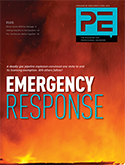
The September natural gas explosion in Lawrence, Massachusetts, led federal investigators to recommend the state end a PE license exemption, a move strongly supported by NSPE. The governor responded by doing so, through the enactment of emergency legislation. Will other states take similar action? Read more.

Over the course of a PE’s career, he or she may need to obtain licenses in additional states through comity licensing. However, challenges can arise with a lack of uniformity in processes. NSPE, state societies, and licensing boards are providing resources and taking substantive actions to ease licensure mobility. Read more.