Registration is open for NSPECon26 in New York City, New York!
 Volunteering at NSPE is a great opportunity to grow your professional network and connect with other leaders in the field.
 Decisions at the ballot box influence policies that support engineering standards and public safety.
December 2013
COMMUNITIES: CONSTRUCTION
Structural Engineer Builds a Career on Constructability
 –David Ruby, P.E
With more than 50 years experience in structural design and construction engineering, NSPE member David Ruby, P.E., is a highly regarded member of his field.
The founder of Michigan-based structural engineering firm Ruby + Associates has received a number of awards throughout his career, including the Structural Engineers Association of Michigan’s Structural Engineer of the Year Award and the American Institute of Steel Construction’s Designer Lifetime Achievement Award. Some of his signature projects include the John Hancock Building in Chicago, Embarcadero Hyatt Hotel in San Francisco, and Renaissance Center in Detroit.
Also among Ruby’s accomplishments, and perhaps the reason for his many others, is his writing the book on constructability, both figuratively and literally. Ruby + Associates has practiced the principles of constructability since it was founded in 1984, making it a pioneer among structural engineering firms, and Ruby himself authored the American Institute of Steel Construction’s Design Guide 23: Constructability of Structural Steel Buildings.
Constructability is the use of construction knowledge and experience in the planning, design, procurement, and field operations of a project. It requires a project team to consider the entire construction process before any design work begins. It’s an approach based on the belief that involving construction industry professionals at the earliest stages of development can deliver significant cost savings, improve quality, and reduce project risk.
“What I believe is that the engineer needs to seek that knowledge in order for him to provide what is truly a well-organized, well-designed, well-coordinated project and therefore beneficial to his client,” Ruby says. “Collaboration is necessary. The engineer needs to be working with the architect, not for the architect; he needs to be working with professionals from the construction industry; he needs to work with the owner; [and] he needs to understand the site. All those things need to be involved.”
Ruby’s passion for the concept of constructability even led to the creation of Ruby University, a Web site at www.rubyuniversity.com that provides access to resources on the value of constructability and how it can be used to deliver greater project efficiency and profitability.
Given his passion and that Ruby is widely recognized as an expert and invaluable resource in both structural engineering and constructability, one might think there was some defining eureka moment in his life that pushed him onto his career path, but according to the man who has worked on high profile projects such as U.S. Cellular Field in Chicago and Lucas Oil Stadium in Indianapolis, it all happened rather naturally.
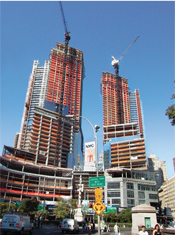 Ruby + Associates performed connection design for the Time Warner Center, one of New York City’s most iconic structures located in the heart of Manhattan.
Lincoln Logs to Sears Tower
Like many children, Ruby’s first experiences with construction and engineering involved playing with toys. “I had Lincoln Logs and Tinkertoys, I had Erector sets and motorized Erector sets, [and] I had a huge train layout,” he says. “Always, during that period of time, I was building things. It was just something that I really felt I liked to do.”
As Ruby grew, so did his interest in construction and engineering, and he had the good fortune to be surrounded by supportive teachers and engineers in his hometown of Aliquippa, Pennsylvania. “My parents owned a grocery store, and customers in the grocery store, a significant number of them, were engineers that worked for the American Bridge Division of U.S. Steel,” Ruby says. “I’d get involved in conversations with them, and they would ask me what I was doing and they would tell me what they were doing, and it just piqued an interest in doing that sort of work.”
When Ruby graduated from high school, his next door neighbor happened to be an engineer as well, vice president of engineering for American Bridge in fact. As a result, Ruby was able to get a summer job in the American Bridge drafting room, and after earning his civil engineering degree from Rensselaer Polytechnic Institute in Troy, New York, he was offered a full-time position with the company.
A few years later Ruby was transferred to Chicago, where he would have the good fortune to work on projects like Sears Tower and learn the foundations of constructability. “Sometimes you are lucky that you are dropped at a certain location at a certain time,” he says. “I was assigned to a group in Chicago called the High Rise Group, and we were assigned to assist U.S. Steel marketing. Their objective was to increase their market share in steel.”
To assist U.S. Steel marketing, Ruby and other engineers reviewed the design of existing structures from the Rocky Mountains to the East Coast to determine if they could make changes to the designs to make them more efficient. Because of that work, looking at the constructability of projects just came naturally, Ruby says. “Just because that was how I was trained and how I was brought up, and I had this three-and-a-half years of just doing this on a daily basis, every day, every day, every day.”