

 Registration is open for NSPECon26 in New York City, New York!
 Volunteering at NSPE is a great opportunity to grow your professional network and connect with other leaders in the field.
 Decisions at the ballot box influence policies that support engineering standards and public safety.
Professional engineers can be empowered to influence leaders, clients, and organizations to put ethics at the forefront.
Given the significant ethical implications of their work, it is important for professional engineers to understand and apply professional ethical standards. However, in my research on engineering ethics, I often find that engineers do not struggle to distinguish right from wrong. They face obstacles, though, when trying to influence others, especially when trying to resist an unethical request from a leader—whether it comes from their boss, a project manager, or a client.
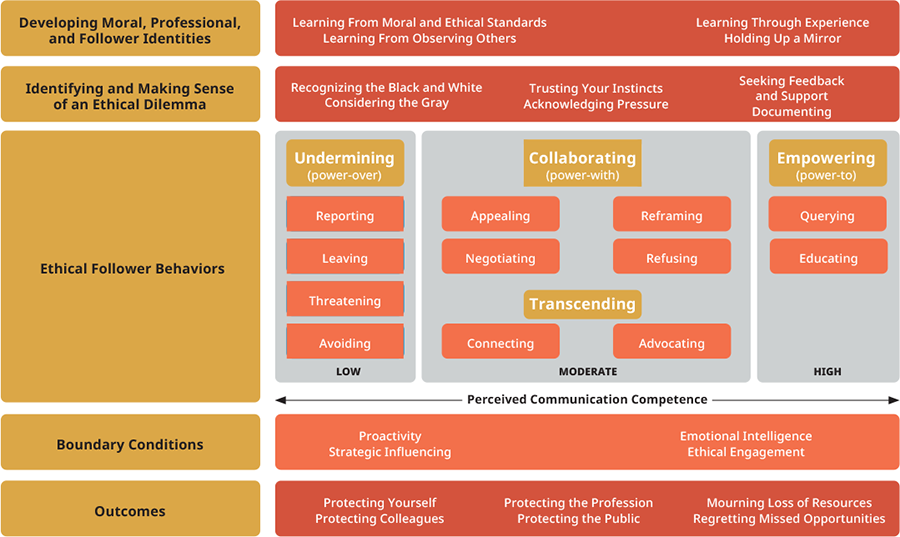
Following my article in the Spring 2024 issue of PE magazine, I would like to share key findings from a new study on ethical followership in the engineering profession. The study found that when resisting an unethical request from a leader, professional engineers should consider how to empower or collaborate with that leader to make the right decision. It also associated their effectiveness with being proactive, strategic with one’s influencing, emotionally intelligent, and engaged in fostering ethics at work.
The study was conducted in two parts, a survey of 188 adults in the United States who have experience working with professional engineers and interviews with 40 of those participants. In the survey, I used a concept that communication scholars call "communication competence" to evaluate reactions to professional engineers resisting an unethical request and determine which "ethical follower behaviors" are more effective than others. If stakeholders see an ethical follower behavior as competent, the behavior is more likely to achieve its intended outcomes, such as "doing the right thing." Interviews then helped explain these results and point to conditions that enable ethical followership.
Followers Empowering the Leader
One approach to ethical followership was found to be highly competent and included querying and educating. This approach represents a "power to" relationship in which the follower empowers the leader. That is, the follower is querying and educating the leader and thereby empowering them to think critically and make the right (ethical) decision.
Participants noted that the follower facing an unethical request from a leader may not have access to the same information. Querying can resolve this issue. It can help the follower assess whether the leader understands the ethical implications of their actions and what their intentions really are. As one participant described, "It’s possible to misunderstand what the leader was saying." Querying can also help both leader and follower identify alternatives. "In addition to determining whether this situation is unethical," one participant explained, "asking questions helps us understand the context and find a remedy."
Participants emphasized the value of followers recognizing their expertise and sharing it in a manner that educates stakeholders. They referenced examples when communication was perceived as less competent because the follower either did not share what they knew or failed to share it in a manner that others can understand. One participant remarked that his followers "understand the technical details at a level that myself as a project executive, and in most cases the client, do not and will not understand." Another stated, "A lot of engineers struggle because they weren’t trained in engineering school how to communicate technical information to a nontechnical audience."
Followers Collaborating with the Leader
Another approach to ethical followership was found to be somewhat competent and included appealing, reframing, negotiating, and refusing. This group reflected a "power with" collaborative relationship. That is, the follower attempts to collaborate with the leader to rework or rescind the unethical request by offering concerns, perspectives, proposals, and boundaries.
According to participants, power with behaviors exemplified "pushback," efforts to persuade the leader to modify their request. These behaviors reflected a good faith assumption that the leader and follower, working together, could land on a shared understanding of the problem and a shared commitment to an appropriate solution. When using power with behaviors, the follower is "not playing hardball," as one participant identified power over behaviors, or "putting anyone’s back against the wall." Participants described power with behaviors as "constructive," rooted in shared interests, and focused on helping the leader to make minor corrections or adjustments. One participant noted, "It’s not whether it’s your way or the other person’s way that is right. It’s an amalgamation of both things."
Followers Undermining the Leader
Another approach to ethical followership was found to be less competent than other ethical follower behaviors and included reporting, leaving, threatening, and avoiding. These behaviors align with a "power over" relationship in which the follower undermines the leader. That is, rather than empowering the leader (i.e., power to) or collaborating with them (i.e., power with), the follower attempts to limit their options and exert power over them.
Participants described power over behaviors as "extreme" and "destructive." They referred to these behaviors as a "last resort," suggesting that power to and power with behaviors should be attempted first. Participants found reporting or leaving, or threatening to do either, to be competent behaviors only in cases when there was a clear and serious ethical lapse and when the follower had exhausted all other options for resistance. Participants remarked that a follower may have a disproportionate amount of influence in the firm and be able to "do whatever they want," a resource one participant described as a "shooting license." While perhaps effective in those limited circumstances, participants did not perceive using one’s "shooting license" as competent.
Participants set further parameters around the perceived competence of threatening, acknowledging that this behavior may only provide short-term relief for the follower. As one participant described this approach, "You’re still in an organization where those kinds of requests are going to come your way." Other participants critiqued this behavior more pointedly, stating, "Only a fool would threaten," and "Threatening tells me they’re on the edge of losing their job." Participants acknowledged that avoiding may also provide some short-term relief to the follower and enable them to develop a plan of action. However, they pointed out that engineers bear significant responsibility to deliver results for the business and to do so quickly, rendering the act of avoiding ineffective.
Followers Transcending the Leader-Follower Relationship
Finally, study participants identified a fourth approach to ethical followership, which included connecting and advocating and entailed transcending the leader-follower relationship. Rather than exercising power to, power with, or power over the leader, the follower is working above that relationship to foster ethical behavior at a group, organizational, or even societal level.
Participants expressed an appreciation for engineers who connect, whether by building coalitions, or bringing together diverse perspectives, or in general building their network. They likewise appreciated engineers who advocate, advancing policies and practices that elevate the profession—whether that’s internally (e.g., proposing a hotline or other support for those who may wish to report an ethical lapse) or externally (e.g., revising professional standards to reflect a greater accountability for environmental stewardship). While not directed at the leader who issued an unethical request, these transcending behaviors may ultimately influence that leader.
Conditions That Enable Ethical Followership
When resisting an unethical request, what ethical follower behaviors a professional engineer uses is important, but other factors influence how a leader or other stakeholders perceive their resistance. Four factors emerged in interviews with study participants. According to the study, ethical followers tend to be more effective when they are proactive, strategic with their influencing, emotionally intelligent, and engaged in fostering ethics at work.
Proactivity
Ethical followers who are proactive were perceived as more competent in their communication. Participants identified a few proactive steps that ethical followers take. They include recognizing and communicating relevant ethical, moral, and legal implications of their work, as well as appropriate methods and criteria for ethical decision making. Ethical followers are also proactive in seeking alignment with the organization’s values, goals, and priorities. They also leverage their expertise when facing ethical dilemmas and take ownership of their conclusions.
Participants consistently emphasized the need for ethical followers to "do their homework" if they are going to resist what they perceive to be an unethical request. As one participant shared, "It’s not enough for someone to say, ‘This is wrong.’ They need to say, ‘It’s wrong because of X, Y, and Z,’ and they have to give concrete examples that will provide a good reason to care."
Strategic Influencing
Ethical followers who are strategic about their influencing and rely on multiple ethical follower behaviors, in sequence or in tandem, were perceived as more competent in their communication. They seek first to empower the leader to make the right decision, and then, if necessary, they collaborate with that leader to generate an agreement. When describing highly competent ethical followership, participants frequently described combinations of power to and power with behaviors, with some transcending behaviors operating in the background. Strategic influencing also leaves open the potential use of power over behaviors should they become necessary. When selecting their approach, ethical followers were also perceived as more competent when they take into account context, including the relationship with the leader, the ethical climate of the organization, and the extent of the organization’s commitment to diversity, equity, and inclusion. Participants also suggested considering the size of the firm, the extent of accountability for unethical leaders, and the severity and frequency of unethical requests.
Emotional Intelligence
Ethical followers who are emotionally intelligent were perceived as more competent in their communication. They are able to "manage emotions in the moment." Ethical followers who don’t manage their emotions are more likely to resort to less competent ethical follower behaviors or be perceived as less competent in their communication. Often, ethical followers need to pause and consider how to respond to an unethical request. With this pause in mind, one participant distinguished reacting and responding: "Reacting is how I’m feeling in the moment and my emotions driving it. Responding does not mean you ignore the emotions, but your emotions don’t get to make the decision for you."
Ethical followers are also aware of, and express empathy for, the feelings of the leader or peers they are trying to influence, particularly when even the most competent ethical follower behaviors may cause discomfort or create tension. In one example, a participant phrased an expression of empathy as, "I’m sure you’re feeling frustrated about the cost. I would like to help you find a solution that achieves your goals while meeting legal and ethical requirements."
Engagement
Finally, ethical followers who are engaged with their organization and with the profession to foster ethical behavior, such as through connecting and advocating behaviors, were perceived as more competent in their communication. Connecting serves as an antidote to the fear, anguish, and self-doubt that can occur when an engineer faces an unethical request from a leader, or when they are encouraged to look the other way and ignore wrongdoing. As one participant shared about a sexual harassment claim filed by a colleague in their office, "Knowing that other people are aware of what happened, you realize that you’re not crazy. You’re not alone." Ethical followers also advocate for policies and practices that elevate the profession. These efforts establish ethical followers as credible voices of resistance and as active participants in improvement. As one participant shared, "I believe that advocacy is probably the best way to develop accountability and ethics within engineering."
Conclusion
As I reflect on these findings, I worry. In multiple studies on ethical followership in the engineering profession, I have heard evidence that there are professional engineers acting unethically or going along with an unethical request from a leader when they know it is wrong. However, I am also encouraged by the reflections shared by many study participants, which suggest that any engineer can use a variety of behaviors to respond effectively to an unethical request. Before the next ethical dilemma they inevitably face, they can consider how to be an ethical follower and develop the necessary skills to put these behaviors into practice.

KYLE PAYNE, PH.D., IS A LEADERSHIP DEVELOPMENT CONSULTANT AND PROFESSIONAL COACH IN CHICAGO, ILLINOIS, WHO FREQUENTLY WORKS WITH PROFESSIONAL ENGINEERS AND ENGINEERING FIRMS. HE CAN BE REACHED VIA HIS WEBSITE.
More Featured Articles


Licensure exemptions make way for too many engineering projects that are conducted without the direction of PEs—whose paramount responsibility is public protection. The public, which thinks highly of engineers, is not aware that this subjects them to unnecessary risks. There are opportunities for the engineering community to unite to protect the public by reducing or eliminating licensure exemptions. >>

During the height of the COVID pandemic, the level of fear across the globe was unprecedented in living memory. Fortunately, there were a select number of engineers who could help during this time of crisis. Capt. Stephen Martin Jr., Ph.D., P.E., received the 2024 Federal Engineer of the Year Award for using his expertise during the pandemic. >>


The arrival of ChatGPT and other artificial intelligence systems has entered the public consciousness with a vengeance. This new tech is disorienting and raises many questions. How will these systems affect the world of work? Will they take over my job? How will they affect the practice of engineering? An analysis of the introduction of past technologies may offer guidance. >>

DiscoverE has released its latest research on the views of high school students and parents on engineering and engineering careers. The Messages Matter results were encouraging as they reveal that targeted messages and profiles of engineers can spur interest in engineering among the very groups that will ensure a more diverse future for the field. »

NSPE members and professional licensed engineers are stepping up to lead on creating sustainable and resilient communities. This issue of PE magazine offers insight on the role of the engineering community with climate change and puts a spotlight on a Vermont engineering college program that is nationally recognized for its zero energy design focus. »

It’s essential that professional engineers have access to all possible protections from frivolous lawsuits. NSPE pays close attention to proposed legislation, proposed regulations, and court cases affecting the profession. NSPE and state societies take action by reaching out to legislators and agencies to educate and explain the implications of language under consideration. »

NSPE’s Emerging Leaders Program supports the leadership growth of early-career professionals and helps them develop the skills needed to advance beyond the technical. The program’s graduates are taking their careers to the next level and pursuing opportunities to be engineering change makers. »
Every engineering team needs the help of other experts to successfully complete a project. If your aim is to select an expert to help you in the area of professional liability and risk management, this directory and survey will help you get started. »
According to a September survey of 15 leading engineers’ professional liability insurance carriers, there are new pressures on the market. While rates may hold for a time, we can anticipate pressure to increase deductibles. Furthermore, carriers will be evaluating risk factors more closely and adding some new characteristics for monitoring. »