

 Registration is open for NSPECon26 in New York City, New York!
 Volunteering at NSPE is a great opportunity to grow your professional network and connect with other leaders in the field.
 Decisions at the ballot box influence policies that support engineering standards and public safety.
March/April 2019
Can Creating Art Make You a More Effective Engineer?
BY STUART G. WALESH, PH.D., P.E., F.NSPE
 Vision dominates our other senses—hearing, smelling, tasting, touching, and balance. According to neuroscientists, the sense of sight employs connections to more parts of our brain than any of the other senses do. If we want to effectively learn or teach a subject, understand or explain something, we should use images.
Stronger visual abilities can help us be more effective and innovative, work and live smarter. Experience reveals that those of us who practice, as amateurs or professionally, one of the visual arts (such as drawing, painting, sculpture, or photography) develop enhanced observational capabilities. We see what others don’t. Accordingly, we literally and metaphorically define more thoroughly issues, problems, and opportunities, and we generate more innovative resolutions of them. In Seeing With the Mind’s Eye: The History, Techniques, and Uses of Visualization, the authors write, “Learning to see directly affects the ability to visualize. In seeing, the images are external; in visualizing, the images are internal.”
Many engineers will be more effective, especially more innovative and communicative, if they engage in a visual art—not just study one. My experience and research suggest that art’s professional and personal value emanates from actively doing it. Incidentally, I suspect that some of what I share is applicable to the performing arts as well.
More seeing and, relatively speaking, less just looking, is an inevitable by-product of practicing visual arts. Really seeing gradually becomes habitual for artists. When looking at anything, artists, relative to others, tend to see composition, shapes, colors, values, and details. As noted by Ralph Waldo Emerson, “The mind, once stretched by a new idea, never returns to its original dimensions.” And so it is once we engage in visual arts.
Drawing on the History of Drawing

To put visual arts in perspective, consider the evolution of one visual art form: pencil drawing, starting with the freehand version. Drawing, which means converting “a mental image into a visually-recognizable form,” was first employed at least four millennia ago by the predecessors of what are now scientists, engineers, architects, and other similar technical professionals.
Beginning about 1820, US engineers and other technical personnel started to learn projection or mechanical drawing, based on the French system first developed by Gaspard Monge. This systematic manual, but not freehand, form of drawing used tools like straight edges, triangles, and circle guides.
Near the end of the last century, the drawing component of engineering changed drastically, in that computerized graphic tools gradually eclipsed systematic manual drawing. Computer-aided graphics replaced graphite graphics. Therefore, today US engineering and scientific/technical education rarely includes manual drawing, and it is rare in practice.
Advances in drawing, from freehand to the more disciplined projection drawing and into today’s computerized drawing, have been largely beneficial, mainly because they increased the efficiency of drawing and the use of drawings.
However, these changes have had the negative effect of removing some right-brain stimulus potential from engineering education and, as a result, from practice. While computer-aided design and drafting tools are more sophisticated than freehand drawing, they share one characteristic—they are primarily left-brained.
In contrast, “freehand drawing, being free of technical symbols, is dominated by the right hemisphere of the brain,” explains the 1986 book Engineering: An Introduction to a Creative Profession. Further elaborated in the 2009 Successful Education: How to Educate Creative Engineers, “The spontaneity of freehand design, rather than being superfluous, permitted direct expression by parts of the brain that are not engaged by computer-aided drafting tools.”
As visual thinking consultant Dan Roam puts it, “Computers make it easy to draw the wrong thing.” Computer-aided drawing tools might also tempt us to draw the same old things or stop too soon in our creative-innovative efforts. “Technically-perfect, computer-generated drawings always seem to be complete and imply that the work is over,” notes Successful Education. These technically-perfect drawings limit a student’s or practitioner’s creativity and innovation because of the “limited number of objects available in a given computer tool.”
This historic sketch, while recognizing the advantages of computer-aided drawing, suggests that we should also recognize the disadvantages of over- or sole reliance on it. Why? Because freehand drawing, when used in series or parallel with computer-aided drawing, offers engineers, scientists, and other professionals significant benefits.
Enhancing Our Effectiveness As Engineers and Artists
What does enhanced seeing, derived from freehand drawing and other visual arts, have to do with professional work? Improved seeing, whether literally or figuratively, further enables us to define more completely and accurately an issue to be resolved, a problem to be solved, or an opportunity to be pursued. To paraphrase and expand the expression “a problem well defined is half solved,” a challenge more completely and accurately seen, both physically and figuratively, is half resolved, solved, or pursued. We are likely to gain valuable enhanced literal and metaphorical diagnostic vision because of participating in freehand drawing or other visual arts. That enhanced seeing will also enable us to more thoroughly and creatively visualize solutions to the challenges we face.
Learn from the work and words of some engineer-artists:
As a teenager, Leonardo da Vinci spent time in Florence, where he learned about and aspired to become one of the “ingenios,” the engineer/artists. Later, da Vinci, now the engineer-artist-scientist, dissected more than 30 human cadavers and many animal corpses. He conducted the first documented autopsy, in effect making da Vinci pathology’s founder.
Because da Vinci saw, and could draw, now others could see what they had not seen. He said there are three classes of people: “those who see, those who see when they are shown, those who do not see,” which supports the idea that doing art can enhance the sight of those who want to see more.
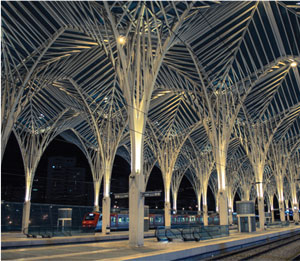
The architectural and engineering firm headed by Santiago Calatrava, the famous Spanish-born engineer and architect, designs creative, now-signature structures. Examples include a gently twisted Malmö, Sweden, skyscraper influenced by the human spine; a portion of the Milwaukee, Wisconsin, art museum with wings that open to the sky to moderate interior illumination; and the Lisbon, Portugal, train station inspired by a palm tree forest.

Calatrava earned a degree in architecture and a doctorate in civil engineering. He has held engineering licenses in the US, such as in Texas and Wisconsin. Calatrava draws, paints, sculpts, and does ceramics. He synthesizes some of his interests with this thought: “I have tried to get close to the frontier between architecture and sculpture and to understand architecture as an art.” And maybe we could replace “architecture” with “engineering,” or add “architecture” to “engineering” based on Calatrava’s engineering-architecture masterpieces. As a Smithsonian article noted, “Being an engineer frees him to make his architecture daring.”
Artist Wendy Crone is a professor in the Department of Engineering Physics at the University of Wisconsin – Madison where she also has appointments in the departments of Biomedical Engineering and Materials Science and Engineering. Crone’s research specialty is solid mechanics, which has connected her to nanotechnology and biotechnology. She does sculpting and pottery and paints with pastels.
In her research, Crone uses microscopy—that is, instrumentation that provides images of objects not visible to the naked eye. She says, “The ability to see detail and attend to subtle changes in images is critical to my engineering research,” and she believes that “these skills are enhanced by my practice of painting.”
As a teacher, Crone uses her art knowledge and skill to prepare visuals that enable students to understand complex concepts. Her art also supports collaboration with professional artists and scientists in preparing presentations, writing articles and papers, and designing museum exhibits.

Stephen Ressler, P.E., professor emeritus for the US Military Academy, works in oil, watercolor, pencil, and pen and ink. He creates mostly landscapes and architectural images.
He says, “doing art has been immensely influential in my development as an engineer and, especially, as an engineering educator.” Ressler describes the benefits of being an engineer-artist as dual-directional.
Doing art helps him be a more effective engineer because now he is more able to develop two-dimensional representations of three-dimensional objects; see details he might otherwise have missed; use sketches to communicate, particularly in design, and on a chalk-board when teaching; compose presentations; and develop three-dimensional computer models.
And doing engineering has made him a more effective artist because he can see and represent three-dimensional objects in two dimensions, see and represent detail, and master perspective drawing methods.
Like some of the preceding, I am an amateur artist working in pencil and acrylic and prefer realism such as landscapes and animals. A decade ago, after a five-decade lapse, I took a one-day freehand pencil drawing course, and enjoyed it. Classes and drawing continued, initially as a diversion but also because I gradually saw intriguing connections between doing art and doing engineering.
Some of my now-learned insights are identical to those already shared, in that, broadly stated, doing engineering enables me to do art, and doing art enables me to be a more effective engineer.
Consider a few more examples of the latter:
The accomplished artist applies rules of composition to draw us in, set a mood, and send a message. We are not sure why, but the human brain tends to respond favorably to classical composition rules traced back to at least the Renaissance. Many of those art rules also rule effective communication by engineers. For example, when designing an image, such as for a slide, put the focus point or principal image off-center, not in the center, though the latter would be a natural tendency.
And the odd-over-even composition rule, when applied to written or visual engineering communication, means favoring an odd number of major points, objects, conclusions, or recommendations.
Too many presentation slides use the format of a statement followed by several to many lines of text, each preceded by a bullet. In light of vision being the most powerful sense and recognizing composition rules, such as create a focus point and use an odd number, why do we make bland, all-text slides? Experience, art, and research indicate that the most effective slides, as determined by audience understanding and remembering, contain a declarative statement and a supporting image.
Benefits and Joys
Because vision dominates our senses, enhanced visual abilities enable engineers to be more effective. By doing—not just studying—one of the visual arts, such as drawing, painting, sculpture, or photography, we develop enhanced observational capabilities. We see what others don’t. Therefore, we more thoroughly define issues, problems, and opportunities and we more creatively resolve them.

Doing art enhances the development and ability of engineers. We see more details; more effectively represent three-dimensional objects with two-dimensional images; compose more-communicative text and images for presentations, published articles, and papers; and produce more creative processes, products, structures, facilities, and systems.
The engineer-art connection also works in the opposite direction. Engaging in engineering equips us to create enjoyable and productive art. Because we readily “see” in three dimensions, we can represent an object in two dimensions, and we understand principles of perspective drawing.
However, please recognize that just as we do some of our engineering for the fun of it, artists do some of their art for pleasure. For me, hours fly by as I enjoyably create images with pencils and paint. If you are not engaging in visual arts, consider exploring it. You may find a new joy—and enhanced engineering capability.
What do you think? Get in touch and share your perspective.
Stuart G. Walesh, Ph.D., P.E., F.NSPE, is an independent consultant-teacher-author providing engineering, leadership, management, and education/training services. His most recent book is Introduction to Creativity and Innovation for Engineers (Pearson 2017). Contact him at [email protected] or visit www.HelpingYouEngineerYourFuture.com.
More Featured Articles
As engineers seek to move up the career ladder toward management and leadership positions, effective communication skills will benefit them greatly. While it is no secret that top managers often demonstrate effective communication, what are the specific skills that engineers need, and where can they go to gain, practice, and maintain these important skills? »
Each year, the Professional Liability Committee of NSPE’s Professional Engineers in Private Practice, in conjunction with the risk management committees of the American Institute of Architects and the American Council of Engineering Companies, conducts a survey and face-to-face interviews with representatives of companies serving the A/E professional liability insurance market. The results and the accompanying directory can help you select the best provider for your firm. »
The Principles and Practice of Engineering Exam is an important part of ensuring the competency of professional engineers sworn to protect the public. But it hasn't always looked the same. The administration, format, and content of the various PE exams have changed over the years. PE looks behind the curtain at past and current transitions. »
Ethical practice is vital for ensuring the public trust in engineering and in its practitioners. To teach professional ethics, some organizations use case-based reasoning, but there is still much to be understood about how professionals learn ethics this way. So, how can professionals ensure that solving ethical dilemmas at work will become second nature? »
The use of drones is becoming more common, with the technology contributing to construction inspections, mapping, and other tasks. Recent easing of user requirements and reduced costs have sped this process. But the unmanned air space is still a “wild west” of sorts. Safely incorporating drones into the national airspace has become a leading issue for government and individuals involved in facilities design and construction, such as professional engineers. »
The licensing and certification of professions and occupations are under increasing scrutiny, as legislators and regulators aim to remove barriers to the free flow of workers. Are the profession’s own longtime challenges, such as communicating the unique role of PE licensure in protecting the public, making the fight against threatening bills and regulations more difficult? »
Professional engineers often have a rare combination of leadership talent, problem-solving abilities, and knowledge of the technical matters that are such a big part of living in modern society. These attributes often shine at the office, but do PEs have a responsibility to also put them to use in their communities? »