

 Registration is open for NSPECon26 in New York City, New York!
 Volunteering at NSPE is a great opportunity to grow your professional network and connect with other leaders in the field.
 Decisions at the ballot box influence policies that support engineering standards and public safety.
January/February 2019
Communities: Government
Training Engineers for Public Involvement: FDOT’s Story
BY RUSTY ENNEMOSER, PH.D, AND MICHAEL GARAU, P.E.
 To ensure the success of any public-sector project, public involvement is instrumental. We’ve seen the negative scenario played out time and time again: controversy erupts, there is public outcry, pressure mounts on local officials, and then the project is shelved indefinitely. As a result, money is wasted that could have been spent on other worthwhile efforts.
The Florida Department of Transportation long ago recognized the need for practicing good public outreach based on this philosophy: early and often. FDOT understood that good outreach maintains good community relations. It helps to gain an understanding of community issues that ultimately can inform how we implement our projects. This leads to less public outcry and project delays.
FDOT prides itself on being a “customer-driven organization”—a phrase that is embedded within the mission and values statement. This emphasis on community outreach has evolved over time and led to the development of a robust, statewide public involvement program that includes guidance materials and specialized training available to all staff and consultants.
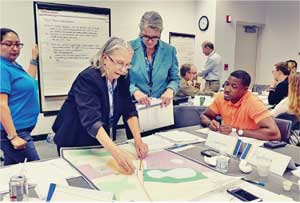
IMPROVING COMMUNITY OUTREACH CAN REDUCE PROJECT DELAYS, FDOT EMPHASIZES. CREDIT: FLORIDA DEPARTMENT OF TRANSPORTATION
The program’s centerpiece is the public involvement training class. This one-and-a-half-day course is offered multiple times throughout the year and rotated around each of the department’s eight district offices. Hundreds of FDOT staff and consultants participate each year. The class covers public involvement throughout the project life cycle (planning, project development, design, construction, and maintenance) and emphasizes building relationships with the communities that would be served by a project or program. It also provides multiple opportunities for hands-on practice.
Sometimes the class is tailored to specific needs; for example, a public involvement course was developed specifically for roundabout projects. As more and more roundabout projects got underway, FDOT noticed that the standard outreach methods were not working. Engineers and planners may understand roundabouts, but it was quickly evident that the public did not understand the concept or how they worked. The special class covered specific educational and engagement techniques for discussing roundabouts, and offered a dedicated roundabout website with resources.
Lessons Learned
Regardless of the type of training, a few fundamental lessons are incorporated into each class.
Plan ahead. Advance planning starts by understanding the project context and how it fits into the community. This helps to tailor the outreach to the context.
Identify stakeholders. What are the demographics? Are you primarily impacting residents, businesses, or both? If a sizable percentage of the community is transit-dependent, then public meetings should be held in a location accessible by transit.
Understand key federal, state, and DOT requirements. Florida laws specify which projects need a public hearing as well as advertising requirements. Failure to follow those laws could lead to legal challenges that could undo years of time and effort.
Incorporate education. We can assume that most people understand the concept of a signalized intersection or an expressway, but not many have ever heard of a diverging diamond interchange. For this reason, education needs to be blended into outreach.
There is no mechanism for tracking how investment in public outreach saves money by reducing project delays, but it is clear that these investments do pay off and lead to better results. FDOT sees the value in these efforts and will continue to emphasize the need for public outreach in all aspects of its program.
Rusty Ennemoser, Ph.D., serves as the Florida Department of Transportation’s statewide public involvement and community resources coordinator. Based in Tallahassee, she is the lead facilitator for the department’s public involvement training course. Michael Garau, P.E., is a civil engineer with Kimley-Horn and Associates Inc., based in Orlando. He serves as a co-trainer for FDOT’s public involvement training course.
More PE Community: Government Articles
March/April 2018