

 Registration is open for NSPECon26 in New York City, New York!
 Volunteering at NSPE is a great opportunity to grow your professional network and connect with other leaders in the field.
 Decisions at the ballot box influence policies that support engineering standards and public safety.
November/December 2018
Communities: Government
Green Infrastructure Gains Followers as Waters Rise
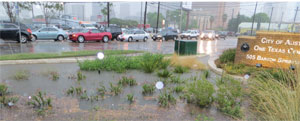 A RAIN GARDEN BUILT BY THE CITY OF AUSTIN TREATS PARKING LOT RUNOFF AT AN OFFICE CAMPUS. CITY OF AUSTIN
Flooding has grabbed national headlines following recent hurricanes, but it’s not just an issue during severe weather. Flooding can be a challenge year-round, especially in light of changing weather patterns. Solutions will likely be multifaceted—but among the tools available is green infrastructure. The strategy is receiving growing attention, as is its integration with more traditional stormwater management solutions.
Shortly after Hurricane Harvey last year, University of Georgia civil and environmental engineering professor Brian Bledsoe, P.E., authored a Washington Post article, “We Still Don’t Know How to Talk About Floods.” It explained that “flood hazards are moving targets,” as the rain patterns, urban footprint, and drainage systems evolve. Bledsoe emphasized investment in hybrid systems of traditional “gray” infrastructure, natural “green” infrastructure, and solutions such as insurance reform, zoning, buyout, and relocation.
Bledsoe is the director of the Institute for Resilient Infrastructure Systems at UGA, which brings together disciplines to understand how green and conventional infrastructure can work together to provide economic, social, and environmental benefits.
Green infrastructure can include strategies such as green roofs, rain gardens, and bioswales. But Bledsoe, in a phone interview, offered an expansive definition that incorporates other natural elements, such as reconnecting a floodplain through stream restoration.
In addition to reducing flooding, he points out, green infrastructure can provide water quality, aesthetic, and health benefits. But it’s not a panacea. For instance, during intense rainfall, natural features can get saturated and generate runoff. More work is needed, Bledsoe says, to understand factors such as performance during different event intensities, drainage area size, and the need for drying between events.
The PE is working on a project through the Water Research Foundation to develop an online tool that can help communities make stormwater infrastructure decisions and compare green, gray, and hybrid infrastructure.
As Bledsoe points out, although use of green infrastructure is growing, it’s “not necessarily in an intentional or strategic way,” and design criteria and performance data are still lacking. People still tend to “default to the familiar,” he notes. Improved communication and quantifying benefits are important.
“Something we’ve known for a long time as engineers is that you can have the most elegant technical solution to a problem,” Bledsoe says, “but if you can’t communicate it effectively to the various stakeholders and have the technical solution adopted within the broader social and political context, then it doesn’t matter how great a technical solution is.”
Michael Kelly, P.E., is the managing engineer in the Watershed Protection Department for the City of Austin. He’s spent about the last seven years studying what Austin calls green stormwater infrastructure—“stormwater management practices that use landscape features and engineered systems to mimic natural processes, thereby improving the quantity and quality of runoff.”
The city conducted a study to determine the ability of GSI to reduce floods. It found that, combined with traditional approaches used strategically, GSI could increase the capacity of drainage systems from a two-year storm to a 10-year storm.
Learn More
However, in the city known as “flash flood alley,” reaching the 100-year level of service would require very large facilities. So, Kelly says, the city has determined that green stormwater infrastructure is best suited for smaller storms and water quality benefits. “You can’t green stormwater infrastructure your way out of Austin, Texas’s flood issues,” he says. Too many houses are too deep in the floodplain, necessitating buyouts.
Kelly warns against jumping on the green infrastructure bandwagon too quickly. Critical are quantifiable stormwater management goals, research and calculations comparing costs and benefits with traditional methods, and proper methods and experienced personnel for construction and maintenance.
While green solutions are visually pleasing and may seem relatively simple, Kelly says, these stormwater management systems are “engineered systems largely and their performance should be measured by engineering standards.”
More PE Community: Government Articles

March/April 2018