September/October 2017
You Said It
No longer is the letter to the editor the only way NSPE members can share their views with others. Take a look, and join the conversation.
Nurture and Support
I picked up your magazine for March/April 2017 that somebody had left on a plane, and found it quite interesting. I had a comment about the “All for One...” article.
Very good article, but too many business owners ignore the obvious benefits of engaging the employees with the work.
I was on the board of a $400 million credit union years ago, and advocated for more sensitivity on the part of management of the employees.
One suggestion I made, which I think is aligned with the philosophy of the article, is to reinvent the organization chart. Most org charts have the CEO at the top, the VPs in a layer below that, managers in the layer below that, and the workers at the bottom. That design fits the “command and control” management paradigm.
But instead, if the org chart has the CEO at the bottom, the diagram shows that the CEO is supporting the layer of VPs above him, and those VPs are supporting the managers above them, etc. That design fits the “nurture and support” management paradigm.
Something as simple as changing the org chart can cause people to think differently about how they relate to the organization, which is the first step in creating a positive culture in an organization.
Paul Kinzelman
Peralta, NM
The book Citizen Engineer and the engineer’s role in community service and public policy were recently the subject of a thread in the Open Forum of NSPE’s online Communities.
The Citizen Engineer
As an educator in a relatively new engineering program, I have the privilege of teaching Citizen Engineer as a required part of our fourth-year mechanical engineering curriculum. In it, I try to integrate ethics and politics with technical content around the themes of sustainable development and social justice. The course pairs with “Professional Engineer,” which covers economics, professional practice, and preparation for taking the FE exam. Through both courses I try to instill in my students an awareness of engineering as a means for achieving moral and political ends. Although we may disagree on what those ends may be, we have institutions and processes through which the debates play out; and we have an obligation, as citizens and professionals, to be part of them.
My initiation into the idea of the citizen engineer came from my undergraduate engineering education at University of Virginia (to which I returned later to study government and foreign affairs). In accord with its founder Thomas Jefferson’s vision of the liberally educated citizen as integral to the survival of a republic, even engineering education was infused with philosophy, history, and ethics; I came away with a strong sense that engineering could not be divorced from values and purposes to which it is directed. For every artifact made by an engineer, every act of engineering says something about who we are, what we value, our conceptions of the good life.
I would welcome opportunities to help fellow NSPE members and officers raise the visibility of our profession in the political process. Thanks to our past and current NSPE presidents for keeping this goal on our agenda.
Steven Collins, P.E.
Bothell, WA
We live in a highly technological world too many of whose people are unable to understand enough science to be good citizens. We, as engineers, especially as professional engineers, must do what we can to compensate for the failure of this country to suitably educate its people in those things they should know to be able to properly react to technical realities. Doing so is not easy because not enough of us are participating. This would be a far better world if more PEs got involved. If even just the members of NSPE got involved there would be a major positive effect.
Neil Yeoman, P.E.
Merrick, NY
NSPE members: Join the conversation today.
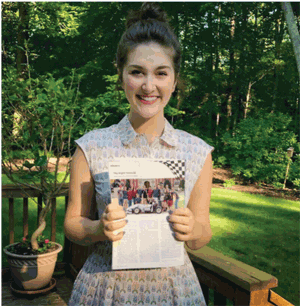
sarahciccaglione Check me and my team out in the National Society of Professional Engineers May/June issue #womeninengineering
gillybunny17 YOU ARE BEAUTIFUL AND SMART!!! 
Don’t miss out on the discussion in NSPE’s online Communities for professional engineers. Engage with your peers on issues of professional importance. Visit https://community.nspe.org.
Join the Conversation
There’s no shortage of ways to connect with the Society as well as other members. NSPE’s Communities, Twitter, Facebook, LinkedIn, and Instagram all help you make that connection. Or you can write a letter or send an e-mail to the address below.
On this page, we’ll show you some highlights of what people are saying. Keep in mind, however, that the views expressed are those of the author and do not necessarily represent the views of and should not be attributable to the National Society of Professional Engineers.
Share Your PE Experience with NSPE


 Registration is open for NSPECon26 in New York City, New York!
 Volunteering at NSPE is a great opportunity to grow your professional network and connect with other leaders in the field.
 Decisions at the ballot box influence policies that support engineering standards and public safety.