Registration is open for NSPECon26 in New York City, New York!
 Volunteering at NSPE is a great opportunity to grow your professional network and connect with other leaders in the field.
 Decisions at the ballot box influence policies that support engineering standards and public safety.
November 2014
COMMUNITIES: GOVERNMENT
Engineering the Peace
The National Academy of Engineering and the United States Institute of Peace are working to bring technological solutions to conflict zones.
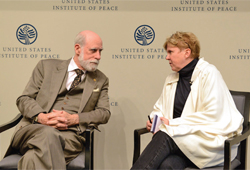 VINT CERF, ONE OF THE FATHERS OF THE INTERNET, AND JANE HOLL LUTE, FORMER DEPUTY SECRETARY OF HOMELAND SECURITY, AT THE PEACETECH SUMMIT IN SEPTEMBER.
Engineering is often thought of in terms of inanimate objects, like bridges, iPhones, and space shuttles. But the field actually has a very human side, offering solutions to human problems. So explained C.D. (Dan) Mote, president of the National Academy of Engineering, at the PeaceTech Summit in September.
The summit, subtitled “Engineering Durable Peace,” was cosponsored by the NAE and the United States Institute of Peace, two independent organizations founded by acts of Congress. The event brought together government officials, nongovernmental organization (NGO) leaders, engineers, technologists, and others to examine the use of technology in conflict zones.
As Mote described, although engineering and science have not traditionally been thought of as tools for building peace, they can’t be avoided in the process. They help make peacebuilding “a more strategic and systematic enterprise,” he said.
The NAE has been collaborating with the USIP since 2008, when the two organizations held a joint workshop on IT communication technologies and their applications in peacebuilding. Out of that came the Roundtable on Technology, Science, and Peacebuilding, “an alliance of government agencies, corporations, international organizations, NGOs, and academic leaders pursuing technology applications that support the peacebuilding agenda.” Launched in 2011, it meets twice a year and is cochaired by Mote and the president of the USIP.
The roundtable has sponsored workshops and subsequent reports on subjects such as “Using Data Sharing to Improve Coordination in Peacebuilding” and “Harnessing Operational Systems Engineering to Support Peacebuilding.”
According to Proctor Reid, the NAE’s director of programs, bringing the engineering and peacebuilding communities together can help engineers understand the social, political, and cultural dimensions of the problems that their tools can assist with.
Thus far, the workshops, as well as much of the September summit, have been largely focused on information technology. For example, presentations at the summit included ways in which text messaging and geographic information systems are being used to promote peace.
And the new PeaceTech Lab, also launched at the summit, is initially focusing on IT communications. This new USIP effort will be a first-of-its-kind collaborative facility. It will bring technology and conflict management experts together with PeaceTech fellows from conflict zones, focusing on technology, media, and data solutions.
But Reid says that the academy is serving in an advisory role on the lab and hopes to help expand other engineering applications. Issues such as access to water resources can be drivers of conflict, he explains; technology such as satellite imaging can aid in finding and allocating water resources and desalination can provide for clean water in areas where there are shortages.
Reid explains that the NAE would also like to find ways to support the involvement of engineering educators and graduate students in the lab.
Although peacebuilding is not specifically mentioned in the academy’s list of Grand Challenges engineering will need to solve in the 21st century, he notes that the issue “is certainly touched by any number of the challenges, be they related to health, sustainability, security, [or] resilience.”
Retired Lieutenant General Henry “Hank” Hatch, P.E., former Chief of Engineers for the Army Corps of Engineers, attended the summit and says that although many of the presentations focused on information technology, the broader application of technology in the pursuit of enduring peace involves engineering.
This pursuit, Hatch says, includes the building of human, institutional, and infrastructure capacity to help develop stable societies that can flourish. “I firmly believe that engineers are essential for capacity building in the developing world and in failed and failing states,” says Hatch. “I often say that the keys to enduring peace are security, stability, and sustainability.”
As Reid puts it when asked why it’s important for engineering to be a part of the PeaceTech efforts: “I would ask, ‘How could engineering not be involved in this?’ It’s an area, with its societal problems and challenges, that cries out for the involvement of those with the skills and knowledge and capabilities that engineers are equipped with.”
Additional Information
Roundtable on Technology, Science, and Peacebuilding: www.usip.org/publications/roundtable-technology-science-and-peacebuildi…
PeaceTech Summit: www.usip.org/events/peacetech-summit-engineering-durable-peace
PeaceTech Lab: www.usip.org/programs/projects/the-peacetech-lab