Registration is open for NSPECon26 in New York City, New York!
 Volunteering at NSPE is a great opportunity to grow your professional network and connect with other leaders in the field.
 Decisions at the ballot box influence policies that support engineering standards and public safety.
May/June 2017
Communities: Education
Social Media Comes to USC Classroom
Can you summarize your work in a 140-character tweet? It’s not a typical engineering class assignment, but it’s one that students will soon face in a Viterbi School of Engineering course.
“Social Media for Scientists and Engineers,” launching this fall in the University of Southern California’s engineering school, will examine the evolving role of social media and online communities in how engineers and scientists engage with each other and outside audiences.
The course will be part of the Engineering Writing Program, created in 1998 to respond to the growing need for engineers to develop skills in communicating with colleagues in other disciplines and the public.
 Social media and digital communications platforms are “really the future of how all of us are going to be interacting.”
—Instructor Sarah Mojarad
Bringing together students from various disciplines is an important aspect of the class, says instructor Sarah Mojarad, a lecturer with a master’s in corporate and organizational communications with a concentration in social media and online communities. “You get them communicating with one another, and ideas can come from that,” she explains. “People can understand the differences and similarities in their fields. I really like that component of it.”
Mojarad had previously co-taught a similar “Social Media for Scientists” course at the California Institute of Technology; registration for that class filled up within four minutes last fall.
“Social Media for Scientists and Engineers” will examine case studies for issues of ethics, privacy, reputation management, ownership, and the law. Mojarad points out that the class doesn’t focus on the mechanics of social media, which students are likely already adept in.
The course may provide new challenges for students, she notes. Engineers and scientists are used to being asked for one solution, but in this class, no one answer exists. Instead, case studies will draw out discussion.
For example, Mojarad has used a case study about the 2014 Elk River chemical spill in West Virginia to examine the issue of trust. Information about the safety of water was inconsistent, and it was revealed that authorities withheld details from the public. Students examined an event timeline to determine where the breakdown of trust occurred and were asked in class discussion what they would have done differently.
Another case study focused on an incident with reality TV star and businesswoman Kim Kardashian West. She had promoted a morning sickness medication on Instagram, having partnered with the company; however, the Food and Drug Administration asked her to remove the information because she hadn’t included the risks. The law has now changed to make it more clear when a celebrity is posting a paid ad on social media, Mojarad explains.
As the law and technology change, the course will need to evolve, too, she says.
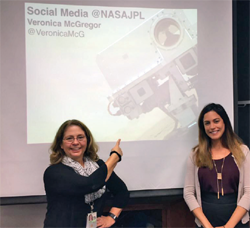
In addition, guest lecturers will share their insights. Guests in Mojarad’s “Social Media for Scientists” course have included the head of social media at NASA’s Jet Propulsion Laboratory and the director of analytics at Facebook.
Among the skills she hopes students gain from the class: avoidance of jargon. As students become more technically adept, jargon begins to dominate, she says, so students need to unlearn its use to communicate with a broad audience.
The class will also teach students to develop skills in personal branding and ensure the professionalism of their online presence. One activity pairs classmates to edit personal statements they then use on their social media accounts.
For her class at the Viterbi School, Mojarad plans to further develop a section on combatting misinformation, which can be a challenge on social media platforms. And she is interested in examining additional technology, such as augmented and virtual reality, and what those technologies can do for communication and collaboration among engineers and scientists.
Mojarad is working on a book and has presented at institutions including the National Science Board, the Department of State, and universities around the world.
Technically trained people should be able to communicate effectively on social media and digital communications platforms, she says. These technologies are “really the future of how all of us are going to be interacting.”