

 Registration is open for NSPECon26 in New York City, New York!
 Volunteering at NSPE is a great opportunity to grow your professional network and connect with other leaders in the field.
 Decisions at the ballot box influence policies that support engineering standards and public safety.
July/August 2018
Communities: Education
Tennessee Licensing Board Invests in Future PEs
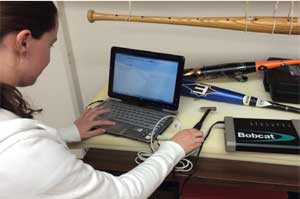 DATA ACQUISITION EQUIPMENT PURCHASED WITH TENNESSEE LICENSING BOARD FUNDS HELPS STUDENTS AT LIPSCOMB UNIVERSITY CAPTURE VIBRATION DATA THAT CAN, FOR EXAMPLE, DETERMINE THE “SWEET SPOT” FOR BASEBALL BATS.
Among the stories of government budgets stretched to the breaking point, there’s a rare bit of good news in Tennessee. For more than 15 years, the state’s Board of Architectural and Engineering Examiners has been reinvesting surplus funds into the education of the next generation. A portion of each licensing fee paid goes into grants for accredited programs in engineering, architecture, landscape architecture, and interior design.
Grants committee chair Susan Ballard explains that the money helps students learn about the board, and promotes licensing in the state. “It feeds back to, ‘The state of Tennessee gives me money. I want to be registered here because they care about education, and they care about students.’”
In 2017, the allotments ranged from $3,000, to the O’More College of Design’s School of Interior Design for a desktop laser cutter, to more than $33,000, to Tennessee Technological University’s College of Engineering for furniture, computer equipment, networks for Internet access, and work benches for a student design center.
Institutions can submit proposals for needed equipment, computers, library resources, or funds for intern development. The grants can also go toward the payment of fees for exams such as the Fundamentals of Engineering Exam.
Lipscomb University, a private school in Nashville, received $12,777 last year; part of the money went into FE exam fees. Dean Justin Myrick explains that the College of Engineering requires students to take the exam to graduate, although not to pass it.
“We think it’s that important that we pay for it,” he says, and the grant money has allowed the school to continue to do so despite increasing costs. “It certainly allows us to promote and encourage students to get their PE,” Myrick continues. “It’s good for the profession.”
Since 2002, the board has awarded more than $3 million to public and private institutions. Recipients later give the board a presentation on how they’ve used the funds. “We’re not just handing out money,” says Ballard. “We want to see what the results are.”
She believes the program could be a model for other states. In Oklahoma, the state licensing board is in the planning stages of a program to provide scholarships to engineering and surveying students.
More PE Community: Education Articles
July/August 2018
January/February 2018
September/October 2017