Registration is open for NSPECon26 in New York City, New York!
 Volunteering at NSPE is a great opportunity to grow your professional network and connect with other leaders in the field.
 Decisions at the ballot box influence policies that support engineering standards and public safety.
The NSPE Code of Ethics (the Code) has developed to its current form over decades as the engineering profession defined what responsible practice required, both in principle and in application. The Code became a record of how professional engineers understood their obligations to clients, employers, the public, and one another. Its history shows that professional engineering ethics has never been static; it has been continually refined to reflect the demands of professional judgment, public protection, and lawful practice.
Early Efforts to Define Engineering Ethics
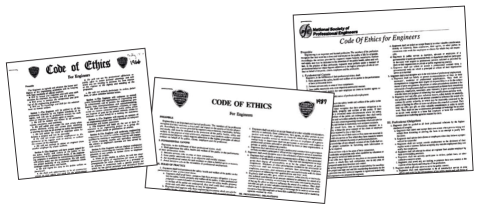
The earliest known reference to a consolidated code of professional engineering ethics appeared in May 1935, when The American Engineer published a suggested code for consideration by its membership.1 Whether that draft was formally adopted remains unclear, but it marked the beginning of a serious effort to define ethical engineering practice. A more meaningful foundation came in 1946, when the NSPE Board of Directors (the NSPE Board) approved the Canons of Ethics for Engineers, a short set of ethical principles prepared by a joint committee sponsored by the Engineers’ Council for Professional Development.2 The Canons of Ethics for Engineers were published in January 1947 and became the starting point for the modern Code.
Following publication of the Canons of Ethics for Engineers, the NSPE Board moved steadily toward greater specificity: revised canons were circulated to state societies in 1948, 15 Rules of Ethical Conduct were adopted in 1952, and Rules of Professional Conduct followed in 1957.3 By July 1964, NSPE replaced the earlier canons and rules with a formal Code.4 The progression from broad canons to a more unified Code reflected the profession’s growing recognition that ethical duties had to be stated with enough precision to guide actual practice.
The Code also developed alongside a mechanism for its interpretation. In 1954, NSPE established the Board of Ethical Review (BER) to examine hypothetical cases and provide guidance on ethical obligations under the Code.5 This function remains central to understanding the Code’s history. The Code establishes the guiding principles for professional engineering as determined by NSPE, and the BER has long supplied reasoning about how those guiding principles apply in practice. That relationship became particularly important as the Code was revised in response to changing business practices and legal developments.
Revision and Expansion in the 1960s and 1970s
During the 1960s and 1970s, NSPE repeatedly revised the Code. Amendments addressed competitive bidding, contingent contracts, advertising, criticism of another engineer’s work, conflicts of interest, and participation in strikes.6 Of particular note is the evolution of competitive bidding provisions within the Code. In 1961, the Board revised the Rules of Professional Conduct dealing with competitive bidding and proposals.7 After the formal adoption of the Code in 1964, § 11(c), the provision addressing competitive bidding, underwent further refinement.8 In 1966, the NSPE Board approved a change in § 11(c) that applied the competitive bidding provisions to the procurement of other professionals’ services and permitted the submission of tenders for work in foreign countries when required by that country’s laws, regulations, or practices.9
The legality of § 11(c) was put to the test in 1978, when the ban on competitive bidding was challenged as an unlawful restraint of trade under § 1 of the Sherman Act.10 In brief, NSPE argued that the restriction protected the public because price competition could lead engineers to cut corners, reduce quality, and compromise safety.11 The Supreme Court of the United States SCOTUS rejected that defense and held that the Sherman Act does not permit a professional association to restrict competition on the theory that competition itself is contrary to the public interest.12 However strongly NSPE believed that fee competition could impair quality, (SCOTUS) concluded that those concerns had to be addressed through lawful standards and regulation, not through private restraints on the market.13 Following the SCOTUS opinion in National Society of Professional Engineers v. United States, NSPE revised the Code by removing the competitive bidding portions. Specifically, § 11(c) was deleted and § 11 was altered to delete the words "by competitive bidding" in the first paragraph of the section.14 Around the same time,15 a statement by the NSPE Executive Committee was also added to address SCOTUS’s decision in National Society of Professional Engineers v. United States.
Advertising Restrictions and FTC Intervention
Advertising provisions produced a similar conflict. Over the years, the Code had included provisions that stated, in part, that engineers should refrain from making statements that contain an opinion as to the quality of the engineers’ services and should not employ advertising that was intended to attract clients by the use of showmanship, puffery or self-laudation or the use of slogans, jingles or sensational language or format.16 In 1993, the Federal Trade Commission (FTC) gave final approval to a consent agreement with NSPE, settling charges that it restricted certain types of truthful advertising by its members.17 The consent agreement prohibited NSPE from restricting truthful and nondeceptive advertising by its members or from encouraging or inducing any non-governmental person from engaging in any practice that would violate the FTC consent agreement.18 Following the 1993 FTC consent agreement, the NSPE Board deleted the restrictive language from § III.3.a. of the Code.19
In connection with the 1993 revisions, the BER revoked BER Cases 81-5 and 84-2, two opinions that treated aggressive advertising as inconsistent with the Code. Subsequent BER opinions took a different approach. Rather than asking whether a communication was undignified or overly promotional, the analysis turned to whether it was truthful, non-misleading, and consistent with state licensure requirements. BER Case 04-11 explained that advertising questions must now be evaluated with caution in light of commercial free speech and antitrust principles, and it identified two governing considerations: whether the advertising is truthful and not misleading, and whether it complies with applicable state registration laws. BER Case 16-6 carried the same approach forward.
Modern Revisions to the Code
In the decades that followed, the Code continued to evolve, though not always because of enforcement actions. In 1996, NSPE added a new Fundamental Canon addressing honorable and responsible conduct.20 In 2001, an old anti-strike provision was removed.21 In 2002, the Code added language providing that professional engineers shall not aid or abet the unlawful practice of engineering by a person or firm.22 In 2003, NSPE made continuing professional development an explicit ethical obligation, later repositioning that duty in 2018 within the Code’s public-interest provisions.23 These changes signaled that professional ethics was understood to include maintaining competence, strengthening judgment, and preserving the profession’s credibility over the course of an entire career, rather than avoiding misconduct.
The same pattern appears in the Code’s more recent modernization. In 2006, NSPE added language encouraging engineers to adhere to the principles of sustainable development in order to protect the environment for future generations, and in 2007 the House of Delegates refined that language and placed it within a broader public-interest framework.24 In 2019, NSPE added § III.1.f., providing that engineers shall treat all persons with dignity, respect, fairness, and without discrimination. Those changes represent the profession’s affirmative effort to expand the ethical vocabulary of engineering, and to recognize that environmental stewardship, professional development, and respectful treatment of others are not peripheral concerns, but part of what the public now expects from professional practice.
Conclusion
The history of the NSPE Code is therefore best understood not as a sequence of edits, but as a record of professional self-definition. Some revisions came from within, as professional engineers reconsidered what honor, competence, and public service required in changing circumstances. Others came from outside, when courts and regulators made clear that certain ethical restrictions would run afoul of other statutory requirements.
Through both kinds of change, the Code has remained anchored to a central premise: professional engineering is a public-serving profession, and its members bear obligations that extend beyond technical performance alone. That is why the Code endures. Its language has changed but its function has remained the same: to express, in evolving form, what is demanded of licensed professional engineers.

Spencer Rojas is an attorney with Taft Stettinius & Hollister LLP. Rojas is based in the firm’s Minneapolis office.

Kodi J. Verhalen, ESQ., P.E., F.NSPE, is a partner in Taft’s Energy Practice Group, focusing her practice on a wide variety of electric and natural gas regulatory matters.
More On Ethics Articles

Every morning, millions of children reach for a phone before their feet hit the floor.

Citicorp Center Lessons: Engineering Innovation, Risk Discovery, and Ethical Reflection

A review of the US Supreme Court opinion in National Society of Professional Engineers v.

Given recent legal and regulatory changes, professional engineers face a complex landscape impacting their professional responsibilities and ethical obligations.


Spring 2023