Registration is open for NSPECon26 in New York City, New York!
 Volunteering at NSPE is a great opportunity to grow your professional network and connect with other leaders in the field.
 Decisions at the ballot box influence policies that support engineering standards and public safety.
Citicorp Center Lessons: Engineering Innovation, Risk Discovery, and Ethical Reflection
Complex structures can present ethical issues that are not fully recognized until after construction and occupancy. The Citicorp Center is a frequently cited example because it involved an unconventional structural configuration, a post-occupancy reassessment of wind effects and connection detailing, and an accelerated repair program.1 In the shadow of the public disclosures of the concerns experienced with the Citicorp Center, NSPE’s Board of Ethical Review (BER) Case 98-9: Duty to Report Unsafe Conditions/Client Request for Secrecy, considered a hypothetical case addressing how the NSPE Code of Ethics (the Code) applies when a professional engineer must balance the safety of the public and client-driven secrecy.
Site Constraints, Structural Innovation, and Discovery of the Vulnerability
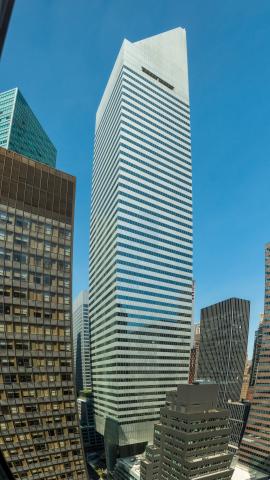
The Citicorp Center’s distinctive design grew out of a real-estate negotiation with St. Peter’s Lutheran Church (St. Peter’s), which occupied the northwest corner of the project site. In exchange for granting Citicorp air rights above St. Peter’s land, Citicorp Center’s commercial real estate broker, Julien J. Studley Inc., agreed to build St. Peter’s a new freestanding church structure.2 The result was Citicorp Center, located in the Manhattan area of New York City, a 59-story tower supported on four nine-story columns placed at the midpoints of each face rather than at the typical corner locations.
To transfer gravity and lateral loads from the facade inward to those columns, structural engineer William LeMessurier (LeMessurier) designed a system of chevron-style diagonal bracing on all faces.3 The arrangement distributed loads efficiently and supported the dramatic overhangs created to accommodate the church below.4 Additionally, the tower included a first-of-its-kind tuned mass damper at the roof level—a 400-ton mass designed to reduce wind-induced motion.5
Citicorp Center was completed in late 1977, and initially, the building performed well under expected loads.6 In June 1978, however, questions arose when student inquiries prompted a reassessment of the tower’s wind response.7 The inquiry focused on winds striking the building at roughly 45 degrees to its faces (quartering winds), which the engineering student’s calculations suggested quartering winds could result in failure of building structural components.8
LeMessurier revisited wind loading and found that the stress in certain structural members increased by approximately 40% under quartering winds compared to design assumptions.9 Crucially, he also learned that connection details had differed from original specifications: some diagonal brace joints that were designed to be full-penetration welds had been substituted with bolted connections, reducing joint strength.10 This combination produced a scenario where the structure’s ability to resist lateral forces was materially lower than intended.
Engineering Response Under Occupancy
Confronted with the possibility of structural collapse under certain wind conditions, LeMessurier and his team faced immediate ethical questions. A full retrofit was technically straightforward; however, the challenge was executing this fix while occupying tenants remained in the building.
Over the summer of 1978, LeMessurier mobilized a confidential strengthening program involving multiple stakeholders, including Citicorp leadership, design and construction professionals, city building officials, insurers, and emergency planners.11 Repairs were staged at night; interior finishes were removed and replaced around each joint so tenants would not be displaced during the day.12 Comprehensive emergency response plans were also developed in the event of an high-wind event.13 During the repairs, Hurricane Ella threatened New York City and the repair efforts, but the hurricane did not make landfall.14
The repair effort was deliberately kept out of public view, in part to avoid unnecessary panic. Because few severe storms struck during the retrofit window, the work progressed to completion without incident, and the building was later understood to be structurally stronger than its original design. The entire episode remained largely unknown to the public until 1995, when a detailed narrative appeared in The New Yorker.15
Ethical Question Analysis and BER Case 98-9
The Citicorp Center events described above are often studied in engineering ethics because it illustrates how high technical competence intersects with decisions about communication, confidentiality, and public safety.
The BER examined similar considerations through the lens of the hypothetical set of facts in BER Case 98-9. In BER Case 98-9 Engineer A discovered an omission in a large commercial building’s design that could result in collapse under severe, but not unusual wind conditions. Engineer A informed the client and design team, and together they planned remedial construction that would be completed in a few months. During the interim, a storm-monitoring system and evacuation plan were drafted to mitigate risk. At the same time, the client requested secrecy and proposed conducting repairs at night to avoid public alarm. Engineer B, the city engineer, had concern for the public well-being, but the architect and the client maintained that the possibility of causing public panic resulting from any notification outweighed any duty to notify the public of the potential risk.
The questions presented to the BER were: (1) was it ethical for Engineer A, the structural engineer, to comply with the client’s and the architect’s desire for secrecy; and (2) was it ethical for Engineer B, the city engineer, to maintain the secrecy?
The BER framed the conflict as a tension between confidentiality and the Code’s core responsibility to "hold paramount the safety, health, and welfare of the public," as well as an obligation to report to appropriate authorities when judgment is overruled in conditions endangering life or property. In weighing these obligations, the BER concluded that it was not ethical for the structural engineer to comply with the desire of the client and the architect for secrecy. Further, it was not ethical for the Engineer B, the city engineer, to agree to maintain the secrecy.
In determining that it was unethical for Engineer A not to report the safety violations to the appropriate public authorities, the BER first noted that the facts presented raised a conflict between two basic ethical obligations of an engineer: The obligation of the engineer to be faithful to the client and not to disclose confidential information concerning the business affairs of a client without that client’s consent, and the obligation of the engineer to hold paramount the public health and safety. In its discussion, the BER noted that Code Section III.4 can be clearly understood to mean that an engineer has an ethical obligation not to disclose confidential information concerning the business affairs of any present client without the consent of that client. However, the BER went on to conclude the primary obligation of the engineer is to protect the safety, health, property, and welfare of the public. The obligation of the engineer to refrain from revealing confidential information, data, facts concerning the business affairs of the client without consent of the client is a significant ethical obligation. The BER plainly stated that "matters of public health and safety must take precedence."
Although the BER acknowledged that avoiding panic may be a legitimate consideration, it found that maintaining secrecy while occupants and surrounding areas remain exposed for months, protected only by an untested evacuation plan, is not an acceptable substitute for public protection. The BER indicated Engineer A should have advised the client and architect that, notwithstanding confidentiality, the engineer must ensure the public is protected and must notify appropriate authorities unless the client and architect promptly implement an effective notification plan (potentially with public relations and legal support). The BER further noted that, given the magnitude of the hazard, both Engineer A and Engineer B were expected to vigorously advocate for public protection and notification to higher authorities.
An Engineer’s Obligations Extend Beyond Technical Remediation
Although BER Case 98-9 is not a direct account of Citicorp Center, the Citicorp Center example and BER Case 98-9 converge on a practical point: when an occupied facility may be exposed to unacceptable risk during a repair window, an engineer’s obligations extend beyond technical remediation. The Code recognizes confidentiality as an important duty, but it does not permit secrecy to substitute for public protection where life and property may be endangered. BER’s analysis highlights the expectation that engineers press for appropriate notification and, if necessary, escalation to higher authorities.
1See Eugene Kremer, 2002, Reexamining the Citicorp Case: Ethical Paragon or Chimera, at 2-4, Cross Currents, https://stuckeyinsurance.com/wp-content/uploads/2014/01/Citicorp-re-examining-the-case.pdf.
22Matthew Postal, 2016, Citicorp Center (now 601 Lexington Avenue) Including Saint Peter’s Church, at 5, New York City Landmarks Preservation Commission, https://s-media.nyc.gov/agencies/lpc/lp/2582.pdf.
3Caroline Whitbeck, Eric Plosky, 2006, William LeMessurier - The Fifty-Nine-Story Crisis: A Lesson in Professional Behavior, at Parts 2-4, Online Ethics Center, https://onlineethics.org/cases/william-lemessurier-fifty-ninestory-crisis-lesson-professional-behavior.
4 Id.
5 Id.
6 Supra n.1 at 2.
7 There are differing accounts as to whether it was one or two students who inquired about the quartering winds issue. See supra n.3 at Addendum; Lee DeCarolis, Citicorp Building: Who Was the Mystery Student?, Online Ethics Center, https://onlineethics.org/node/41606.
8Id.
9Supra n.3 at Parts 4-5.
10Id.
11Id. at Parts 6-7.
12Id.
13Id. at Part 7.
14Id.
15Joe Morgenstern, 1995, The Fifty-Nine-Story Crisis, The New Yorker, https://www newyorker.com/magazine/1995/05/29/the-fifty-nine-story-crisis-citicorp-center.

Spencer Rojas is an attorney with Taft Stettinius & Hollister LLP. Rojas is based in the firm’s Minneapolis office.
Kodi J. Verhalen, ESQ., P.E., F.NSPE, is a partner in Taft’s Energy Practice Group, focusing her practice on a wide variety of electric and natural gas regulatory matters.
More On Ethics Articles

A review of the US Supreme Court opinion in National Society of Professional Engineers v.
Given recent legal and regulatory changes, professional engineers face a complex landscape impacting their professional responsibilities and ethical obligations.



Spring 2023