

 Registration is open for NSPECon26 in New York City, New York!
 Volunteering at NSPE is a great opportunity to grow your professional network and connect with other leaders in the field.
 Decisions at the ballot box influence policies that support engineering standards and public safety.
On May 11, 1926, 14 design professionals gathered at the Schnorer Club in the Bronx, a borough of New York City, and took part in reshaping the engineering profession. The meeting, attended by NSPE founder David B. Steinman, P.E., led to the creation of the New York State Society of Professional Engineers (NYSSPE), paving the way for the advancement of professional accountability and public safety nationwide.
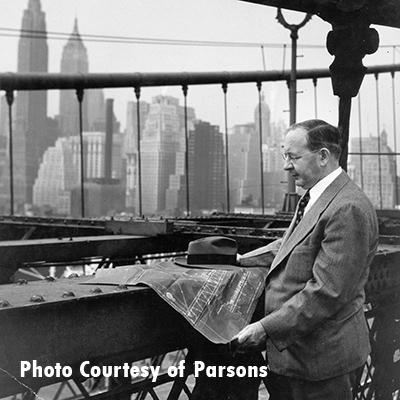
A century later, NYSSPE continues its work for the betterment of the engineering profession and represents the interests of more than 25,000 engineering licensees, of all disciplines, in New York.
“The current board and members of the NYSSPE continue to be inspired by David Steinman’s vision and are proud to advocate for upholding the integrity of the PE license and the protection of the public health, safety and welfare,” says NYSSPE President David Macedonio, P.E.
Recognition of David B. Steinman’s legacy—and of the iconic Brooklyn Bridge—will be a highlight of NSPECon26, NSPE’s annual conference taking place in New York City. On the evening of August 5 (PE Day), conference attendees will take a guided walk across the bridge for a centennial plaque dedication honoring Steinman. Armand Gilinsky, the grandson of Steinman, is elated that his grandfather's contributions will get this recognition. His mother, Alberta Steinman Gilinsky, is the daughter of David Steinman.
Gilinsky was a young boy when his grandfather passed away, yet he left a lasting impression that has guided Gilinsky throughout his life. "I certainly looked up to him in more ways than I can count," he says. "I’m so honored to be part of anything that celebrates grandpa and also celebrates the future generation of people who make it possible for people to live through engineering."
United in Service to the Public
Steinman’s contributions extend far beyond bridge design. He believed engineering was more than a technical discipline; it was a public trust. In his view, engineers were responsible not only for innovation, but also for protecting safety, upholding integrity, and serving society.
Under Steinman’s leadership, NYSSPE joined professional engineering societies in Connecticut, New Jersey, and Pennsylvania to form the National Society of Professional Engineers. As NSPE’s first president, he sought to unite engineers across disciplines around a shared commitment to public service, ethical conduct, and professional excellence.
A Special Connection
Completed in 1883, the Brooklyn Bridge is a vital transportation link and National Historic Landmark. Today, the bridge still carries millions of vehicles, pedestrians, and cyclists each year. Updates such as the protected bike lane added in 2021 exhibit how the bridge continues to adapt to changing needs.
Steinman’s legacy is closely tied to the Brooklyn Bridge. Raised in lower Manhattan, he grew up determined to leave his mark on it. Through his leadership in its reconstruction and his role in shaping the engineering profession, he helped ensure the bridge would endure not only as a structure, but also as a symbol of innovation, beauty, and responsibility.
Ultimately, the story of the Brooklyn Bridge and David Steinman is one of continuity, of one generation inspiring the next, and of engineering serving both practical needs and human imagination.
An Iconic Structure
The Brooklyn Bridge was designed by John A. Roebling and completed by his son, Washington Roebling, after John’s death. Washington’s wife, Emily, contributed to the construction of the bridge during a period when he became ill. When the bridge was completed and the opening celebration was held, it was Emily who was first to cross the bridge with US President Chester A. Arthur in 1883.
At its debut, the Brooklyn Bridge was the longest suspension bridge in the world and the first to use steel cables, setting a new standard in bridge design. The bridge spans the East River, linking Manhattan and Brooklyn. It stretches more than 6,000 feet, with a main span of 1,595.5 feet. Its Gothic towers, sweeping cables, and elevated promenade make it one of New York City’s defining landmarks.
As Steinman observed, the Roeblings approached their work not simply as engineers, but as artists, creating a structure that joined utility with beauty in a form that still resonates today.
But the bridge was built for another era. By the early 20th century, increasing automobile traffic exposed the limits of a design intended for horse-drawn vehicles and pedestrians. By the mid-1900s, the structure was carrying far more weight and volume than its designers could have foreseen, making modernization essential.
A Pioneer of Design
Steinman was born in 1886 in lower Manhattan, just three years after the Brooklyn Bridge opened. The bridge helped shape his future as one of the leading bridge engineers of the 20th century.
Steinman graduated summa cum laude from the City College of New York and later earned multiple advanced degrees, including a PhD in civil engineering from Columbia University. Over his career, Steinman contributed to the design of more than 400 bridges, including the Mackinac Bridge (Michigan), the Henry Hudson Bridge (New York), the Florianopolis Bridge (Brazil), and the Carquinez Strait Bridge (California).
Steinman was known not only for his technical achievements, but also for viewing engineering as both science and art. He famously described bridges as "a poem stretched across a river, a symphony of stone and steel," reflecting his belief that great engineering should inspire as well as perform.
An Enduring Legacy
Armand Gilinsky is filled with fond memories of a man of modest stature but towering insight and vision. He recalls a grandfather who was active, patient, and eager to teach him chess and card games. They also shared an affinity for poetry; Steinman authored two poetry collections. He also taught Gilinksy his most important life lesson, "it’s important to set goals and try your best to achieve to them."
Steinman’s influence extended throughout the family, especially through Gilinsky’s mother. As a scientist and researcher, she was "a powerful role model in her own right" and helped pave the way for women in academia.
While Gilinsky did not pursue a career in engineering or science, his grandfather’s sage advice on service and preparing the next generation of professionals resonated with him during his 30-year career as a tenured professor in California.
For Gilinsky, seeing Steinman’s bridges is a reminder of the scale and endurance of his grandfather’s work. "It’s awesome," he says. "I have been to many places in the world, but I have yet to see all of the bridges that he designed." One bridge on his bucket list is the Ponte 25 de Abril bridge over the Tagus River in Lisbon, Portugal. During a cross-country trip in 2020, he made a point of stopping to see the Mackinac Bridge.
"It’s wonderful to see the legacy of his existence," he says. "Another life lesson he offered was to leave tracks so that others could follow them and achieve greatness themselves."
Steinman’s legacy to the engineering profession also continues in the current suspension and long-span bridge design practice at Parsons, the firm that acquired Steinman’s consulting engineering firm.
The Reconstruction of the Brooklyn Bridge
Between 1944 and 1954, the bridge underwent a major reconstruction. Railroad and trolley tracks were removed, roadways were widened, and structural components were reinforced to meet modern demands—all while preserving the bridge’s historic character.
In 1948, Steinman was appointed to lead engineering studies and develop plans to modernize the bridge. His approach balanced innovation with respect for the past. By redesigning the roadway system and reorganizing structural elements such as the stiffening trusses, Steinman increased the bridge’s capacity from two narrow lanes to six lanes of modern traffic. The changes met contemporary transportation needs without compromising structural integrity.
Steinman was committed to preserving the features that defined the Brooklyn Bridge’s character rather than replacing the structure. His work reflected a philosophy that still guides infrastructure projects today: historic landmarks can be modernized without losing their identity.
David B. Steinman: A Bridge Builder Professional and Technical Legacy
David B. Steinman’s legacy to the engineering profession continues in the current suspension and long-span bridge design practice at Parsons, the firm that acquired Steinman’s consulting engineering firm. A NSPECon26 advanced webinar will highlight the projects that rehabilitate and maintain the bridges designed by Steinman, as well as the design of new cable-suspended bridges.
By linking Steinman’s historical contributions to modern suspension bridge practice, this presentation underscores the lasting relevance of his work to both the profession and the infrastructure it serves. Maria G. Bruschi, P.E., ENV SP, vice president – program manager, and Nicole Melendez, P.E., senior project manager, are the webinar presenters.
This webinar is accessible free of charge for anyone (NSPE membership not required) and is eligible for 1 PDH. ∗Individuals are responsible for ensuring compliance with state PDH/CPD/CE requirements. Consult your state licensing board for more information. Register and watch the webinar in the PE Institute.
More NSPE Now Articles


NSPE offers a live webinar—"WORKability Wednesdays"— to support your professional development goals.



The NSPE Education Foundation recently awarded several scholarships to support talented students

Each year, NSPE presents the New Professional Engineer of the Year Award to a young engineer who
NSPE is proud to welcome the 2025 Class of NSPE Fellows—a group of exceptional engineers who have

The Pennsylvania Engineering Foundation’s (PEF) "Take the FE Exam" program isn’t just about helpi