Registration is open for NSPECon26 in New York City, New York!
 Volunteering at NSPE is a great opportunity to grow your professional network and connect with other leaders in the field.
 Decisions at the ballot box influence policies that support engineering standards and public safety.
Leveraging Community Partnerships to Advance NSPE’s Mission
My daughter is four. She is smart, spunky, and fully convinced she can do anything, including becoming a unicorn, which she currently considers a perfectly reasonable life plan. So, when I read a finding from the American Institutes for Research that said, "Children as young as age 6 develop gender stereotypes about computer science and engineering, viewing boys as more capable than girls," my mom brain panicked.
Six-years-old. That meant those perceptions take root before children even truly understand what engineering is. I didn’t want my daughter—or any other child—to quietly absorb the idea that engineering "wasn’t for them."
As a family, we spend a lot of time at our local library. While some may still picture libraries as hushed rooms lined only with books, ours is alive with movement and conversation—vibrant children’s areas, and hands-on programming that make learning look like play.
It was during one of those visits that the idea began to take shape. If this is where families naturally gather—where children already feel comfortable exploring and asking questions—what would it look like for engineers to show up here? Instead of waiting for students to discover engineering later, we could meet them where they are.
An Idea Meets Opportunity: Leveraging Discretionary Funding
Within the Michigan Society of Professional Engineers (MSPE), we were aware of a valuable but often underutilized resource. The MSPE discretionary fund provides reimbursement-based support for chapter initiatives that advance membership, education, and outreach.
Our Western Chapter had been looking for the right opportunity to apply. When the idea of partnering with the Kent District Library (KDL) surfaced, it felt like a natural fit. I brought the concept to our chapter board to pursue a library partnership and seek discretionary funding to support it. I received immediate support to move forward with a proposal.
From Concept to Alignment
Our initial vision was straightforward—develop engineering-focused STEM kits that families could check out from the library. We prepared a proposal outlining MSPE’s mission, highlighting successful STEM kit models across Michigan, and presenting a practical implementation plan with defined objectives and resources.
Then we met with the library. What we discovered reinforced an important lesson for chapters considering community partnerships: libraries are often doing far more than we realize. During our first meeting, we learned about KDL’s extensive lab programming—hands-on STEAM experiences offered throughout its 20-branch system. In 2024 alone, KDL recorded more than 2.4 million visits and engaged over 233,000 participants in in-person programs.
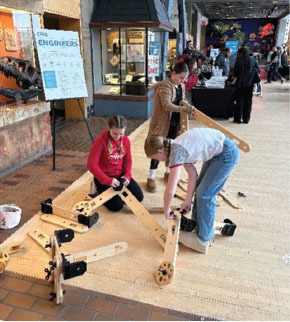
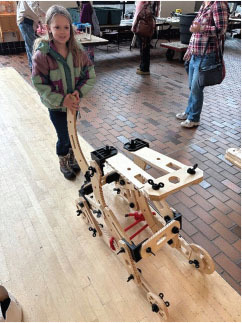
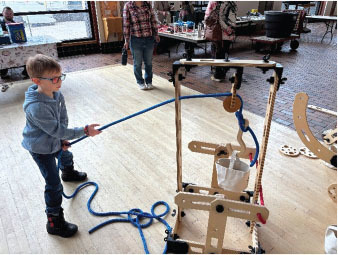
They weren’t looking for someone to introduce STEM, they were already doing it at scale. As we listened, a clear opportunity emerged. KDL had long hoped to add a Rigamajig Lab Tub to its rotating programming but had not yet secured funding. Rigamajig is a large-scale, open-ended building system composed of wooden planks, wheels, pulleys, bolts, and ropes that invites children to design, test ideas, and collaborate.
Rather than launching a parallel program, we realized we could strengthen an existing one that was already reaching thousands of children. We refined the concept with KDL, gathered chapter feedback, and submitted an MSPE Discretionary Fund application. It was approved, allowing KDL to purchase the Rigamajig and integrate it into lab programming across all branches.
Engineering Day in Action
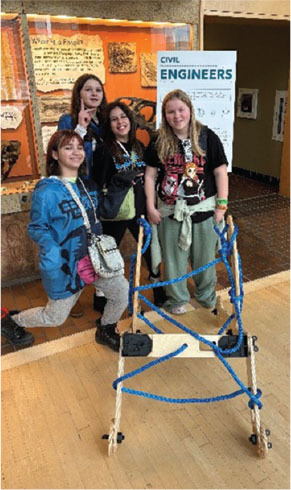
Soon after the funding was approved, we saw the partnership in action. At Engineering Day at the Grand Rapids Public Museum, hundreds of middle school students rotated through hands-on exhibits hosted by local STEAM organizations. For the second year, MSPE partnered with ASCE to host an engineering booth, and KDL allowed us to bring the Rigamajig.
Our challenge was simple: "Build something with wheels that you can move across the floor."
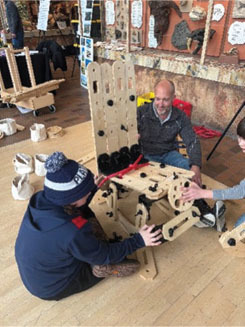
Students quickly turned the prompt into what they called the "Granny Challenge"—designing a wheeled device to help Grandma get around. Each group reviewed previous builds and considered how they might improve them. The ideas ranged from fall-prevention features and adjustable frames to seats, cup holders, and creative mobility solutions. As the day progressed and groups kept returning to see how their designs had evolved, we expanded the prompts to include everything from Trojan horses to strollers, rocking chairs, and pulley systems.
What stood out most was the shift in confidence. Many groups began by saying, "We’re going to need your help." Minutes later, it became "We’ve got this." Students organized themselves naturally, delegating tasks, testing ideas, and refining designs together.
The engineering design process unfolded organically:
- Identify a problem.
- Brainstorm solutions.
- Build and test.
- Refine and improve.
Students rarely wanted to leave our booth. We didn’t offer prizes or giveaways, but what they gained was more meaningful: the experience of building, collaborating, and solving problems. Watching them work made it easy to highlight the qualities that define engineers—creativity, persistence, teamwork, and curiosity—because they could see those traits in themselves.
A Road Map for Chapters Nationwide
If your chapter is looking for ways to promote engineering to younger generations, consider this framework:
- Start with mission clarity. Advancing the profession includes shaping how engineering is understood by the public. Outreach to K–12 audiences isn’t extracurricular, it is strategic.
- Leverage existing community infrastructure. Libraries, museums, schools, and community centers already have trusted relationships, space, programming, and built-in audiences. Instead of building new platforms, look for places where engineers can plug into systems that already work. Libraries are especially powerful partners because they are free, accessible, and community-centered.
- Understand available funding tools. Discretionary funds, grants, and sponsorships can turn a good idea into action and allow chapters to move quickly when opportunities arise.
- Listen first and build on existing momentum. Approach potential partners with curiosity, not a predetermined solution. Strengthening programs that already engage the community often expands impact more quickly than creating new ones.
- Keep members engaged. Regular updates and volunteer opportunities build chapter ownership and help sustain efforts beyond a single event.
This model is scalable. It does not require a large budget or a full-time outreach coordinator. It requires awareness of mission, willingness to collaborate, and thoughtful use of existing frameworks.
If we want to strengthen the future of our profession, we must invest not only in licensure and standards but in visibility, access, and early inspiration. Because somewhere, there’s a four-year-old who still believes she can do anything—and we have the power to help her keep believing it.
Want to get involved? Visit your state society website to connect and learn about opportunities to engage with other members in your area.

Danielle N. Yoon, P.E., is a grant and funding specialist and civil engineer at Fishbeck, a full-service consulting firm. She is a graduate of the NSPE Emerging Leaders Program.
More NSPE Now Articles

NSPE offers a live webinar—"WORKability Wednesdays"— to support your professional development goals.



The NSPE Education Foundation recently awarded several scholarships to support talented students

Each year, NSPE presents the New Professional Engineer of the Year Award to a young engineer who
The Pennsylvania Engineering Foundation’s (PEF) "Take the FE Exam" program isn’t just about helpi
NSPE is proud to welcome the 2025 Class of NSPE Fellows—a group of exceptional engineers who have
NSPE membership helps you navigate your career and build for the future.