Registration is open for NSPECon26 in New York City, New York!
 Volunteering at NSPE is a great opportunity to grow your professional network and connect with other leaders in the field.
 Decisions at the ballot box influence policies that support engineering standards and public safety.
If you read advice columns, you know that it is unwise to use the words "always" or "never" in disagreements with your partner. Hyperbolic statements like "You’re always late" or "You never take out the trash" are rarely true, inflame tempers, and make the original dispute about timeliness or trash harder to resolve. For insurance brokers, "always" and "never" are hazardous in the professional context, too.
This column will identify and explain some of the commonly contested "nevers" applicable to design professionals’ professional liability insurance, so you will be ready the next time your client challenges you to provide evidence that you are not just making stuff up in the hope of negotiating more favorable contract terms.
We can, however, state with confidence that certain coverage is not commercially available. The need for these "never" statements typically arises when a design professional’s client disputes the design professional’s assertion that professional liability insurance will not provide coverage for the client’s desired contract terms.
PL insurance won’t cover the insured’s promises of perfection. Professional liability insurance covers the insured design professional’s legal liability arising from their performance of professional services (as defined by the policy). Design professionals are legally liable for damages caused by their negligence—their failure to perform design services in accordance with the professional standard of care, which, in turn, means designing with the skill, care, and knowledge that would ordinarily be exercised by a design professional of the same discipline under similar circumstances, at the same time and locality.
The law does not require design professionals to render perfect performance or to guarantee the outcome of their services unless their contract with the client obligates them to meet this higher standard of care. But this, unfortunately, is the kind of contract language to which clients want their design professional to agree.
The problem is that these promises of perfection are not covered by professional liability insurance.
The practical reason for this is that insurers are not in the business of insuring against sure things like imperfections in design; doing so would be the road to financial ruin. The policy reason (nerd alert) is that all professional liability insurance policies have a contractual liability exclusion (sometimes it’s called the "liability assumed by contract" exclusion) that bars coverage for liability assumed by contract unless the insured would be liable in the absence of the contract.
If you are now saying "What?!?" or some saltier variant thereof, think about it this way—would the insured design professional be responsible for perfect performance if this contract term did not exist? And the answer, of course, is that they would not; they would simply be responsible for meeting the professional standard of care. Accordingly, the exclusion applies to block coverage for claims alleging that the insured breached their contractual promise of perfect design.
PL insurance won’t pay damages not caused by the insured design professional or those for whom they are legally liable. This is just a corollary of the previous "never." Professional liability insurance pays for the legal liability of the design professional (which may include legal liability due to the negligence of their subconsultants), but it will not pay for damages caused by parties who aren’t insured under the policy.
This often becomes an issue when a client proposes an indemnity clause shifting liability for damages caused by others to the design professional. For example, it might say that the design professional is obligated to pay damages caused "in whole or in part" by their negligence. This dangerous little phrase means that the design professional must pay 100% of the damages to the client, even if the design professional only caused, say, 55% of them. Professional liability insurance will cover the damages caused by the design professional, but the damages caused by other parties will not be covered and will have to be funded with the insured’s own money.
PL insurance won’t defend parties who are not insured under the policy. One of the truly useful things about professional liability insurance is that it not only covers indemnity (e.g., judgment or insurer-approved settlement of a covered claim) but also a defense for the insured design professional. This is true even if the claim against the insured turns out to be meritless. But professional liability insurers will not pay to defend parties who are not insureds under the policy.
Like the "never" discussed in the previous section, this typically comes up during negotiation of a contract indemnity clause. For example, the client’s clause may call for the insured to "indemnify and defend" the client. The obligation to defend means that the insured will need to pay for the client’s defense as soon as a claim is made against the client, even if the insured ultimately turns out to have done nothing wrong. This defense will not be funded by the insurer, and it is easy to see how this obligation can cost the insured real money.
Clients who frequently contract with construction contractors may be surprised by the design professional’s objections to a contractual duty to defend the client. Construction contractors are not concerned about the defense obligation because they can add the client as an additional insured on their CGL policy, which affords the client a defense and coverage for damages for claims connected with the contractor’s work. In fact, the design professional likely can make the client an additional insured on their CGL, too, but not on their PL policy. This brings us to our last "never."
PL insurance won’t add the client as an "additional insured" on the policy. It can be helpful to understand why underwriters universally refuse to add the client as an additional insured on the policy. For one thing, the policy provides coverage for negligent performance of professional services. If the client is not a design professional, this coverage is meaningless. If the client is a design professional, underwriters take the view that they should be insuring their professional liability on their own policy. But perhaps the reason that will resonate best with clients is that professional liability policies typically exclude claims made by one insured against another (the "insured vs. insured" exclusion). If the client were added as an additional insured to the PL policy, there would be no coverage for claims by the client against the design professional.
The bottom line for the design professional and the client. Clients sometimes respond to the above "nevers" by saying, "I don’t care if there’s no insurance coverage for our contract language; that’s your problem." This, however, is a fallacy. Unlike other project participants (like construction contractors), design firms typically do not retain assets or cash reserves adequate to pay an exceptionally large claim.
Professional liability insurance coverage provides financial assurance that the client can be made whole if they are damaged by the design professional’s negligence. It protects not only the design professional’s bottom line, but the client’s, too.

Karen Erger is senior vice president and director of practice risk management for insurance brokerage firm Lockton.
More Legal Beat Articles

The data doesn’t lie! It is well documented that severe weather incidents are becoming more frequent, affecting businesses across the United States and the world, including the construction and design industry.
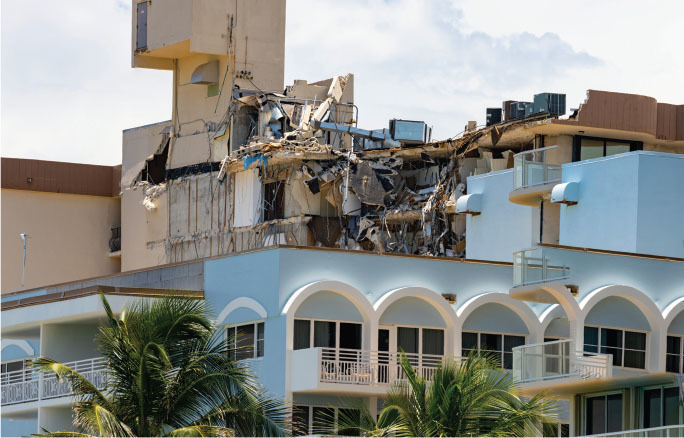
Structural failures, while rare, serve as critical reminders of the importance of design, oversight, and adherence to safety standards in construction and building maintenance.

When an engineering firm is winding up its affairs — perhaps closing its doors due to the retirem

The Equal Employment Opportunity Commission (EEOC) recently issued guidance tailored to the construction industry concerning harassment in the workplace or at the jobsite.


Spring 2023