Registration is open for NSPECon26 in New York City, New York!
 Volunteering at NSPE is a great opportunity to grow your professional network and connect with other leaders in the field.
 Decisions at the ballot box influence policies that support engineering standards and public safety.
The data doesn’t lie! It is well documented that severe weather incidents are becoming more frequent, affecting businesses across the United States and the world, including the construction and design industry.
Public and private sectors have reacted to climate change impacts in different ways. Adherents of the Environmental, Social, and Governance (ESG) movement have pressured business entities to adopt governing principles and make financial disclosures that reflect sustainability efforts. Public interest activists and various governmental entities have launched lawsuits against leading producers of carbon emissions, and various countries and US states have passed laws requiring reduced carbon emissions and new building codes. Natural disasters have forced communities and companies to take more concrete steps toward adaptation to and mitigation of climate change.
Concerned industry and financial groups have enacted climate risk recommendations aimed at encouraging entities, large companies in particular, to identify, assess, and disclose climate-related impacts. The frameworks, approaches, and applicable taxonomy vary widely across jurisdictions. Generally speaking, such rules require assessments of "physical" risks, such as direct risks to assets and indirect risks to supply chains, and "transition" risks, which are those that arise from the need to adapt to climate change and a low-carbon economy.
One widely accepted approach is known as Task Force on Climate-related Financial Disclosures (TCFD). TCFD was created in 2015 by the G20 and the Financial Stability Board, an international group that makes recommendations about the global financial system. The recommendations are organized into four categories: governance, strategy, risk management, and metrics and targets. These categories encompass recommendations for disclosing how a company’s leadership oversees and manages climate risks, and assesses the impacts of climate-related risks and opportunities on its operations and financial planning. The categories also outline how companies identify and manage these risks and use metrics and targets to assess and manage them, including greenhouse gas emissions.
Another widely recognized approach is that of the Corporate Sustainability Reporting Directive (CSRD), which is followed by the European Union. The CSRD requirements are said to be more robust than that of TCFD because CSRD adopts what is called a "double materiality" approach that requires entities to disclose not only how climate-related risks and opportunities impact their operations and businesses, but also how their businesses impact climate and the environment.
Regulatory Developments in the United States
Despite what has amounted to an ESG political backlash, there have been several important regulatory developments in the United States. Those regulatory developments have followed the TCFD approach.
A key development occurred in March 2024 when, following a two-year public comment period, the Securities and Exchange Commission (the SEC) adopted final rules requiring climate-related disclosures by public companies. The rules require reporting entities to disclose material levels of "Scope 1" and "Scope 2" greenhouse gas emissions and other related information. Scope 1 emissions relate to direct emissions from assets owned by a reporting entity. Scope 2 emissions are indirect emissions from the purchase of electricity and gas for the reporting entity’s own use. The SEC also included physical risk and transition risk assessments, aligning with the TCFD framework. Scenario analysis was not required, but entities would have to disclose if they used one AND found material climate impacts. The SEC rules also included a "severe weather disclosure," where companies must include a footnote providing the costs, losses incurred, and capital expenses associated with severe weather from that financial year.
The rules were subject to criticism since their inception and challenged in court. Earlier this year the SEC withdrew its defense of the rules.
Reaching Beyond SEC Regulations
Meanwhile, in October 2023, California became the first state to enact climate reporting requirements when the governor signed watershed legislation.
The Climate Corporate Data Accountability Act (SB 253) requires entities with more than $1 billion in annual revenue and "doing business" in California to disclose scope 1, 2, and 3 emissions in accordance with regulations to be published by the California Air Resources Board (CARB). This bill is estimated to apply to over 5,000 entities.
The Climate-Related Financial Risk Act (SB 261) requires entities with more than $500 million in annual revenues to report climate-related financial risks, as well as measures used to mitigate and adapt to these risks. The disclosures are to be in accordance with the TCFD framework or its equivalent. Certain types of disclosures must be independently verified by third-party assurance providers with significant experience in measuring, analyzing, and reporting on corporate carbon accounting. This law is estimated to apply to over 10,000 companies.
A new bill, SB 219, was signed in September 2024 and made a change to SB 253. As amended, SB 253 requires Scope 1 and 2 annual emissions disclosures starting in 2026, and Scope 3 emissions annual disclosures starting in 2027. The SB 261 disclosures are biennial and due on or before January 1, 2026.
The California bills reach beyond the SEC regulations in critical ways. First, they target not only public companies but private companies meeting certain revenue requirements. Second, they require disclosure of Scope 1, 2, and 3 emissions information regardless of their relevance to investor decisions. And there are other differences relating to scope and methodology of reporting and third-party verification requirements. It would be expected for scenario analysis to be included in the California disclosures as they are strongly recommended in TCFD guidelines. However, the SEC is not requiring scenario analyses.
After initial doubts that various deadlines in the bills could be met, the CARB was granted an extension until July 1, 2025, to publish its disclosure regulations. Although earlier this year it did hold a public workshop and issue answers to FAQs, the rules have not yet been published. Nevertheless, initial deadlines for disclosures of emissions remain in place with Scope 1 and 2 disclosures due by January 1, 2026, and Scope 3 emissions disclosures by 2027.
Like the SEC rules, the California legislation is under legal challenge, with claims that the California laws are void because they violate the First Amendment, are precluded by the Supremacy Clause, suffer from other infirmities involving the Commerce Clause and federal principles involving "extraterritorial regulation" and alleging that the laws will impose huge costs and burdens on businesses and disproportionately large burdens and costs on small-to medium-size companies. Some of the claims have been dismissed, but others are still pending.
Meanwhile other US states have laws in committee that are in the spirit of the California laws. New York’s proposed laws are the most like California’s laws, requiring both emissions and climate risk disclosures and aligning with the company size criteria. Illinois and New Jersey only propose emissions disclosures, also aligned with the revenue criteria of more than $1 billion total revenue. Minnesota recently passed a law for banks and credit unions to complete climate disclosure surveys provided by their state regulator.
Impact on the Construction and Design Industry
Construction and design companies should monitor the progress, review these laws and prepare for the required disclosures. They need to determine how they are going to collect and assess the required data.
Some companies would be well advised to engage consultants who can advise on metrics selections and scenario analysis and help companies comply with laws that require third-party verification. Megan Arnold, the competitive and regulatory intelligence manager of Jupiter Intelligence, a climate analytics firm, advises that,: "Scenario analysis is a key part of climate risk assessments. It is important to use forward-looking climate analytics that align with your business in terms of timeframes, hazards, structural vulnerability and workforce thresholds, and financial metrics. Even with the uncertainty in timing of disclosure requirements in the US, it would be best to start your disclosure and climate assessment work right away. If the deadlines are delayed, you can treat the work as a "dry run" and improve your internal process to meet the official deadline." She adds that "the disclosure frameworks and analysis processes can also help businesses to build more resilience with integrating climate risk into risk management and business operations."
Some construction industry leaders are ahead of the curve and have built their own internal staff capable of guiding their companies through efforts to adapt to climate change and build resiliency strategies. Many such companies already have been making voluntary climate change disclosures. Their disclosures focus on methodologies for developing and reporting data, business opportunities, efforts to reduce emissions, energy and emissions data relating to offices, project sites, and fuel sources, uses of lower carbon steel, concrete and other materials, waste treatment, supply chain and procurement efforts, and even business travel.
One such example is Clayco, number five on the latest ENR list of Top Green Contractors, which for the past several years has issued voluntary and robust annual ESG reports and a climate brief. Their climate brief describes in detail how the company integrates decarbonization practices into its projects, operations, and procurement. Clayco has a target of achieving net zero carbon emissions by 2050 that includes efforts to reduce emissions from its operations, projects, and project sites, including equipment, using low-emission construction materials, informing building design with energy models and data collection methods, identifying sustainable business opportunities, implementing annual sustainable action plans, and partnering with vendors and suppliers with similar priorities. These efforts enable Clayco to meet climate change disclosures that may or may not currently be on the horizon.
Alana Spencer, Clayco’s vice president of sustainability, says, "Being a part of an organization that plays a crucial role in the built environment, we work daily to minimize environmental impacts and have the ability to address climate change issues, influence market transformation, and provide more meaningful ways to advance sustainability action."
Eden Axelrad, Clayco’s director of climate change and decarbonization, says, "We have found the most success when we engage early and often. A sustainability practice that is woven into the various phases and partnerships of a project can yield a much bigger impact than one that is viewed as a supplementary add-on service. At Clayco, we pride ourselves on our integrated sustainability approach. It’s how we’ve managed to create such positive improvements across all built environment verticals and maximize outcomes."
An example on the design side is AECOM Technical Services, Inc. (AECOM), number one on the ENR 2025 Top 500 Design Firms list, which has created a business unit dedicated to helping its global clients adapt to climate change and enhance resilience to extreme weather. AECOM states that its mission is to deliver a better world by designing and delivering sustainable and resilient infrastructure. The company integrates ESG principles into its business strategy, emphasizing innovation, climate adaptation, and the reduction of carbon emissions. AECOM also helps clients navigate the regulatory landscape, through technical expertise, climate analytics, and integrated sustainability planning.
Lauren Swan, AECOM’s vice president for resilience and sustainable development, says, "As climate-related regulations evolve at both the federal and state levels, it’s clear that the construction and design industry cannot afford to take a wait-and-see approach. The built environment sits at the intersection of environmental impact and community resilience. We must lead with accountability, not only by reducing our carbon footprint across project lifecycles but by embedding climate risk into every design, procurement, and operational decision we make. Regulatory compliance is just the baseline — the true opportunity lies in rethinking how we build for a low-carbon, climate-resilient future."
Companies like Clayco and AECOM tend to be the same companies that recognize the business opportunities that climate change represents, whether that is taking advantage of tax and government incentive programs, assisting clients with adaptation and mitigation efforts, integrating new business technologies, reacting to lender, investor and customer requirements or simply valuing climate change as a community and business priority.
Whatever the reason, climate change impacts on the industry seem here to stay, and to keep up with these impacts and changing requirements, companies need to act now. If contractors and design professionals take the ostrich’s head-in-thesand approach and fail to adapt, then their competitors, courts, regulators, lenders, insurers, and customers will do it for them!

JOSH M. LEAVITT, ESQ., IS A PRINCIPAL AND CONSTRUCTION COCHAIR AT MUCH SHELIST, P.C. IN CHICAGO, ILLINOIS. HE HAS OVER 35 YEARS OF EXPERIENCE GUIDING COMPANIES THROUGH COMPLEX CONSTRUCTION AND DESIGN PROJECTS.
More Legal Beat Articles
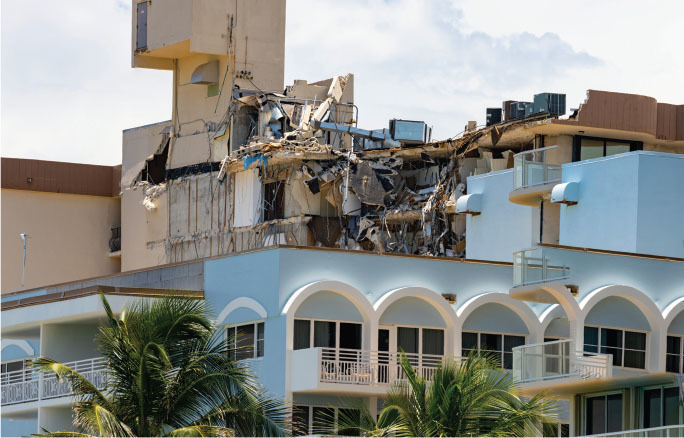
Structural failures, while rare, serve as critical reminders of the importance of design, oversight, and adherence to safety standards in construction and building maintenance.

When an engineering firm is winding up its affairs — perhaps closing its doors due to the retirem

The Equal Employment Opportunity Commission (EEOC) recently issued guidance tailored to the construction industry concerning harassment in the workplace or at the jobsite.


Spring 2023