

 Registration is open for NSPECon26 in New York City, New York!
 Volunteering at NSPE is a great opportunity to grow your professional network and connect with other leaders in the field.
 Decisions at the ballot box influence policies that support engineering standards and public safety.
December 2013
Shelter From The Storm
Pioneering storm shelter research was only the beginning for PEs at Texas Tech University.
BY MATTHEW McLAUGHLIN
 Weather-related disasters have become something of a regular occurrence in recent years, and some of the most deadly among them have been tornadoes. National Weather Service statistics from the past decade show tornadoes kill on average 109 people in the U.S. each year, a number that is surpassed only by the average number of people killed in the U.S. each year by extreme heat.
In 2012 and 2011 alone, more than 2,000 tornadoes were recorded in the U.S., more than 80 of which were classified as killer tornadoes. So far this year, the U.S. has seen nine killer tornadoes, one of which hit Moore, Oklahoma, in May.
The Moore tornado claimed 23 lives and was so devastating it managed to bring a veteran television news reporter to tears on the air. “I’ve never seen anything like this in my 18 years covering tornadoes,” Lance West said before breaking down moments later during Oklahoma City news station KFOR’s live coverage of the disaster.
Despite its power, not everything in the path of the EF5 Moore tornado was destroyed. Properly designed storm shelters survived the monstrous windstorm unscathed, protecting those inside. “All of the shelters performed very well, [with] no injuries or deaths,” says Larry Tanner, P.E., a research assistant professor at Texas Tech University’s National Wind Institute who surveyed more than 60 storm shelters in the path of the Moore tornado in a study funded by the National Science Foundation.
Shelters in Moore were not the first to survive the tremendous wind pressures and debris impacts of an EF5 tornado, however. Shelters both below and above ground have also performed well in other tornadoes, including the May 2011 EF5 tornado that hit Joplin, Missouri. The Joplin tornado was the single deadliest U.S. tornado since modern record-keeping began in 1950, killing 158 people while traveling 22 miles on the ground. Despite the deadly force of the tornado, those in storm shelters survived, and they owe that, in part, to PEs like Tanner as well as NSPE member Ernst Kiesling, P.E.
In addition to his contributions to storm shelter research, Tanner manages the National Wind Institute’s Debris Impact Test Facility, where shelters are researched and must be tested if they are to meet Federal Emergency Management Agency and other standards. Kiesling, National Wind Institute research professor and National Storm Shelter Association executive director, meanwhile, is one of the pioneers of storm shelter research and was instrumental in the formation of NSSA.
The Debris Impact Test Facility dates back to the early 1970s, and Kiesling initiated the research. “The young engineers and researchers of the time were convinced they could design structures that could resist the wind pressures but realized that they could not numerically analyze debris impacts on building assemblies,” Tanner says, “so thus the debris impact laboratory began.”
Knowledge From the Rubble
Extensive research into designing and building structures capable of withstanding tornadoes and other storms began as the result of a tornado much like the ones that hit Moore and Joplin. The tornado, which hit Texas Tech’s home of Lubbock in May 1970, caused $250 million in damages (more than $1 billion in today’s dollars), and killed 26 people and injured more than 1,500 others along its 8.5-mile path.
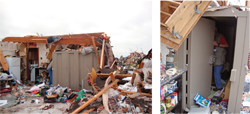 A shelter in the aftermath of the tornado that hit Moore, Oklahoma, in May and claimed 23 lives.
Seeing their homes destroyed and friends and neighbors injured or dead, engineers at Texas Tech immediately began surveying the damage in a hunt for knowledge that might prevent similar injury and loss of life in future disasters. Among those engineers was the new chair of the civil engineering department. “It was within the first year that I was chairman that the Lubbock tornado hit,” Kiesling says. “We had a number of young assistant or associate professors here at Texas Tech, primarily in the civil engineering department, that were looking for opportunities to do research but had very little going. So, when the Lubbock tornado hit they sprung out in the field and took pictures of damaged structures and did a rather comprehensive report.”
It turned out, the report by Texas Tech researchers, which was intended to help architects and engineers design structures more resilient to tornadoes and other storms, was the first of its kind. As a result, the civil engineering department was given funding from both the university and National Science Foundation to continue such research, and the Wind Science and Engineering Research Center (that would later join with the Texas Wind Energy Institute to create the National Wind Institute) was formed. From that point forward, researchers at Texas Tech began doing post-storm studies of all major storms around the world. It was a 1972 post-storm study in Burnet, Texas, though, that sparked another major step forward in storm shelter research.
“When we went to Burnet, Texas, there was a house that was almost totally destroyed—the roof was gone completely, two or three walls were missing—but right in the middle of the house was a pantry with all four walls still standing,” Kiesling says. “The idea occurred then that if this small room in the middle of the house was still standing it would have provided some protection to occupants, but furthermore, it would be very inexpensive to harden and stiffen a small room like that to provide a high degree of protection. That was the birth then of the concept of the aboveground storm shelter.”
 — Ernst Kiesling, P.E.
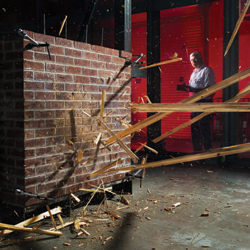
Two years later Kiesling and his research assistant, graduate student David Goolsby, presented their research on creating aboveground storm shelters in Civil Engineering magazine. In the 1974 article Kiesling and Goolsby stress the importance of debris impact testing, calling it “the most basic and urgent research need” in designing an aboveground shelter. Not surprisingly, the Debris Impact Test Facility was born out of that need, as was one of its most prominent features: a pneumatic cannon, capable of simulating wind speeds of more than 250 miles per hour. With the cannon, researchers can simulate the impact of wind-born debris in a controlled environment.
In addition to debris impact testing of storm shelters and storm shelter components, testing at the facility today includes doors and windows for debris impact and pressure resistance, hurricane impact testing for national and international companies, impact resistance for products in the mining industry, and research and development for numerous international companies.
A New Industry
Research and development continued in the years following the introduction of the concept of aboveground storm shelters, but it wasn’t until the late 1990s that interest in and support of storm shelter research gained ground. Unfortunately, it took a devastating tornado for that to happen.
“It was rather slow development through the years; then in 1997 a tornado hit Jarell, Texas,” Kielsing says. “It basically destroyed a rural subdivision outside [Jarell], and most of the people who were home were killed and the houses were pretty well demolished and swept to the slabs.”
The damage done by the Jarell tornado received national attention, which came to a head when Dateline NBC aired a special on the disaster. As part of the program’s coverage, they met with Texas Tech researchers and asked what could have been done to save the 27 lives lost in Jarell. This gave the researchers the chance to share the life-saving potential of their work with a national audience.
“Many television stations then came to Texas Tech and filmed the Debris Impact Test Facility,” Kiesling says. “So it really started getting widespread visibility.”
FEMA also took notice of Texas Tech’s storm shelter research following the Jarell tornado, and in 1998, using Texas Tech’s storm shelter designs and research, FEMA published P-320 Taking Shelter From the Storm, the first design guide for storm shelters. The guide, combined with the creation of storm shelter incentive grants, resulted in the birth of a storm shelter industry.
Quality Control
As one might expect of a new industry, the budding storm shelter industry was not without its problems, among them quality control.
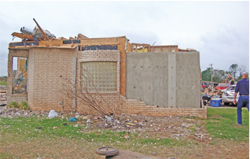 Shelters in Moore, Oklahoma, were not the first to survive the wind pressures and debris impacts caused by an EF5 tornado.
FEMA incentive grants provided some control over quality by requiring shelters to meet certain design standards and be tested at Texas Tech’s Debris Impact Test Facility, but not nearly enough. “A lot of shelters were being built without any standards and were being built in some cases by very unscrupulous people,” Tanner says.
Both in the Debris Impact Test Facility and during the 1999 tornado season it became apparent to researchers there was a serious problem with quality. “What we saw in terms of design left much to be desired,” Kiesling says. “Many of the shelters that were brought to us did not pass the debris impact test.”
Concerned for the public’s health, safety, and welfare and hoping to find a solution to the problems with quality in the storm shelter industry, Kiesling invited storm shelter manufacturers to Texas Tech in February 2000. It was decided at that meeting the National Storm Shelter Association would be formed. Its goal: to ensure the highest quality of manufactured and constructed shelters for protecting people from injury or loss of life from the effects of tornadoes, hurricanes, and other devastating natural disasters.
Those at the February 2000 meeting also decided the NSSA would develop a process for evaluating the design of storm shelters against an association standard, and shelter manufacturers who met the standard would have the opportunity to join the association and receive an NSSA seal of quality to display on their products.
Since the formation of NSSA and its standard, progress has been made in improving storm shelter quality. Not only has the NSSA seal been required by some local governments for storm shelter rebates, but NSSA also has moved on from an industry standard to a consensus standard it developed with the International Code Counsel.
NSSA partnered with ICC to develop the consensus standard in 2004, and by 2008 the first consensus standard for storm shelters was published. “So, we now have a consensus standard [and] we now have prescriptive designs that are published in FEMA 320 that meet the standard,” Kiesling says. “In addition, we have a process through the National Storm Shelter Association that requires debris impact testing and engineering analysis to make sure that any manufactured shelter is in compliance with the standard.”
Looking Forward
PEs and other researchers have made enormous strides in improving storm shelters since the 1970 tornado that ripped apart a huge swath of Lubbock, Texas. Despite their progress, however, they continue trying to develop even better shelters.
At Texas Tech’s National Wind Institute, the development of a mobile debris testing cannon by Tanner, for example, is about to open up entirely new research opportunities. The cannon is mounted on a trailer and articulates vertically, allowing researchers to take it to various sites and do impact studies on existing structures.
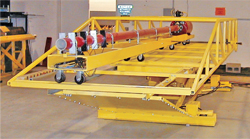 Texas Tech’s pneumatic cannon is capable of simulating the impact of debris propelled by winds of more than 250 miles per hour.
At NSSA, too, work to improve the quality of the storm shelter industry continues, and due to recent weather-related disasters, it is seeing a boom.
“We’re hearing from more and more people who want to join NSSA to gain the credibility of being a member,” Kiesling says. “With 2011 and the Joplin tornado and all of the tornadoes in Alabama, the whole shelter movement took a giant step forward. This past year has been, again, another important year because of tornadoes in the country, so things are moving along rather rapidly.”
Of course, even now, the storm shelter industry and NSSA are both young and the work to improve the quality of storm shelters being sold to the public is far from done. While NSSA may be gaining more members, for example, only 10%–15% of storm shelter manufacturers are NSSA members.
“The whole industry has not been in existence long enough for many people to be educated as to what constitutes quality, so whatever they can get by with, some will do it,” Kiesling says. “We still have challenges on our hands in terms of quality.”
Additionally, there is a need to educate the public that aboveground storm shelters are actually safe. While belowground storm shelters are obviously safe as well, aboveground shelters have some advantages, such as faster ingress and easier egress.
“There still seems to be a preference of an underground to an aboveground shelter, which I think is primarily based upon old wives’ tales and things like that,” Tanner says. “The thing is that a lot of people that have shelters are middle to senior age and they are finding that their ability to access belowground shelters is becoming diminished as their age increases.”
While in Moore, Tanner and other researchers spoke to people with belowground storm shelters who had to be rescued from their shelters after the storm because they were unable to climb out of them. Many were only able to free themselves from their shelter with the help of neighbors.
The problem is serious in Oklahoma, according to Kiesling, where some weather forecasters have declared for years the only safe place during a tornado is underground.
“We’re overcoming that,” he says. “We’re working hard through the National Storm Shelter Association and some allied organizations to get people to realize you can indeed provide a high degree of protection above ground. We’re confident that if you build an aboveground storm shelter that’s in compliance with the standard you’ll be very safe.”
More Featured Articles

Each year, the Professional Liability Committee of NSPE’s Professional Engineers in Private Practice, in conjunction with the risk management committees of the American Institute of Architects and the American Council of Engineering Companies, conducts a survey and face-to-face interviews with representatives of companies serving the A/E professional liability insurance market.
Professional engineers are trained to eliminate or reduce risks, and entrepreneurs assume risks. Combining the two different ways of thinking isn't easy. Entrepreneurial PEs offer their advice on knowing when to go into business for yourself and how to succeed. >>
Sidebar: The following 10 steps are recommended by the Small Business Administration for anyone starting their own business >>
At the intersection of human health and design lies biomedical engineering. It isn't a large discipline, but the field has been experiencing explosive growth. The Bureau of Labor Statistics predicts employment of biomedical engineers to grow 62% between 2010 and 2020. PE explores how this young discipline is making a powerful impact. >>
There is no substitute for lawmakers hearing from the united voices of professional engineers on issues that affect the engineering community and the public health, safety, and welfare. NSPE works at all levels of the government to broaden the reach of that voice. The Society's current legislative priorities include protecting and promoting qualifications-based selection, enhancing STEM education, licensing of veterans, enacting a comprehensive energy policy, and improving U.S. infrastructure. >>
Sidebar: How to Get Involved >>
Nationwide, student debt tops $1 trillion, and student loans are now the second-largest form of consumer debt, after home mortgages. Some financial experts are calling student debt the next financial crisis. What are the implications for engineering students and the engineering profession. >>
Economic indicators reveal a turnaround in the economy, yet architecture, engineering, and construction firms still face increased competition and scrutiny in the process to retain clients and secure more projects. Engineering leaders and marketing experts emphasize the importance of helping employees to maximize their communications, marketing, and client-engagement skills to foster a firm's business development culture. >>
When the Shinkansen "bullet train" launched in Japan in 1964 the world took notice and followed suit by developing high-speed rail systems throughout Europe and Asia. Now, California is set to become the first state in the U.S. to construct a high-speed rail system. Some PEs and transportation experts believe that the California project and other projects to increase rail speeds may trigger a transportation evolution. >>
No engineer wants a project to fail. But between failure and triumph are many different degrees of success. Projects that don't meet goals or fail entirely waste money and reduce competitive advantage. Experts share how engineering firms can best implement project management strategies to ensure project success and reduce headaches. >>
Since 2007, economic conditions and modern technology have increased employment liability risks for employers. Liability insurers have seen the number of employment claims, driven by the recession, increase and remain high. Experts share their perspectives to help firms mitigate the risks. >>
The boomers—the generation born between 1946 and 1964— are aging out of the workforce, and there aren't enough engineers in the pipeline to replace them. PE takes a look at the industries that are most heavily hit by these retirements and the strategies that will help companies address this employment trend. >>
Professionals must never stop learning and taking their skills and knowledge to the next level. Since 1955, specialty certifications have increased in both number and reputation. These certifications—provided by organizations such as the American Academy of Environmental Engineers and Scientists—are affording professional engineers the chance to increase their credibility and opportunities for advancement. >>