Registration is open for NSPECon26 in New York City, New York!
 Volunteering at NSPE is a great opportunity to grow your professional network and connect with other leaders in the field.
 Decisions at the ballot box influence policies that support engineering standards and public safety.
January/February 2014
VARIABLES
Saving Watts Towers
 Civil engineers at the University of California, Los Angeles, are using their technical skills and knowledge to help preserve Watts Towers, one of the area’s iconic structures and a National Historic Landmark.
Completed in 1954, Watts Towers was put together in artist Simon Rodia’s backyard. The 17 steel and mosaic sculptures are layered with cement, which is inlaid with glass, ceramic pieces, and found objects, such as bottles and sea shells. It took over 30 years to finish.
Time and the environment have taken a toll on the folk art structures—some of which are nearly 100 feet tall—so UCLA’s engineers have joined with conservators from the Los Angeles County Museum of Art who want to repair cracks and prevent further damage.
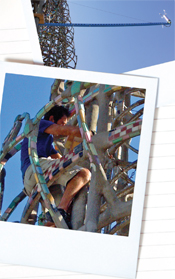 Last spring, the UCLA team installed sensors on the central tower to measure acceleration, tilt, and crack displacements, and accelerometers measure the magnitudes of external forces from wind and earthquakes. The engineering team also installed a weather station, which enables them to determine how crack movements correlate with factors such as wind and temperature.
Around the clock, digital data is recorded on site, and the data is transmitted to labs on campus for analysis.
The National Science Foundation is supporting the effort, which is using monitoring equipment and technical support from the George E. Brown Jr. Network for Earthquake Engineering Simulation Research.
UCLA expects to complete the project by the end of 2014.
Photos by Robert Nigbor