

 Registration is open for NSPECon26 in New York City, New York!
 Volunteering at NSPE is a great opportunity to grow your professional network and connect with other leaders in the field.
 Decisions at the ballot box influence policies that support engineering standards and public safety.
Jan/Feb 2008
VARIABLES
PEs Pursue Perfect Powder
 |
|
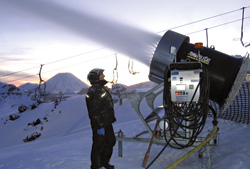
At the Whakapapa ski area in New Zealand, a fan system from Snow Machines Inc. is used to replicate mother nature. Photo Credit: Snow Machines Inc. |
Jean Petit, P.E., has an unusual job. "You meet somebody, and they ask what you do," he explains. "You say, 'I make snow,' and of course they don't believe you."
NSPE member Petit is engineering manager at Johnson Controls Snow, a division so small that most people within the larger Johnson Controls company don't even know that it exists. The tiny operation, with three people in North America and 70 in France, is known among ski resorts for its computerized snowmaking systems. "We are like the BMW of snowmaking," says Petit.
William Topham, P.E., general manager at Snow Machines Inc., is another NSPE member who makes snow for a living. His company has been in business for more than 35 years, and its equipment is used at almost every ski resort in North America and around the world, he says.
Both men design the pumping, piping, and electrical components that make the modern snow-making system. Petit enjoys working on both the mechanical engineering aspect and the computerized systems and says the diversity of his duties is a top benefit of the job.
The companies take two different approaches to snow-making. Snow Machines uses the fan system, a method developed in the 1970s. High-pressure water is pumped up the mountain through underground piping. Nozzles fitted on snow "guns" or "cannons" anodize the water into small droplets.
Those droplets are then propelled into the atmosphere through a large fan. A small amount of compressed air generates ice crystals, which mixes with the water to start the snow crystals growing in a process called nucleation.
"We are in fact duplicating Mother Nature," says Topham. "If you could take one of our machines and put it up at 10,000 feet and let [the snow] fall to the ground, it would look just like Mother Nature's snow."
Petit's company uses the older air-water system, which runs a double pipeline up the mountain. The pipeline contains high-pressure air and water and uses the compressed air to break the water into droplets.
The air-water system is usually considered very energy-intensive because of the high volumes of air and water needed. But Petit says his company's completely computerized systems save energy and labor, because the computer can calculate and control in real-time the correct mix of air and water depending on weather conditions. A human snowmaker who only adjusts the valves every three to four hours will "stay on the safe side and waste more energy," he explains.
Both companies made snow for the 2002 Winter Olympics in Salt Lake City, and Snow Machines Inc. is currently working on a system for the 2010 Olympics in Vancouver, British Columbia.
Some of Snow Machines' biggest clients are in Korea and China, where developers are creating mega-resorts that include ski facilities as well as golf courses, hotels, casinos, and convention centers. The company is also supplying equipment for an indoor skiing facility being built in Dubai.
Snow Machines has also worked with all of the major automotive companies to build environmental wind tunnels and outdoor snowmaking facilities to test car components.
Petit says that one of the biggest challenges of his work is putting pipelines in mountains because of the nature of the terrain and the shifting weather. For the Salt Lake City Winter Olympics, his company installed 44 miles of pipeline over a mountain, when in an average project they install 3?6 miles. "It was very difficult," he says. "I got a lot of gray hair that summer."