

 Registration is open for NSPECon26 in New York City, New York!
 Volunteering at NSPE is a great opportunity to grow your professional network and connect with other leaders in the field.
 Decisions at the ballot box influence policies that support engineering standards and public safety.
March/April 2020
Harsh Realities Drive Adaptation
BY DANIELLE BOYKIN
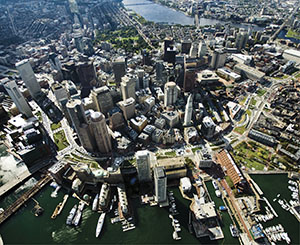 The City of Boston is expected to experience up to 40 inches of sea-level rise by 2070 with historical assets that need major protections. Last year on April 22, the city broke an 82-year old rain record with 2.3 inches of rain. And July 2019 was its hottest month on record, putting Boston on track to have summer temperatures that are comparable to those in Washington, DC, by 2050. This may explain why Boston is such a hot spot for forward thinking on climate change public policy.
Boston (and the Commonwealth of Massachusetts) isn’t alone in its efforts. Across the nation, cities and metropolitan regions are targeting climate-change impacts with comprehensive policies and action plans because they understand their critical role in the US economy and their cultural and historical significance.
As more localities respond to climate change realities, professional engineers and AEC consulting firms are showing that their involvement and expertise are important to bringing these policies and plans to fruition.
A Resilient City
Boston kicked off its climate change agenda in 2007 by issuing environmental and energy efficiency goals. In 2014, newly elected Mayor Martin Walsh expressed a commitment to helping the city become carbon neutral and address climate change.
The Climate Ready Boston initiative launched in 2016 to prepare the city for the impacts of climate change while also ensuring continued livability for citizens and economic growth. The first assessments pinpointed resilience solutions for critical infrastructure, facilities, natural resources, and neighborhood populations that are vulnerable to extreme heat and coastal and stormwater flooding.
The Boston Planning & Development Agency adopted coastal flood resilience design guidelines in September 2019 to provide businesses, property owners, and developers recommendations on protecting buildings and structures from floods.
AEC firm Kleinfelder helped develop the flood resilience guidelines. This work, carried out by the firm’s Climate Change Practice, involved mapping products, resiliency strategy recommendations, zoning review and guidance, and preparing building type case studies. These guidelines will help developers who are required to address sea-level rise in their development proposals as well as property owners just looking to do the right thing.
“As the city has advanced its planning and has gotten more data and more experience to set strategies to address risks, they’ve become much savvier about specific asks,” says Nasser Brahim, who leads Kleinfelder’s multidisciplinary climate change team. “The design guidelines are the next phase with the expectation that developments will meet these standards.”
The guidelines focus on four resilient design principles for building retrofits and new construction development:
Adaptation strategies should be future-looking and draw on best resiliency practices that also respond to the unique condition of Boston’s building types.
Building-scale resilience solutions should contribute to an overall enhancement of the public realm.
Flood resilience strategies should play a beneficial role in overall building sustainability such as enhancing surrounding landscapes and improving stormwater management and energy efficiency.
Individual building upgrades should, wherever possible, be related to adjacent district-scale flood prevention infrastructure investments.
Boston is still in the early stages of implementing district-level plans. Some neighborhoods are at the conceptual design phase, others are having design documents drawn up. “Part of the work of the engineer is not just designing the solution, but also giving us a timeframe based on the climate modeling on when this solution actually has to be implemented,” says Christopher Cook, Boston’s chief of environment, energy, and open space. “In some ways that work is almost as important as the actual design itself.”
With any large-scale public policy agendas, adequate funding is essential. Mayor Walsh has committed 10% of his capital budget to adaptation projects, but the city must be open to all available funding sources. Grant program funding sources help with diversifying project types that target fire, drought, extreme rainfall, and other climate-change impacts.
“We are hopeful that when climate adaptation becomes more of a priority at the federal level, the nation will realize that they have to protect these high economic impact municipalities,” says Cook. “In the meantime, we’ll keep plugging away at this work because it’s important. Every household we save, is another household we don’t have to pay to rebuild.”
Rising to the Challenge
Florida is ground zero for climate change resilience work, says Craig Wells, P.E., who will lead a new Freese and Nichols Inc., office in downtown Tampa with expansion and fortification projects associated with population growth, climate change, and sea-level rise.
Freese and Nichols has a long standing in Texas, but the challenges faced in Florida are similar. Lessons learned from Hurricane Harvey recovery projects will benefit clients. “The design work is the same, with the exception that you’ve got to set the boundary conditions for sea-level rise and storm surge elements and design around those conditions,” says Wells, who has 26 years of experience in the field.
During the 15 years that Wells has worked in Florida, localities have experienced “sunny day” flooding and 100-year flood events that have occurred four to five times in 20 years. “I can’t think of a major coastal infrastructure project in Florida that doesn’t have a climate resilience component,” says Wells, who serves on the American Water Works Association’s National Committee for Emergency Preparedness and is an affiliate of the Florida Climate Institute. He has performed resilience evaluations for more than 20 water and wastewater facilities in Florida.
Communities in the Tampa Bay area and Southeast Florida have taken the lead on resilience mitigation and adaptation projects by signing onto climate compacts and establishing regional planning councils. For instance, the Tampa Bay Regional Planning Council launched the Tampa Bay Regional Resilience Coalition to enhance planning for climate change, to educate about risks and best practices, and secure funding for infrastructure improvements.
These communities and utilities are adding climate resilience considerations into design standards for new construction and development. For example, if a project’s construction valuation is $2 million or more, says Wells, you must perform a climate assessment as part of the design process. “Over the lifespan of the project you’ve got to look at sea-level rise and storm surge and make considerations on hardening of the facility, raising the facilities, and putting waterproof components so that it can operate underwater,” he says. “For every dollar spent on resilience measures, a locality or utility can save on average $36 to over $100 in recovery expenses.”
A Desired Professional Practice
Climate change and resilience appears to be a growing practice area for both AEC firms and government agencies. “Municipalities are looking at hiring in this area, and many firms are repackaging their services associated with water supply and drought, flood control, and fire management into a resilience branch,” says Brahim. “It’s not just the big players, especially in states and regions that have been more proactive about their policies.”
There’s also a stronger push by college engineering programs to add courses on climate change impacts and developing engineering solutions, says Matthew Eckelman, associate chair for research in Northeastern University’s Department of Civil and Environmental Engineering.
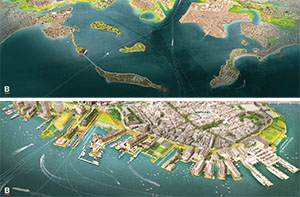 THE CLIMATE READY BOSTON INITIATIVE LAUNCHED IN 2016 TO PREPARE FOR THE IMPACTS OF CLIMATE CHANGE WHILE ENSURING CONTINUED LIVABILITY FOR CITIZENS AND ECONOMIC GROWTH. THE CITY HAS DISTRICT-LEVEL SOLUTIONS TO REDUCE VULNERABILITY TO SEA-LEVEL RISE, COASTAL FLOODING, EXTREME HEAT, AND INTENSE PRECIPITATION.
Four years ago, Northeastern University created the Engineering and Public Policy master’s degree program with a focus on energy, environment, and infrastructure resilience. The program is a joint venture between the Department of Civil and Environmental Engineering and the School of Public Policy and Urban Affairs.
The catalyst for the program was a demand from members of its industry advisory board to educate engineers who can work on climate change projects, understand policy implications of this work, and effectively work with or work in public agencies. “Through our program, you get the resilience content from a public policy aspect,” says Eckelman. “You’ll also learn what kind of policy measures will enable engineers to get the job done quickly and efficiently, at a cost that the public is willing to bear.”
Eckelman adds, “I hope that AEC firms that are taking on resilience and climate change adaptation projects will enable younger engineers to get into the policy aspect of engineering. It shouldn’t take them until the middle of their careers to see how that process works.”
As Boston is experiencing the fastest pace of development in the city’s history, says Christopher Cook, choosing AEC consultants with the right experience and qualifications weighs heavily in the city’s public RFP process. “You’re dealing in a tight environment that’s going to require strict construction schedules, and there are so many different complications that can drive scope creep. The only thing that gives me assurance that that won’t happen is experience.”
AEC firms are going to have to expand their capacity to be able to accept more resilience work. “There is going to be a market to fund this work because we are not going to allow our coastal cities to just fall into the water,” says Cook. “I know [management] wants to watch the bottom line. There also may be worries over an impending recession. Well that recession may or may not come, but guess what is definitely coming…sea level rise.”
Changing Perspectives
There are still plenty of areas in the country where there’s pushback or indifference to the potential effects of climate change and extreme weather events. “No matter what you think is or isn’t happening with climate change, if you design these measures into the project upfront, a lot of that cost is incidental to the overall cost of the project. I don’t know why you wouldn’t take the extra step, even as an insurance measure,” says Wells.
Some localities that have resisted implementing climate change policies and actions plans have received a rude awakening over the last few years. In 2016, Hurricane Matthew left downtown Jacksonville, Florida, underwater and created substantial problems for the city. “After Matthew, the impacted utility stated that their goal is to become the most climate-resilient utility in the United States,” says Wells. “In my opinion, the real-world impact of Matthew resulted in a significant change in the utility’s approach to assessing climate vulnerability and becoming more climate resilient.”
Wells added, “As a professional engineer, you’ve got to make your client aware of the possible range of projected impacts and let them make the decision as to what actions should be pursued to become climate resilient. If climate vulnerability isn’t assessed, the client isn’t being supplied with basic information that really must be incorporated in the facility’s basis of design.”
More government agencies and municipalities are beginning to make climate change resilience part of their standard operating procedures, says Brahim. A standard contract may outline certain types of hazards, levels, or data sources that a designer must consider on a project. “It’s helping to mainstream climate change and resilience thinking in all of the design work and the operations that are going on. That’s an important factor.”
Brahim has seen a major shift for the better in perspectives at some of the highest levels about climate change and extreme weather events. He points to Republican governors Charles Baker in Massachusetts and Ron DeSantis in Florida as having forward-looking climate change policies.
Under Baker’s administration, the commonwealth issued the nation’s first integrated hazard mitigation and climate adaptation plan in 2018. The plan assists cities and towns with funds and technical assistance for building resilient communities.
Last year in Florida, DeSantis appointed the state’s first chief resilience officer. He also issued an executive order to create the Office of Environmental Accountability and Transparency and the Office of Resilience and Coastal Protection.
“There has been substantial improvement over previous years when this issue has been quite polarized,” says Brahim. “Because climate change impacts don’t respect jurisdictional boundaries, everybody is waking up to the reality that this is something they need to consider.”
State Policies and Actions on Climate Change
Governors of 24 states established the United States Climate Alliance to collaborate on solutions to achieve their goals and initiatives around climate resilience, clean energy financing, power-sector modernization, product energy efficiency standards, advanced transportation, natural and work lands, and short-lived climate pollutants while ensuring economic growth.
Here’s a snapshot of policies and actions being taken by some member states
California
 California was the first in the nation to address greenhouse emissions with an economy-wide cap-and-trade program. The California Global Warming Solutions Act of 2006 set the goal of getting emissions down to 1990 levels by 2020. The emissions reduction target was updated by executive order in 2018 to achieve carbon neutrality by 2045.
In 2018, the Indicators of Climate Change in California report provided 36 indicators tracking climate change drivers and the effects on physical and biological systems. More than $10 million has been invested in nearly 50 research projects (Fourth Climate Change Assessment) that provide new findings on expected climate change impacts for the state and inform policies and programs to support adaptation and resilience.
Minnesota
 The Next Generation Energy Act (2007) established a 25% renewable energy standard by 2025. Minnesota reached more than 22% of electricity coming from renewable sources in 2016 and is projected to reach more than 40% by 2030.
State agencies are implementing several programs to address climate impacts. For example, the Minnesota Pollution Control Agency and the Conservation Corps Minnesota support community resiliency projects such as new green infrastructure in underserved urban neighborhoods.
Last year, the Interagency Climate Adaption Team issued a report, Adapting to Climate Change in Minnesota, to advance priority climate adaptation recommendations and assess state agency responses to climate impacts.
New Jersey
 In 2019, New Jersey reauthorized the Global Warming Response Act which establishes targets for greenhouse emissions reduction. The Clean Energy Act (2018) sets additional targets to expanding the state’s generation of clean energy, which includes a renewable portfolio standard of 50% by 2030, restructuring the solar industry to enable long-term growth, establishing a community solar program, and investing in energy storage.
This year, Governor Philip Murphy launched an initiative to require builders and developers to consider the impact of climate change to get approval for state projects. Murphy issued an order for the Department of Environmental Protection to draft regulations for adoption by 2022.
Following Superstorm Sandy, the DEP has funded more than $300 million in storm resiliency improvements. In partnership with the US Army Corp of Engineers, the DEP has completed more than $1.2 billion of coastal protection infrastructure projects during the last five years. More than $800 million is going towards current projects to make sure that developed areas can withstand weather and flooding events with minimal impacts.
New York
 In 2019, Governor Andrew Cuomo signed the Climate Leadership and Communities Protection Action to require the state to reduce greenhouse gas emissions 85% below 1990 levels by 2050 and offset the remaining 15%.
The Community Risk and Resiliency Act requires state agencies to consider sea-level projections, extreme weather events, and other climate change impacts on implementing programs. The Department of State has developed best practices for building resilience and land use. The Climate Smart Communities program provides no-cost state support to local government that pass resolutions to act on climate change. To date, 270 communities have taken the 10-point Climate Smart Communities Pledge and 24 communities have pledged to be certified Climate Smart Communities.
In 2019, legislation that enacts the Climate and Community Investment Act (S. 3616) and establishes the New York State Climate Change Task Force (S. 2742) were introduced in the New York State Legislature.
More Featured Articles

Diversity is a major theme in NSPE’s strategic plan, and it recently gained a place in the NSPE Code of Ethics. For any future-focused, proactive profession or professional society, diversity is increasingly a strategic imperative. But there needs to be an acknowledgement of the missed opportunities created by the biases in our personal, professional, and societal lives. »

Every engineering team needs the help of other experts to successfully complete a project. One team member not to overlook is the expert in professional liability and risk management. If your aim is to select the best provider for your firm, this insurance provider directory and survey will help you get started. »
Engineering firms around the country recognize that their employees want to seek out knowledge and training to advance their careers, and have obliged by furthering their development programs, continuing education offerings, and opportunities to attain professional licensure and advancement within their workplace. »
When a ship experiences a grounding, collision, capsizing, or fire, the responders’ order of priority is to save lives, save the environment, and save property. To that process, salvage engineers bring a problem-solving mindset and flexibility in a field that provides not just the opportunity but the requirement to think creatively. »
Today’s young engineer professionals have a strong desire to lead and make positive impacts in their careers and communities. At the 2019 Professional Engineers Conference, top AEC leaders offered their perspectives on what it takes to develop strong leaders and how the industry will thrive going forward. »
Differences of opinion about the use of “engineer” and similar titles can turn contentious. State licensing boards are usually responsible for regulating use of engineer titles. But in a few cases, including some recent high-profile ones, the issue has reached the courts. Their responsibility: balancing the need to protect the public with free speech. »
As technologies like artificial intelligence, machine learning, automation, advanced robotics, and mobile supercomputing move from the realm of science fiction to reality, there are very real consequences if tomorrow’s engineers are unprepared. »
The NSPE Board of Ethical Review recently released its 60th year of opinions. The compendium of cases offers a unique catalog of ethics interpretation for the profession. The scenarios benefit not only engineers in the profession but also students who haven’t yet faced engineering’s real-world challenges. »
As engineers seek to move up the career ladder toward management and leadership positions, effective communication skills will benefit them greatly. While it is no secret that top managers often demonstrate effective communication, what are the specific skills that engineers need, and where can they go to gain, practice, and maintain these important skills? »