

 Registration is open for NSPECon26 in New York City, New York!
 Volunteering at NSPE is a great opportunity to grow your professional network and connect with other leaders in the field.
 Decisions at the ballot box influence policies that support engineering standards and public safety.
January/February 2020
NSPE Today
PSPE Members Help Drive Student Chapter’s Success
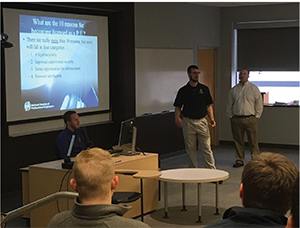 WILKES UNIVERSITY STUDENT CHAPTER MEMBERS LEARN ABOUT LICENSURE FROM KEYSTONE NORTHEAST CHAPTER PROFESSIONAL ENGINEERS. CREDIT: HOLLY FREDERICK, P.E.
At about 70 US colleges and universities, members of NSPE student chapters can learn the benefits of engineering licensure and gain valuable connections with dedicated professionals who have walked in their shoes. At the same time, those professionals—members of NSPE state societies—find satisfaction in helping develop new talent for the profession, building membership in their state, and connecting with students who may later become employees.
One of the most active NSPE student chapters is located at Wilkes University, a 2,500-undergraduate private institution in Wilkes-Barre, Pennsylvania. Licensed faculty who are members of the local Keystone Northeast chapter and the chapter’s tight-knit connection with the students have made the difference.
The student chapter launched in 2011 with encouragement from Keystone Northeast members and efforts by engaged students, such as Brian Palmiter Jr., EIT. Palmiter was the inaugural student chapter treasurer and now acts as a liaison between the Wilkes and the Keystone Northeast chapters.
The professional chapter invites students to participate in any of their events, explains Palmiter. For instance, about 20 students volunteer with the Keystone chapter each year for the MATHCOUNTS regional competition.
Another regular joint event is a panel discussion covering the ethical issues involved in NSPE’s Milton F. Lunch Ethics Contest for that year.
The Order of the Engineer ceremony and banquet is also a major annual gathering. Holly Frederick, P.E., associate professor in Wilkes’ department of environmental engineering and earth sciences, is the student chapter advisor and Keystone Northeast’s chapter treasurer. She explains that the event “gives [the graduating students] the chance to be welcomed into the engineering community, to think about what that responsibility involves, remind them that there are other people they can count on or ask questions to.”
As Marleen Troy, P.E., chair of the Wilkes environmental engineering and earth sciences department, explains, the Keystone chapter members are “almost like older siblings, looking out for [students].” Troy, a former student chapter advisor, highlights the mentoring the Keystone Northeast chapter members provide students. “Any time there’s an event,” she says, “there’s usually time afterwards to talk. It’s always nice to see them lingering and talking and giving advice.”
The twice annual Young Professionals Bowling Night, organized by the Keystone Northeast chapter with other local engineering organizations, is also popular. Students from Wilkes and other colleges and universities benefit from speaking with professionals 35-years-old and younger who aren’t too far removed from their college days, explains Frederick. It’s both a networking opportunity and a chance for students to learn about what the professionals do.
Additional joint activities between the Wilkes and Keystone chapters include both fun (a local hockey game) and educational (lectures, site tours, PSPE conference) events. And, of course, licensure is always a hot topic. As Palmiter says, anytime the Keystone chapter has an event with Wilkes, “we push the licensure. We say, ‘Hey, the best thing for you to do is get your EIT.’”
The student chapter has begun holding a biannual seminar about licensure and what PEs do, led by Keystone professional engineers. The first hour-long lecture, which also discussed the links to PSPE and NSPE, was attended by at least 30 students.
As Scott Heffelfinger, a senior environmental engineering major and student chapter president puts it, being part of the chapter has solidified his belief that he needs to get his PE “in order to excel in my career…. Having a PE opens a lot of doors for upward mobility.”
Kaitlin Sutton, also a senior environmental engineering major and chapter member, says she plans to get a PE license because she doesn’t “want to be limited in what I can do in the engineering field, and getting a PE license will help me go a lot further.” She didn’t know much about licensure before her professor, Holly Frederick, recommended she join the chapter. But now, she says, her participation “has greatly increased my motivation towards becoming licensed.”
Find resources for starting and maintaining a student chapter.
More NSPE Now Articles
September/October 2019