Registration is open for NSPECon26 in New York City, New York!
 Volunteering at NSPE is a great opportunity to grow your professional network and connect with other leaders in the field.
 Decisions at the ballot box influence policies that support engineering standards and public safety.
January/February 2019
PE Report
House Legislation Focuses on Sexual Harassment in STEM
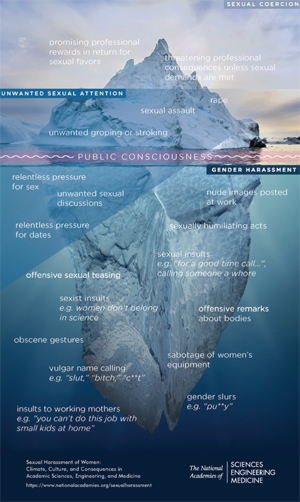
THIS NATIONAL ACADEMIES IMAGE OF “THE ICEBERG OF SEXUAL HARASSMENT” HIGHLIGHTS THE FORMS OF GENDER HARASSMENT THAT MAY RECEIVE LESS PUBLIC ATTENTION BUT THAT CAN STILL INFLUENCE ACADEMIC AND WORKPLACE EXPERIENCES.
As sexual harassment allegations continue to proliferate across industries and sectors, STEM fields have increasingly come under scrutiny. In June, the National Academies released a landmark report examining the issue in the academic sciences, engineering, and medicine. Now, some of that report’s recommendations have been codified into legislation introduced in the House of Representatives.
The Combatting Sexual Harassment in Science Act of 2018 (H.R. 7031) was introduced in October by Rep. Eddie Bernice Johnson (D-TX), with more than 30 cosponsors. As Johnson noted in a statement, 58% of women in academia have reported experiences of sexual harassment, undermining career advancement for women in critical STEM fields. Women of color are even more likely to experience sexual harassment.
“We cannot afford—morally, scientifically, or economically—to continue to lose these skilled scientists and engineers,” Johnson said, “particularly from groups that are already underrepresented in STEM.”
The legislation would establish National Science Foundation programs to fund research on the contributing factors, consequences, and interventions for sexual harassment in the STEM workforce and collect data on its prevalence.
The bill also directs the Office of Science and Technology Policy to provide federal guidelines to agencies to ensure clear policies and dedicated resources to prevent and respond to sexual harassment incidents at institutions that receive federal research funding. And H.R. 7031 would create an interagency working group to improve agency coordination and communication.
In addition, the legislation would direct the NSF to engage the National Academies in studying the influence of sexual harassment on the career advancement of individuals in the STEM workforce.
The legislation is endorsed by the Society of Women Engineers, which notes that its proposals aimed at “better understanding the causes and consequences of sexual harassment and reducing its incidence and impact…will support the endeavors of current and future female scientists and create a richer research enterprise in the United States.”