Registration is open for NSPECon26 in New York City, New York!
 Volunteering at NSPE is a great opportunity to grow your professional network and connect with other leaders in the field.
 Decisions at the ballot box influence policies that support engineering standards and public safety.
July/August 2018
Communities: Private Practice
Fire Protection Engineers Promote Performance-Based Design
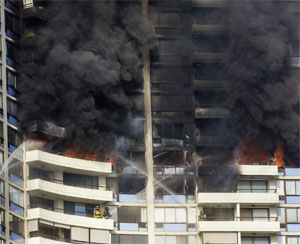 ON JULY 14, 2017, A FIRE AT THE MARCO POLO CONDOMINIUM IN HONOLULU RESULTED IN THE DEATH OF FOUR PEOPLE AND INJURIES TO 13. THE BUILDING DIDN’T HAVE A PROPER SPRINKLER SYSTEM.
Professional fire protection engineers are compelled to work within the boundaries of safety codes and standards—often with little leeway for innovative engineering concepts. Over the years, the Society of Fire Protection Engineers has increased efforts to help fire protection engineers and their firms incorporate more innovative performance-based design, while maximizing public safety.
According to industry experts, one of the top drivers of change in this field is performance-based design. With this type of design, practitioners must demonstrate compliance with requirements while incorporating innovative engineering.
The concept of performance-based design isn’t new, says SFPE Technical Director Chris Jelenewicz, P.E., and has been practiced throughout the history of codes and standards. Any code or standard usually has an alternative method section, he says, which allows the engineer to design while keeping the code’s intent in mind.
To promote performance-based design and address knowledge areas such as fire dynamics, fire protection systems, human behavior in fire, and risk analysis, the organization offers the SFPE Handbook of Fire Protection. The sixth edition of the reference book is in the works, but the fifth edition is currently available.
SFPE dedicates an entire conference to performance-based design to help ensure that fire protection and safety engineers can build on their knowledge base with new research, case studies, and networking opportunities. During the most recent conference in April, the sessions touched on topics including hospital fire protection; fire engineering challenges and the redevelopment of existing shopping centers; performance-based fire resilience evaluation for tall building structures; and fire safety standards and the need for global consistency. The conference also maintains an international focus as globalization increases and since performance-based design is practiced differently in countries throughout the world.
Sometimes the greatest and toughest lessons for any engineering professional can come from a tragic event. One session during the conference addressed the Marco Polo high-rise condominium fire in Honolulu, where four people died and 13 were injured last year in a building that didn’t have a proper sprinkler system. And it’s likely that the Grenfell Tower fire tragedy in London, in which 72 people perished, will also provide necessary lessons that can help save lives. “Anytime you get a catastrophe like with the Grenfell, it makes our profession stop, learn what happened, and find out ways to improve in the future,” says Jelenewicz.
The Workforce Outlook
 SFPE TECHNICAL DIRECTOR CHRIS JELENEWICZ, P.E.
Fire protection engineers play an important role in ensuring that buildings and their occupants are secure in the event of a fire and can be evacuated safely. Yet, there is still a need to educate society about fire protection engineers and what they do. “Some people think we are just fire fighters, but then again, some people still don’t know what an engineer is,” says Jelenewicz.
Qualified engineers are in high demand all over this nation. But if you’re a fire protection engineer—even a recent graduate—you’re really in high demand. There are only a few ABET-accredited fire protection engineering and fire protection and safety technology programs in the US, says Jelenewicz. According to Glassdoor, the average annual salary for a fire protection engineer is $78,415. A senior fire and safety engineer can command a $90,000 average annual salary.
Fire protection engineering is still in its infancy compared to other engineering disciplines, says Jelenewicz. And he believes that licensure is critical because the first goal of fire protection engineering is to protect people and the second is to protect property. “The main thing that pulls people into this discipline is that there’s a strong human element behind it,” says the technical editor for Fire Protection Engineering magazine. “You’re helping to save people’s lives. That’s important.”
Core Competencies for Fire Protection Engineering
The Society of Fire Protection Engineers is in the process of recommending minimum core competencies and standards to assist jurisdictions, firms, and universities that are offering credentialing and continuing education programs for fire protection and fire safety engineers.
The SFPE Committee on Professional Qualifications has released a draft document outlining four competencies (and associated knowledge areas) that professionals should master as practicing fire protection engineers.
Fire Safety Science
A comprehensive understanding of the underlying physical principles of fire and its related mechanisms. This includes the principles of ignition, heat transfer, mass transfer, fire chemistry, and fire dynamics.
Human Behavior and Evacuation
A comprehensive understanding of human behavior and the principles of evacuation design. This includes the behavior of persons during an emergency, different design approaches, and the tools and methods to perform evacuation assessments. The knowledge areas for this competency will address physiological and psychological response, social and cultural issues, and crowd dynamics in addition to egress and life safety issues.
Fire Protection Systems
A comprehensive understanding of fire mitigation includes water and nonwater-based suppression, detection systems, fire modeling, fire testing, and code and standards concerns. The knowledge areas of this competency address passive systems, active systems, fire detection and alarm, and fire suppression.
Fire Safety Analysis
A comprehensive understanding of the principles of technical analysis related to fire safety design. This includes design approaches, concepts for evaluating design options, establishing boundary conditions, and limits of analysis and design. The knowledge areas of this competency are performance-based design, smoke management, evacuation analysis, structural fire safety, risk management, fire modeling, and fire protection-related codes and standards.
The core competencies document also addresses professional ethical conduct through the SFPE Canons of Ethics. The canons call on fire protection engineers to do the following:
- Practice in an ethical manner, with personal and professional integrity.
- Abide by one or more applicable (e.g., employer, professional society, client) strict codes of ethics and behavior, even in the face of opposition.
- Encourage others to behave ethically.
- Understand that behaving ethically goes beyond what the law requires.
- Respect the need for confidentiality, when appropriate.
- Distinguish between a legal or management issue and an ethical matter.
- Select and take appropriate steps to record or to report to higher-level management or to public authorities in the event that an ethical matter is not adequately resolved in a manner consistent with the public health, safety, and welfare.
Access the “Minimum Core Competencies for Fire Protection Engineering” at www.sfpe.org.