

 Registration is open for NSPECon26 in New York City, New York!
 Volunteering at NSPE is a great opportunity to grow your professional network and connect with other leaders in the field.
 Decisions at the ballot box influence policies that support engineering standards and public safety.
January/February 2018
PE Report
Wyoming, Nevada Ink Mobility Agreement
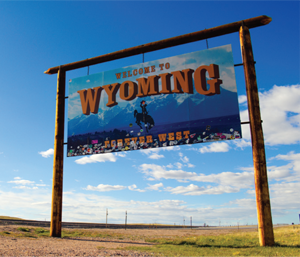 NEVADA PEs WHO WANT TO WORK IN WYOMING, AND VICE VERSA, WILL NOW HAVE A MUCH EASIER TIME GETTING LICENSED.
The Wyoming and Nevada licensing boards have signed a first-of-its-kind pact in which a PE in one state can be accepted as a PE in the other.
The boards signed the agreement in August at the annual meeting of the National Council of Examiners for Engineering and Surveying. Under the agreement, an NCEES Model Law Engineer who applies for licensure in either state can choose to be licensed in the other state. State-specific exams and respective fees will still be required, but an applicant must complete only one application to become licensed in either state. Wyoming and Nevada are the first two states to sign this kind of memorandum.
Corky Stetson, P.E., Wyoming board president, says that the memorandum is a great stepping stone toward improved mobility of the PE. It can be a long and trying process to become licensed in more than one state, he says, even if you regularly work in multiple states or just moved to a new state.
“It’s so painful,” says Stetson. “We’ve got to do something to make it easier. We just need to keep taking the steps to make mobility easier. We kept talking about it, but we needed to do something.”
Patty Mamola, P.E., executive director of the Nevada board, points out that the new memorandum between Nevada and Wyoming benefits the states’ economies: When engineers are quickly licensed, they can begin working and generating revenue in that state sooner.
“It saves time,” says Mamola. “And since time is money, it provides a financial savings, too.”
Mamola adds that several state boards have already asked the Nevada and Wyoming boards about the memorandum. She hopes the agreement encourages more states to adopt similar licensure mobility agreements.
“It’s a matter of getting board members to think bigger and challenge the status quo,” says Mamola. “We have to do something to improve mobility, and this is a step in that direction.”
Obstacles to mobility and uncertainty associated with comity licensure are both persistent problems plaguing the PE license. In the early 1900s, when PE licensure began, it was rare for engineers to practice outside of their own states; with advancements in technology and transportation, it is now common.
Becoming licensed in multiple states can be a complicated process, however. A PE licensed in one state may not even qualify for licensure in another state due to varying requirements in education and other areas.
According to the 2015 NSPE Engineering Outlook Survey, 50% of PEs, EIs, and students agreed and 38% strongly agreed that states should align licensing requirements to improve licensure mobility for PEs.
Read the full memorandum on the Nevada board’s website at https://nvbpels.org.
More PE Report Articles
January/February 2018
November/December 2017