

 Registration is open for NSPECon26 in New York City, New York!
 Volunteering at NSPE is a great opportunity to grow your professional network and connect with other leaders in the field.
 Decisions at the ballot box influence policies that support engineering standards and public safety.
Concrete buildings, compared to buildings built with other materials, have received attention for being better able to withstand and recover from many categories of disaster. Concrete provides these same resiliency benefits when it is used for paving.
Building for safety and resilience—a longstanding goal for infrastructure designers—has taken on even greater importance as the social and economic costs of disaster events have skyrocketed. Data from the National Oceanic and Atmospheric Administration (NOAA) indicate that in 2024, billion-dollar disasters (with disasters defined as drought, flooding, freezing, severe storms, cyclones, and wildfires) cost $182.7 billion, while over the last five years the average cost per year was $149.3 billion.1
A working definition of resilience, and one used by the US Army Corps of Engineers in its resilience roadmap,2 is "the ability to anticipate, prepare for and adapt to changing conditions and withstand and recover from disruptions." Infrastructure is resilient if it enables optimal safety, rescue and recovery during a natural or man-made disaster. Resilient systems also reduce future reconstruction costs, as well as future societal costs, associated with not being able to use the infrastructure during rebuilding efforts. Another factor to consider is that waste is reduced if a pavement is not damaged or destroyed, and by avoiding replacement costs, resources can be focused on the communities the roads serve. Resilient pavements should be considered for both airfield and roadway applications.
In low- and middle-income countries, where there is a stock of low-resilience infrastructure, the cost becomes stark. In 2019, the World Bank and the Global Facility for Disaster Reduction and Recovery calculated "the net benefit of building more resilient infrastructure in low-and middle-income countries would be $4.2 trillion, with $4 in benefit for each $1 invested."3
The Engineering Solution: Rigid Pavements
For pavements, the challenge is to design cost-effective systems that will function under the expected weather conditions and loading. With flooding being one of the main risks to surface roadways, the best solution is to install rigid pavements. Rigid pavements maintain their structural integrity during and after flooding events better than flexible pavements. This is because flooding causes the subgrade to become supersaturated, and as moisture infiltrates the road base, it pushes subgrade particles apart, weakening the system. Rigid pavements, however, rely minimally on subgrade base strength, so flooding does not affect load-carrying capacity as severely. Thus, deterioration is lessened, and the pavements are better able to maintain their original life expectancy following flooding.
Research has shown that California Bearing Ratio (CBR) values for soaked soils typically represent a loss of bearing capacity between 20% and 50%, depending on clay and silt content.4 (CBR testing is a method for evaluating the strength and bearing capacity of subgrade soil.) In a Florida field study, subgrade modulus was shown to be reduced by 40-60-60% for three evaluated sections, with a long recovery time and approximately three years’ loss of pavement life.5
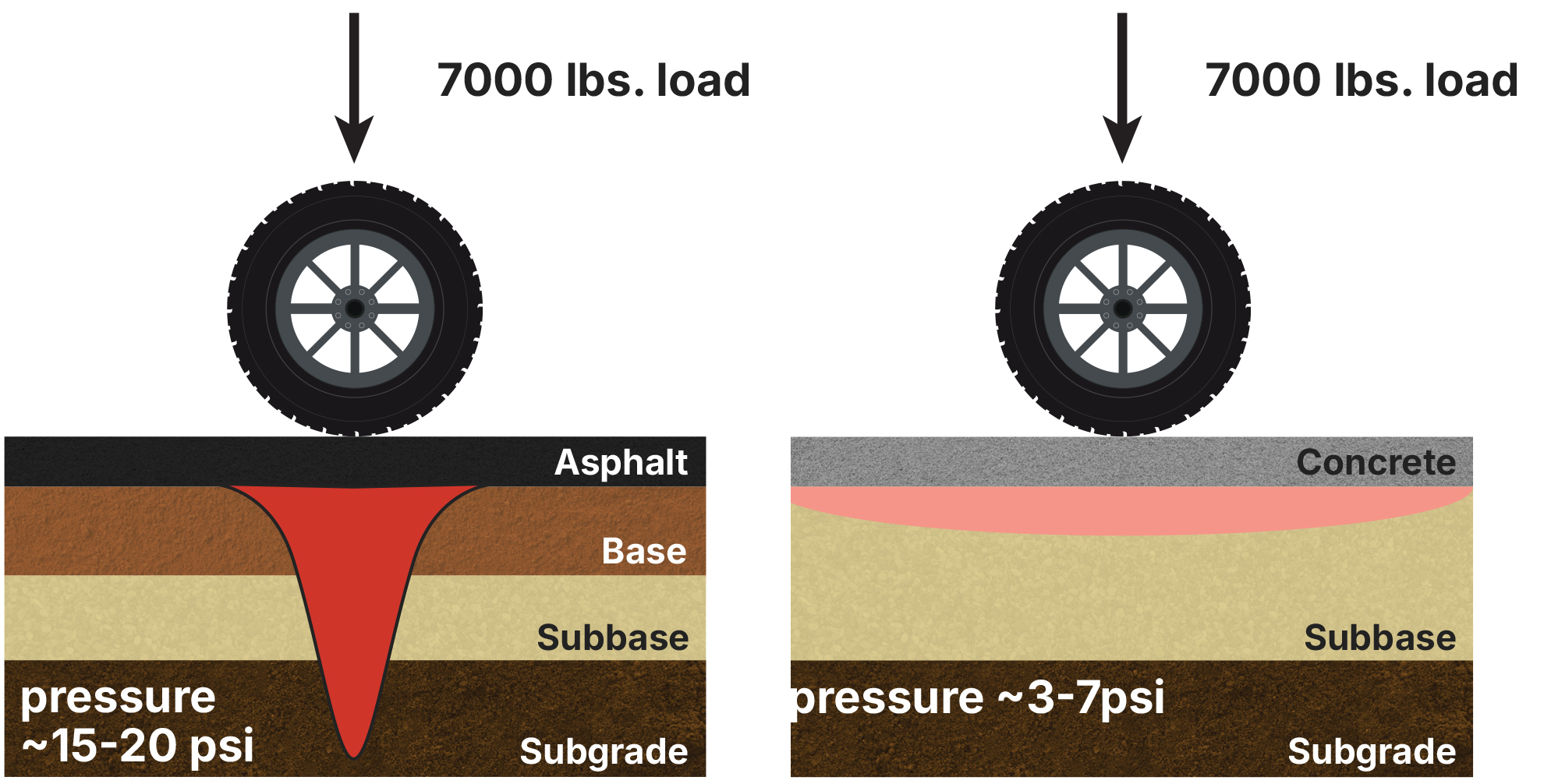
Rigid pavements distribute loads over a larger area than asphalt pavements, and experience only minor deflection. Under a 7,000-pound load from a tire, flexible asphalt pavements concentrate the load, transmitting it through the base and subbase layers into the subgrade, at a pressure of approximately 15-to-20 psi. The same 7,000-pound load on a rigid concrete pavement will significantly reduce the pressures on the subgrade, and the distribution of the load will restrict pressure to 3-to-7 psi. [See Figure 1.]
Flexible pavements show reduced load carrying capacity during flooding, and it can take up to a year for those pavements to sufficiently dry out and regain strength. Loading that happens during the one-year recovery period further accelerates damage to the pavement. This is especially concerning considering the fact that large numbers of extremely heavy vehicles, such as articulated trucks, are deployed as part of rescue and recovery efforts. The result is reduced lifespan for flexible pavements.
Studies performed following hurricanes have shown that after submersion, flexible pavements suffered strength loss, while stiffer pavements did not. Flexible pavements studied experienced damage regardless of the length of time they were submerged, while stiffer pavements exhibited a similar resilient modulus for both affected and unaffected pavements.6
Although flooding is the main risk to US infrastructure, it is important to note that with the increase in wildfires, especially in the western United States, concrete paving materials will not melt or deform under intense heat and will perform well under increased loading from overweight recovery vehicles.
Design Strategies: New and Existing Roadways
For both new and existing roadways, performing updated risk assessments is key. Many flood maps are outdated or inaccurate, so determining the true risk of flooding can indicate where design efforts should be focused. In addition to identifying areas at risk of flooding and/or severe weather, consider pavements that are critical for life safety needs, such as those that preserve evacuation routes and ensure airfield and ground access for rescue crews. In flood-prone areas, pavement design should be based on soaked subgrade strength.
For existing pavements, once priority roadways have been identified, there are several options for stiffening the pavement and reducing the likelihood of moisture-related damage. Concrete overlays can be placed over asphalt surfaces. This reduces loading pressures significantly at the top of the asphalt layer and can build the pavement up above flooding conditions.
Full-depth reclamation using a cement-stabilized base (CSB) is another treatment option. CSB creates a base layer that is less permeable than an unstabilized base, reducing water infiltration from underneath the road surface. A CSB layer maintains good strength and stiffness even during flooding and helps spread the load over a larger area.
New-build projects offer the opportunity to design stiffer roadways from the ground up. Start with proper sitework (scarifying or compacting soils, etc. as needed) and cement-stabilized bases, and follow by paving with concrete (or thick asphalt). In some situations, roller-compacted concrete is a good solution. According to the National Ready Mixed Concrete Association, "because of its density and compaction, roller compacted concrete can achieve sufficient load carrying capacity quickly and has, in some instances, been open to traffic within 24 hours after placement."
Resilient pavements—those designed or retrofitted using a life-cycle approach—provide economic benefits because of their durability and social sustainability because of their life safety benefits. In an era of rising monetary and social costs attributable to natural disasters, increased attention to resiliency during pavement design is necessary.
1 NOAA National Centers for Environmental Information (NCEI). "U.S. Billion-Dollar Weather and Climate Disasters." 2025. https://www.ncei.noaa.gov/access/billions/state-summary/US
2 US Army Corps of Engineers. "USACE Resilience Roadmap." 2016. https://www.publications.usace.army.mil/Portals/76/Publications/EngineerPamphlets/EP_1100-1-2.pdf
3 World Bank Group. "Lifelines: The Resilient Infrastructure Opportunity." 2019. https://openknowledge.worldbank.org/entities/publication/c3a753a6-2310-501b-a37e-5dcab3e96a0b.
4 Sathawara, Jigar K., Patel, A.K. "Comparison Between Soaked and Unsoaked CBR." International Journal of Advanced Engineering Research and Studies. E-ISSN2249–8974
5 Gundla, A., Offei, E., Wang, G., Holzschuher, C. and Choubane, B. "Decision Support Criteria for Flood Inundated Roadways: A Case Study." Presented at the 2020 TRB Annual Meeting.
6 Wathne, L. "Pavement Resilience." Presented at the 2021 National Concrete Consortium. https://www.intrans.iastate.edu/wp-content/uploads/sites/7/2021/05/6Sp21_Wathne.pdf
7 Roller Compacted Concrete. Concrete Answers Series Hub for Architects, Engineers & Developers. 2013. https://www.rollercompacted.org/benefits.html

Eric Ferrebee, P.E., is Senior Director of Technical Services at the American Concrete Pavement Association (ACPA). He joined ACPA in 2014.
More PE Community: Construction Articles

There is no work setting where risk management policies aren’t linked to protecting workers.



A recent survey of civil engineers and contractors about the business revealed confidence in the industry’s outlook for the next two years, thanks to heavy project backlogs and increased infrastructure funding. An increased focus on resiliency projects is another contributing factor.