Registration is open for NSPECon26 in New York City, New York!
 Volunteering at NSPE is a great opportunity to grow your professional network and connect with other leaders in the field.
 Decisions at the ballot box influence policies that support engineering standards and public safety.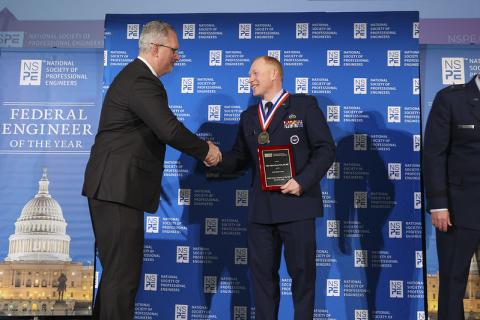
Lt. Col. Brigham Moore, Ph.D., P.E., PMP, was named the 2025 Federal Engineer of the Year by NSPE. A deputy squadron commander in the US Air Force, Pacific Air Force, Lt. Col. Moore has served in a variety of roles throughout the course of his 15-year career, including civil engineer, chief of programs, and chief of operations engineering.
In his current role as deputy commander of the 51st Civil Engineering Squadron, Moore leads a team of military personnel, contract engineers, and both American and Korean civilians in the management and maintenance of facilities; runways; utilities; various design and construction projects; and housing units. He recently oversaw a $42 million military construction project designed to limit carcinogenic exposure to industrial chemicals and provide corrosion control for $1.5 billion in aircraft assets. Before Moore took control, the project was on the verge of being canceled, but he was able to quickly develop an innovative design solution that saved the effort by leveraging the skills and knowledge of experts in the commercial sector to bring the facility back up to commander priority capability.
Moore’s dedication to making a positive and lasting impact on others extends to his various community service efforts. Among his volunteer activities, he has participated in a program that supports families experiencing malnutrition in the local community and regularly served as a mentor in a summer K-12 STEM program that provides assistance to students facing challenges in mathematics education.
Moore recently offered details about his path toward a career in engineering and the US military, insight on his impressive accomplishments, and his perspectives on ethics and leadership.
What motivated you to choose an engineering career?
Prior to entering college, I took some time for self-reflection to consider what I was good at and what I enjoyed. I have been blessed with a gift of understanding and a love for math and sciences. I also loved creative arts like writing and theater, so I didn’t really know what to do. At a Utah State University career fair, I grabbed nearly every science and engineering-related fact sheet and eventually landed on mechanical engineering. About a semester into the course work, the classes were fascinating, but I was way more interested in engineering as it related to people and the environment. I found a home in civil and environmental engineering and never looked back.
What led you to a career in the military?
As part of my faith, young men and women often go on service missions following high school or during the early years of college. I served for two years in eastern portions of Ukraine before going off to college. While there, I met a few individuals who had entered the military, and they convinced me to enroll in the Reserved Officer Training Corps (ROTC) in college. I did just that and fell in love with the higher sense of purpose that comes with federal service, which includes supporting and defending the Constitution and the principles it espouses.
How did you first hear about the licensing of engineers, and why did you decide to pursue a professional engineering license?
During my studies in environmental engineering at Utah State University, there was a fairly big focus on licensing. Most of the engineering students take the FE exam around their junior year. The curriculum is built to cover most of the FE content within the first 2-3 years at the university.
When I decided to join the military, [pursing licensure] was a no-brainer for me. I had classmates who were struggling to find jobs following college, and knowing there was a four-year work experience requirement to achieve a license, I was excited to have a career path lined out that would help me get there. Once I entered the military, I realized that there wasn’t a big incentive to get your license, but that didn’t detract from my ambition. I figured it could only help me become a more competent engineer, which would open doors for me in the military.
What’s the best part of your current role?
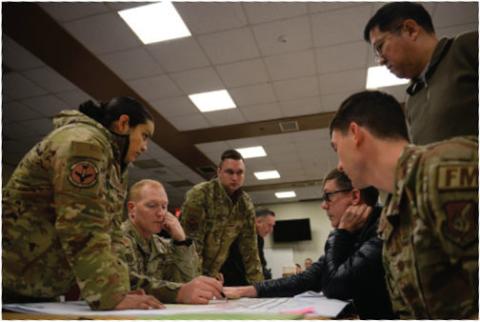
Currently, I serve as the deputy commander of the 51st Civil Engineer Squadron, a multi-faceted unit with approximately 550 US and Korean engineers at Osan Air Base in the Republic of Korea (ROK), [also known as South Korea]. While the role we play is expansive as we provide cradle-to-grave infrastructure services supporting multi-million dollar weapon systems in defense of US and ROK interests, the greatest part of the current job is the amazing people I get to work with. They are called the mighty Haetaes. A Haetae is a mythological creature, often embodied in a stone statue near the entrance of palaces, homes, and buildings in the ROK. It is a symbol of protection from fire and natural disasters, and it embodies the spirit of the unit that we are here to protect and defend. The people here and their self-sacrifice is incredible. Almost 90% of the military personnel in the squadron have come to Korea without their families and give 12-24 months of their lives just serving. You don’t find that everywhere, and it is a pleasure to be part of that.
How will the projects that you’ve led or the research you’ve conducted help improve operations and lives going forward?
Let’s take the project that reduced the carcinogenic exposure for airmen. That project alone improved their work environment and hopefully helped extend the lives of each of the individuals that will continue to rotate through this base. That is a great feeling to walk away knowing we have made the base that much better for them.
If there is one key lesson I have learned, it is that people matter. Engineers are problem solvers, and we bring to the table tools, techniques, and skill sets that many do not have. But we should consider the end user—the people—in everything that we do. If [engineers] make sure we are meeting their needs and considering their best interest, then we usually are in the right.
What is your perspective on the importance of ethical practice and putting public safety first in the work that you do?
It is absolutely critical. I can do a lot of things as an engineer, and it must pass the test of threes. Is it illegal? Is it immoral? Or is it unethical? If it is, then I WILL NOT do it. If it is not one of those three things, then we can usually find a way to yes.
In terms of safety, it comes back to readiness. If I have a safety mishap, I have lost or damaged my ability to be ready to defend in the moment of need. Safety is critical in keeping every one of the 550 engineers at the top of their game and ready to support as they are called upon.
What career or leadership advice would you give to a recent engineering grad/young engineer?
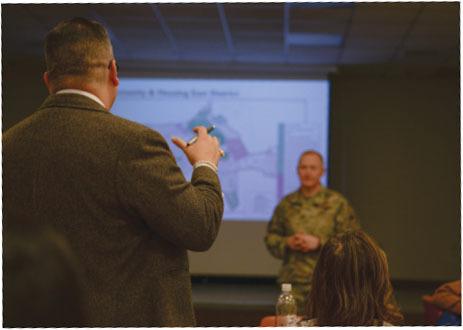
Graduating as an engineer is a great step, and you should be proud. But as an engineer practicing in the field, graduation is just the beginning. One of the best things you can do is learn to do your job well. Look for opportunities to grow and get involved in projects that you love and are passionate about, it really makes work enjoyable and satisfying.
In terms of long-term development, always try to make yourself marketable with the skills you are building and certifications that you are pursuing. As a wise mentor once told me, "A PE is a baseline. It shows that you are competent at your job being an engineer." A different mentor advised, "Go do things that you enjoy!" One of the things I enjoy is service. I have had such a great time and some of my most memorable moments have involved using my skillset as an engineer to give back, whether that was building homes in Honduras, teaching math to at-risk youth, judging science fairs for blossoming young scientists, or a host of other ways—those moments are at the heart of being a [federal] engineer.
More PE Community: Government Articles
Recognizing the economic importance of the United States’ massive transportation system as well a
Federal engineers play a vital role in solving complex challenges, shaping infrastructure, and en