

 Registration is open for NSPECon26 in New York City, New York!
 Volunteering at NSPE is a great opportunity to grow your professional network and connect with other leaders in the field.
 Decisions at the ballot box influence policies that support engineering standards and public safety.
April 2015
IN FOCUS: CAREER DEVELOPMENT
A Second Act
A growing number of PEs are choosing to work part-time after retirement. It’s a decision that benefits engineers, employers, and clients.
BY EVA KAPLAN-LEISERSON
E
 ngineering projects are often not 9–5 endeavors; work must be completed despite the clock. Long hours are common, and tasks can be challenging. It would stand to reason, then, that engineers reaching retirement age would be eager to leave the workforce to focus on reading, playing with the grandkids, and traveling to warmer locales. Not necessarily. A growing proportion are choosing to continue working, albeit in a reduced capacity, after ending full-time positions.
In its Science and Engineering Indicators 2014, the National Science Board pointed to “recent patterns of leaving the labor force and shifting to part-time work among older members of the workforce.”
Between 1993 and 2010, increasing proportions of scientists and engineers in their 60s reported still working. For respondents ages 60–64, the number grew to 74% from 69%, for those ages 65–69, to 47% from 39%. NSB doesn’t specify how many of those are working part-time, but overall about 1.4 million scientists and engineers working in 2010 said they had previously retired from a job, and more than 650,000 respondents working part-time stated the reason as having previously retired or semiretired.
“Retiring at age 50 and riding off into the sunset is not reality,” says Mike Varon, executive director of EASi, a subsidiary of recruiting and staffing agency Aerotek that provides companies with engineering support services. “People can do that with proper planning, but many people don’t want to.”
Valued Experience
Various factors can keep engineers in the workforce. High on the list is the oft-cited need for talent. Baby boomer retirements are causing workplace turmoil, explained David Burstein, P.E., director of client services for AEC management consulting organization PSMJ Resources Inc., in March’s PE. (See “Outlook: Optimism and Opportunity.”)
Even if a company can bring in new hires, it’s not easy to fill the gaps left by workers who have spent decades in the profession. As Varon puts it, “There are so many lessons learned, things people have tried and failed. The only way to learn is through experience.”
Said Burstein, “[Companies] are encouraging their older professionals to not fully retire but to gradually cut back and stay available so they can tap into their historical knowledge.”
NSPE member Harry “Rich” Hutter, P.E., is an example of that, continuing to work in a consulting role after retiring in 2010 as president and owner of manufacturers’ representative agency Belden-Hutter Inc. Hutter’s son and a long-time employee now own the company, but the PE spends about 10 hours a month providing customer information, performing technical work, and making sales calls. He explains that he wanted to continue working not only to stay active but also to help the business’s successors.
Bruce Larcomb, P.E., a 77-year-old semiretired engineer who left his full-time job with the International Code Council in 2004, has taken on a number of consulting jobs, including as an application evaluator with the Ohio State Board of Registration for Professional Engineers and Surveyors. He works about 10–15 hours a month and plans to stay at it as long as his health will allow. “I have an engineering memory that I don’t think ought to go to waste,” says the NSPE member.
By Larcomb’s estimate, about 10%–15% of the active members of his Ohio Society of Professional Engineers local chapter are semiretired. He “would wish [it] on anybody. It’s nice to be able to be of value but then pick the areas [where] you think you can best serve.”
And MK Baldwin, P.E., retired after 20 years in the Navy’s Civil Engineer Corps, spent time as a contractor in support of FEMA’s disaster recovery efforts, including for Hurricane Katrina. The NSPE member currently volunteers as an engineer for the South Carolina State Guard in a detachment providing post-disaster professional engineer and architecture support, and as a FIRST LEGO League referee. “I have skills that are needed and I wanted to be able to give back,” she says.




Mind Over Retirement
In addition to feeling needed, engineers benefit from continued intellectual stimulation. Hutter points to “the enjoyment of keeping the mind [in] new things and accomplishments.”
Or, as Joe Lampinen, director of engineering services for employment and recruiting company Kelly Services explains, mental stimulation is why engineers joined the profession. “Not much demotivates an engineer [more] than not having the ability to contribute, make a technical difference, or solve a technical challenge.”
Varon agrees: “Engineers love to have a purpose, solve problems. It’s the way they’re wired…. To just shut it off one day, it’s not easy for people to do.”
NSPE member Deborah Grubbe, P.E, retired from DuPont after 27 years, worked several years for BP, and then launched her own consulting firm, Operations and Safety Solutions LLC. The chemical engineer explains that “there’s a great deal of satisfaction in being able to participate in an industry that continues to grow, evolve, and change.”
Grubbe felt “way too young and still in too good health to stop [working]” at 53, when she left BP. She now works 25–35 hours per week, including volunteer activities. She enjoys the opportunity to keep her mental acuity sharp and not focus on physical aches and pains.
At 59, she doesn’t have a shutdown date in mind. “I’m still on the young side,” she continues. “Many folks I know are in their 70s and still doing work like this.”
Financial Benefits
Another key driver for this trend is monetary. After recent economic downturns, engineers may feel that their retirement savings are insufficient.
Grubbe receives pensions from DuPont and BP and saved money throughout her career to fulfill her goal of business ownership. But she still feels “the economic future is relatively uncertain.” You might think you have enough saved, she adds, but you never know. “Taking in additional income if you’re able is not a bad thing.”
And employers watching the talent drain may be willing to compensate engineers lucratively to stay around. Says Lampinen: “In certain businesses, it can be too attractive to leave.”
In Kelly Service’s Outsourcing and Consulting Group, Jeff DeWitt is senior director for engineering solutions for global managed services. He tells a story about a company with a very short timeline to launch a product and a unique problem. Only seven people in the world had the required experience to solve it.
The engineer DeWitt’s team brought on board was a retired expert who could join the project for six months to help get the product launched. He not only felt valued, says DeWitt, but was well compensated for his expertise. And “for the client, it was a $100 million product launch. It was worth getting the skills to get to market on time.”
Models
Part-time work after retirement is not limited to particular sectors. Lampinen says he’s seen the phenomenon in just about every industry, including manufacturing, process industries such as pharmaceuticals or food and beverage, and civil and structural engineering.
Engineers who continue working part-time can choose various ways to do so. Some may simply drop down to part-time work for their current employer. Others hang out their own shingle, like Grubbe, and become consultants or independent contractors. This is more common for engineers who have unique skills or expertise, Lampinen says.
Still others will choose an agency that can find work and handle administrative issues such as liability coverage and bookkeeping for them.
“Retired engineers come in different flavors,” Lampinen emphasizes.
Another variable is the structure of work. Engineers are often able to set their own schedules—for instance, work full-time for a project’s duration and then take a break for six months, or work a few hours per month on a consulting basis. DeWitt says it all depends on a person’s personality and circumstances. One engineer “always seems to be on a beach in the Caribbean when I call. But he loves to come back for short-term projects.”
Burstein sees firms offering retiring workers the ability to set their own terms in a “casual employee” status. The agreement is that the company will call you when they need you, he explains, and you’ll work when you want to. “There’s no obligation for the company to call you and no obligation to work when they call, but if [they do] call and you do want to work for a particular period of time, here’s the salary and structure of that employment.”
Those casual employees are usually on payroll, with limited or no benefits but coverage under the company’s liability insurance, he explains. But Lampinen cautions that retirees should consider work limits imposed by social security as well as differences in tax treatment for contracting or consulting and working as a de facto employee. “Consult a tax attorney,” he suggests.
Workplace Trends
Ideally, a company would have multiple retirees on call, Burstein says, so if the workload takes off, someone can pick up the phone and find people to help.
Retirees can also help train younger engineers, he says, in informal knowledge transfer programs in which they are teamed up with junior staff.
Lampinen also points to increasingly common “alumni programs,” which can be as informal as asking a retiree to consult on a manufacturing process or civil engineering project or a more formal apprenticeship program to help transfer knowledge.
As increasing numbers of baby boomers hit retirement age, he says, companies are more seriously considering how to extend the life of their relationship with senior engineers and tap into their expertise as needed.
This is part of increasing trends toward contingent workers and outsourced services, he explains. In a growing “Hollywood model,” companies are bringing in specialized, outside expertise as needed for a particular production (project) and combining those workers with a smaller set of in-house employees.
Win-Win
When DeWitt talks to executive engineers, he finds that what keeps them up at night is the idea of all their employees in the mid- to late-50s retiring at once. “I’m in trouble,” they think.
But leaders who plan ahead for an orderly transition process, perhaps including part-time older workers, will get better sleep. Their companies may even save money, as experienced employees can cut product development cycles and avoid costly mistakes.
For their part, older engineers can gradually ease out of the workforce to a complete retirement when they’re ready.
“It’s obvious that you shouldn’t just quit cold turkey,” says NSPE member Larcomb. “That’s the recipe for an early end.”
He adds, “For those of my age, don’t be afraid to offer yourself. Because we do have value.”
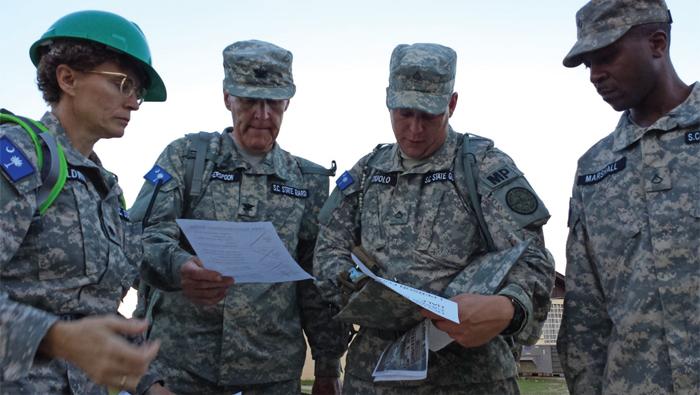
MK BALDWIN, P.E., (LEFT) TALKS WITH THE SOUTH CAROLINA STATE GUARD URBAN SEARCH AND RESCUE TEAM DURING TRAINING.
More Featured Articles

Many NSPE members join the Society because they see the importance of making the engineer’s viewpoint known to elected officials. In a legislative process that doesn’t always follow the rules of logic, NSPE state societies play a powerful role by ensuring that legislators know exactly where PEs stand. >>
Greater optimism is circulating in the AEC world. More opportunities for business growth and increased revenue are projected for 2015. With a return to growth in the industry, competition for engineers is increasing. Firm leaders need to intensely focus on recruiting and retaining top-notch talent to maximize opportunities for growth. >>
Of any generation, millennials have the highest opinion of the engineering profession, according to a recent poll. Yet, the statistics show that not enough young people, particularly women and minorities, are pursuing engineering careers. For many PEs, the statistics are a clear call to action. The next generation needs their attention. >>
The University of Texas at El Paso recently introduced E-Lead, the nation’s first BS degree in engineering leadership, and Rice University has started a certificate program in engineering leadership. Both are examples of how the profession is working to build a talent pool known for more than technical competence. >>
For almost 50 years, the National Park Service has preserved America’s engineering legacy through the Historic American Engineering Record, which includes not only sites, structures, and objects but also processes. In recent years, the program has incorporated new technologies such as CAD and 3D laser scanning. >>
Each year, the Professional Liability Committee of NSPE’s Professional Engineers in Private Practice, in conjunction with the risk management committees of the American Institute of Architects and the American Council of Engineering Companies, conducts a survey and face-to-face interviews with representatives of companies serving the A/E professional liability insurance market. >>
For 80 years, NSPE has been on a mission to serve the licensed professional engineer and support individuals on the path to licensure. The Society’s strategic plan calls for developing stronger collaboration with other engineering societies, which will allow the engineering community to have a bigger voice on licensure, legislation, and other issues that may affect the public health, safety, and welfare. >>
In the last two years, the level of computer hardware available to the average engineer has increased dramatically, and the true revolution in CAD is now more about the computer than the software. While most engineers are not information technology experts, it is an increasingly good idea for them to understand the computer hardware available and how it can make them better practicing engineers. >>
The median duration of unemployment for workers age 45 and above is more than 20 weeks. While for all younger age groups the median duration of unemployment is less than 16 weeks, according to the Bureau of Labor Statistics. The odds may be against job-seeking engineers over age 50, but there are ways to improve those odds. >>
NSPE continues to advocate for legislation that will revitalize and modernize the nation’s infrastructure. The Society’s efforts contributed to significant gains this year, such as the passage of the Water Resources Reform and Development Act, which identifies more than $12 billion worth of new water infrastructure projects and authorizes funding for them. >>
PE recently asked a handful of experts to rate engineers’ overall business skills. The average answer: C. The ability to bring in work and understand the financials are important for engineers at all levels, not just for company principals. In return, these skills help make workers more marketable and can expand their employment opportunities. >>